1
LUBRICATION-403
CHRYSLER SERVICE MANUAL
Section XV
LUBRICATION
CONTENTS
Page
Engine Oil Recommendations
403
Engine Oil Change Periods
405
Lubrication Recommendations
406
Section XV
LUBRICATION
1. ENGINE OIL RECOMMENDATIONS (FIG. 1)
The use of a good quality engine oil is recommended. In selecting an engine crankcase oil
for Chrysler Corporation cars, it is important
that the owner obtain a lubricant of good
quality from a reputable refiner, and that it
has the proper viscosity for the prevailing
temperature. The following viscosity designations will indicate the correct engine oil to use
at any anticipated atmospheric temperature.
Anticipated
Lowest
Above + 32° F
Recommended
Recommended
Viscosity
SAE Viscosity
Range—if
Multi-Viscosity
Number
Oils Are Used
SAE 30
SAE
SAE
Above + 10° F
SAE 20W. .SAE
SAE
Above (-10° F.)..SAE 10W..SAE
Below (-10° F.)..SAE
20W
10W
20W
10W
10W
40
30
40
30
30
SAE
5W 20
5W..SAE
5W 20
When using Multi-Viscosity Oils, make sure
the SAE weight range coincides with the at-
mospheric temperature chart.
2. A.P.I. ENGINE OIL CLASSIFICATIONS
The type of service for which an engine oil
is intended is usually designated by the letters
"MS", "ML" or "MM" on the container. This
system does not replace the SAE numbering
system. It is used in addition to the SAE numbers, which indicate the various temperatures
under which an oil can be used.
NOTE
From the explanation in the following paragraphs of the three types of service designated
by the letters "MS", "ML" and "MM" it is apparent that oils for service "MS" will most
nearly suit the average driver's requirements.
a. Service MS
(1) Continuous high speed highway driving
where the oil becomes unusually hot, such
as summer vacation trips.
(2) Heavy load operation, such as towing a
house trailer in hilly country.
(3) Driving in areas where temperatures below zero degrees F. are encountered for
extended periods.
(4) Driving in moderately cold climates where
most of the operation consists of short
neighborhood trips, and where the engine
never has a chance towarm up.
b. Service MM
(1) High speed operation for short periods of
time.
(2) Long trips at moderate speeds and summer temperatures.
404—LUBRICATION
CHRYSLER SERVICE MANUAL
10,000 MILES
20,000 MILES
5,000 MILES
1,000 MILES
KEY TO LUBRICANTS
STEERING KNUCKLE PIVOT
PIN BEARINGS
4 fittings—CL
CL—Chassis Lubricant
EO —Engine Oil
GL—Gear Lubricant
UJG—Universal Joint Grease
HGL—Hypoid Gear Lubricant
WBG—Wheel Bearing Grease
OIL FILTER
Replace
GENERATOR
2 oil cups—5 drops EO
UPPER CONTROL ARMS
6 fittings—CL
POWER STEERING RESERVOIR
(When so equipped) Add lubricant as necessary
Automatic Transmission Lubricant Type A
SPECIAL ATTENTION
Recommended lubricants are based on average
driving conditions.
A car driven in extreme dusty, cold, or high humidity
climate will require more frequent lubrication
and maintenance.
INTAKE PIPE AIR CLEANER
Wash with kerosene—re-oil SAE 5 0
ENGINE CRANKCASE
Drain and refill—EO
as per seasonal recommendations
Replace oil filter cartridge after 5-thousand miles
of operation.
Wash air cleaner in kerosene and reoil with SAE 50
at each oil change.
Multi-grade engine oils should carry SAE numbers
that are recommended for local temperature ranges.
STEERING GEAR
Manual — add lubricant as necessary
SAE 9 0 Fluid Gear Lubricant
CARBURETOR AIR CLEANER
Clean, drain and refill—EO
DISTRIBUTOR
Oil cup—5 drops EO
Wick—2 drops EO —
THESE POINTS
REQUIRE NO LUBRICATION
POWERFLITE TRANSMISSION
(When so equipped) Check level
Drain and refill
Automatic Transmission Fluid Type A
•
•
•
•
•
Clutch release bearing (C-71 when so equipped).
Starting motor.
Rear spring bolt and shackles.
Foot accelerator and brake pedal.
Propeller shaft center bearing (on long wheelbase
models).
• Carburetor linkage and automatic choke.
• Rubber parts (pads, bushings, seals).
• Water pump and fan belt idler pulley.
TRANSMISSION—STANDARD
Check level
Drain and refill SAE 8 0 , GL
OUTLET PIPE AIR CLEANER
(When so equipped)
UNIVERSAL JOINTS
Ball and trunnion type—Disassemble,
clean and r e p a c k - 2 Vi oz. UJG
REAR AXLE DIFFERENTIAL
ADDITIONAL LUBRICATION POINTS
Add lubricant at necessary
Drain and refill—HGL
1,000 Miles-Clutch torque shaft and gearshift control
belkrank, 2 fittings (C-71 when so equipped), CL;
Parking brake linkage, £0; Door hinges and springs,
hood clamps etc., MoPar Dripless Penetrating Oil; Door
striker plates, dovetails and rotor wheels, Stainless Stick
Lubricant.
REAR WHEEL BEARINGS
Remove plug, lubricate with gun,
using 1 Vi oz. WBG
LOWER CONTROL ARMS
6 fittings—CL
FRONT WHEEL BEARINGS
Clean and repack-WBG
10,000 Miles-Speedometer wick, MoPar Speedometer Oil;
Speedometer cable shaft, MoPar AlUWeather Speedometer
Cable Lubricant; Door lock cylinders, MoPar Lubriplate.
Also check fluid level in power cylinder reservoir of
convertible top mechanism. If necessary, add MoPar
Super Brake Fluid. Do not overfill.
20,000 Miles-Propeller shaft splines (C-70), clean and
fill half full with Multi-purpose Rear Axle Oil.
TIE ROD BALL JOINTS
4 fittings—CL
STEERING IDLER ARM PIVOT
1 fitting-CL
STEERING RELAY LINK JOINTS
2 fittings—CL
ENGINE OIL PAN DRAIN PLUG
ENGINE OIL
RECOMMENDATIONS
RECOMMENDED
TIRE PRESSURES
Starting Pressure (tires cold)
24 lbs.
ticipated atmosphe
After driving (tires warm)
27 lbs.
A pressure build-up of at least 3 pounds over starting
pressure is normal, otherwise tires are underinflated.
After fast driving (tires hot)
29 lbs.
A pressure build-up of at least 5 pounds over starting
pressure is normal, otherwise tires are underinflated.
NEVER REDUCE OR "BLEED"
BUILT-IN PRESSURE I N TIRES
teniperat
Atmospheric
Temperature
Above +32 F.
Recommended
Viscosity No.
SAE 30
Above+10 F.
SAE 20W
Above-10 F.
SAE 10W
Below - 1 0 F.
SAE 5W
Multi-Grade
Options
SAE 2OW-4O
SAE 10W-30
SAE 20W-40
SAE 10W-30
SAE 10W-30
SAE 5W-2O
SAE 5W-2O
Retain original factory oil in crankcase during first 1,000 miles of
operation.
If necessary to add oil during initial period, use recommended viscosity oil shown above for lowest anticipated temperature.
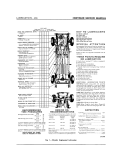
Fig. 1—Chrysler Engineered Lubrication
CAPACITIES
Engine Oil
(add 1 qt. when replacing filter element)
' q«s-
Cooling System—New Yorker and Imperial
—Windsor
2S qts.
24 qts.
PowerFlite Transmission (refill)
New Yorker and Imperial
Windsor
U qts.
10 qts.
Transmission—Standard Shift
3-Speed
2M pts.
Rear Axle Differential
Windsor (except Town & Country)
V/i pts.
New Yorker, all Town & Country and Imperial.... 3H pts.
Crown Imperial
5 pisFuel Tank (except Town & Country)
Town & Country
21 gals.
18H gals.
CHRYSLER SERVICE MANUAL
(3) Operation in moderately cold air temperatures where frequent long trips, as well as
short trips, are included.
LUBRICATION-^05
RLTER ELEMENT
c. Service ML
RESERVOIR
Operation at moderate speeds where the majority of trips are more than 10 miles, and
where no extremely cold or hot temperatures
are encountered.
3. MULTI-VISCOSITY OILS
When using multi-viscosity oils, be sure that
the SAE weight range coincides with the atmospheric temperature chart shown in Paragraph 1.
CLAMP SCREW
49x879
Fig. 3—Typical Carburetor Air Cleaner
4. ENGINE OIL CHANGE PERIODS
During the first 1,000 miles, leave the factory
installed oil in the engine. If it is necessary to
add oil during this driving period, use the
proper viscosity oil according to the atmospheric temperature chart. Refer to paragraph
1 and Figure 1. Drain the crankcase aftef the
first 1,000 miles and refill with the proper viscosity oil for the lowest anticipated atmospheric
temperature. Subsequent oil changes, under
normal driving conditions, should be made
every 5,000 miles—more often if winter driving consists of short trips, or extreme dust or
contaminated atmospheric conditions are encountered. Five quarts of engine oil are necessary for refill. Add an additional quart when
the oil filter element is changed. The oil level
indicator is located on the left side of the engine.
5. UNUSUAL CONDITIONS
Under certain conditions, more than usual care
is advisable in order to keep the engine oper-
ating smoothly. In cold weather, for example,
the car should be driven at moderate speeds
until the engine reaches normal operating temperature. Short trips, in which the engine does
not reach normal operating temperature, may
result in condensation forming in the oil pan.
To protect the engine against this condition,
the engine oil and the oil filter element should
be changed more frequently than recommended
in the regular service schedule. When driving
over dusty roads for extended periods, the lubrication interval should be shortened and the
carburetor air cleaner, crankcase ventilator air
cleaners and oil filter should be serviced more
frequently.
6. ENGINE OIL LEVEL INDICATOR
The engine oil level should be checked each
time the car is refueled. The engine oil level
indicator as shown in Figure 2 has two markings : "Full" and "Add Oil." If the oil level is
between the "Full" and "Add Oil" marks, it is
not necessary to add oil. If the oil level drops
to the "Add Oil" mark, or slightly below it, add
not more than one quart of oil.
7. OIL FILTER
"FULL" MARK-
52 x 587
Fig. 2—Typical Engine Oil Level Indicator
The full-flow type oil filter with replaceable
element is used on the Windsor, New Yorker
and Imperial models. The oil filter element
should be changed every 5,000 miles to coincide with an engine oil change, after the initial
engine oil change. During cold weather operation, or when the car is driven in dusty areas,
406—LUBRICATION
more frequent replacement of the oil filter element may be necessary.
CHRYSLER SERVICE MANUAL
CAUTION
Avoid overfilling the air cleaner as too much
oil may cause excessive fuel consumption.
8. CARBURETOR AIR CLEANER
The carburetor air cleaner as shown in Figure
3 is the heavy-duty, oil-bath type and should
be checked every 1,000 miles, under normal
driving conditions. If sludge accumulation
reaches the lower offset of the reservoir, the
air cleaner should be removed, cleaned and refilled with SAE 50 Engine Oil above 32 degrees
F., and SAE 20W Engine Oil below 32 degrees F. If the car is operated in dusty areas,
the air cleaner may require frequent servicing.
9. OIL FILLER PIPE CAP AIR CLEANER AND
CRANKCASE VENTILATOR OUTLET PIPE
AIR CLEANER
At every 5,000 miles interval, these air cleaners should be removed, thoroughly cleaned in
kersosene, and re-oiled with SAE 50 Engine
Oil. (SAE 40 may be used if SAE 50 is not
available). When car is driven in dusty areas,
the air cleaner may require more frequent
servicing.
LUBRICATION RECOMMENDATIONS
10. EVERY 1,000 MILES
NOTE
a. Manual Steering Gear
Maintain fluid level in pump as recommended
and replenish as necessary with specified lubricant. When reservoir cover is removed, do
not permit dirt to fall into reservoir. It is not
necessary to change the fluid for cold weather
operation.
Check lubricant level at the above mileage and
replenish when level is below filler hole. Do not
use pressure gun! Use SAE 90 Fluid Gear Lubricant. In extremely cold weather, use SAE
80 Fluid Gear Lubricant, or dilute SAE 90 with
small amount of SAE 10-W engine oil to ease
steering.
c. Rear Axle
Use Multi-Purpose Hypoid Gear Lubricant SAE
90 for summer and winter above —10° F., or
SAE 80 for extreme winter below —10° F. Remove filler plug and check level of lubricant. Replenish to level of filler plug hole. Do not overfill!
b. Power Steering
d. 3-Speed Transmission (Car So Equipped)
Use Automatic Transmission Fluid, Type "A"
Check the fluid level with dip stick located in
reservoir behind the generator. Power Steering
Pump—Fluid level should be at the top of filter
element. The Power Steering Pump is adjustable and the reservoir should be level. The
reservoir should be in proper upright position,
however, before the level is checked. Adjust to
correct position by loosening the two nuts on
the pump, turning the pump to its correct level
position, and tightening the nuts. Do not disturb filter element, as periodic changes of this
unit are not required, also DO NOT insert
sharp objects into the reservoir, as this would
damage the filter element.
Use SAE 10-W Engine Oil, at all temperatures.
Remove filler plug and check lubricant level. Replenish to level of filler plug hole.
Refer to Lubrication Chart as shown in Figure
1, for lubrication points, lubrication procedures
and lubricants, also, refer to the following:
e. PowerFlite Transmission—
Checking Fluid Level
Apply parking brakes. Run engine at idle speed
and operate the drive selector lever through all
ranges and return to Neutral (N). Check level
at transmission dipstick. Replenish to "L" mark
if level is below the "L" mark when engine
and transmission are cold; if, after operating
the car for several miles, the level is below
the "F" mark, replenish to the "F" mark. The
oil level however should not be above the Full
LUBRICATION—407
CHRYSLER SERVICE MANUAL
mark after the car has been driven sufficiently
to bring the engine and transmission up to
operating temperatures.
a. Front Wheel Bearings
Use Short Fiber Wheel Bearing Grease—Medium. Check quality and quantity of lubricant.
i Special Low Temperature Recommendation
If it is anticipated that the average temperature
range will be below (—10°) F., replace one
quart of fluid with refined kerosene. This service need be performed once at the beginning of
the low temperature season. Thereafter, necessary replenishment of PowerFlite should be
with Automatic Transmission Fluid, Type "A,"
until the next seasonal dilution or the 20,000
mile oil change.
NOTE
DO NOT ADD GREASE TO WHEEL BEARINGS. If grease is emulsified or in short quantity, it should be replaced. All grease should be
removed from the bearings and hub, and the
assembly cleaned and repacked. Add 2 ^/\ ounces
of lubricant to inner surface of hub on models
C-71 and C-72 only. Add 4^4 ounces of lubricant
to inner surface of hub on models C-73 and
C-70, and C-71, C-72 Town and Country Wagons.
CAUTION
To prevent dirt from entering the transmission,
make sure the oil level indicator is properly
seated in the filler tube.
g. Generator
There are two oil cups. Apply 5 to 10 drops of
Light Engine Oil to each oil cup.
b. Speedometer Oil Tube Wick
Use MOPAR Speedometer Oil. Unscrew and
remove oil tube with wick from speedometer
housing (above speedometer cable flange). Saturate wick, as shown in Figure 4 with oil and
replace.
c. Speedometer Cable
h. Distributor
Use 5 to 10 drops of Light Engine Oil in oil
cup.
11. EVERY 5,000 MILES
Refer to Lubrication Chart, as shown in Figure 1, "Higher Mileage Services (5,000 Miles)."
Also, refer to Paragraphs 3, 4, 5 and 6.
12. EVERY 10,000 MILES
Refer to Lubrication Chart as shown in Figure
1, "10,000 Miles Interval/' and also to the following information.
Use MOPAR All-Weather Speedometer Cable
Lubricant. Disconnect cable at speedometer
housing, as shown in Figure 4, and remove
shaft. Coat shaft with the specified lubricant
and install.
d. Distributor
Use Light Engine Oil and MOPAR Cam Lubricant. Remove distributor rotor and apply 2
or 3 drops of Light Engine Oil to felt wick
in top of cam. When replacing contact points,
apply MOPAR Cam Lubricant to bumper block
on distributor contact arm. Do not permit oil
or lubricant to get on contact points!
13. EVERY 20,000 MILES
Refer to Lubrication Chart, as shown in Figure
1, "20,000 Miles," and also to the information
that follows:
a. 3-Speed Transmission
52x59O
Fig. 4—Speedometer and Cable Lubrication Points
(Unit Positioned to Show Lubrication Points)
1—Oil tube and wick
2-Shaft
Use SAE 80 Fluid Gear Lubricant. Drain and
refill. Keep level at bottom of filler plug hole.
In warm areas where SAE 80 Fluid Gear Lubricant is not available, SAE 90 may be used.
To refill, remove transmission drain plug and
allow unit to drain. Fill transmission to level
408—LUBRICATION
TORQUE CONVERTER DRAIN
CHRYSLER SERVICE MANUAL
add approximately 4 more quarts while engine
is running. Allow engine to idle for 2 minutes.
Operate the PowerFlite Transmission drive
selector push buttons through all speed ranges
and push in the Neutral (N) push button. Add
sufficient fluid to bring fluid level to Low mark
on transmission dip stick (approximately 1
quart).
CAUTION
To prevent dirt from entering transmission,
make sure dip stick is properly seated in filler
tube.
Fig. 5—PowerFlite Transmission and Torque
Converter Drain Points
of filler plug hole with 2% pints of specified
lubricant. Check level of unit and add lubricant,
if necessary.
b. PowerFlite Transmission
Use Automatic Transmission Fluid, Type "A."
To drain, remove transmission oil pan drain
plug, as shown in Figure 5 and allow transmission to drain. Remove access plate from
bottom of housing and rotate torque converter
until drain plug is accessible. Remove the plug
and drain the fluid. Check the gaskets on torque
converter and transmission drain plugs and
install new gaskets, if necessary. Install both
drain plugs and tighten. Install access plate
on housing and tighten screws. To refill, apply
parking brake. Add 5 quarts of Automatic
Transmission Fluid, Type "A," through transmission oil pan filler tube. Start engine and
14. PARTS REQUIRING NO LUBRICATION
Refer to Lubrication Chart, as shown in Figure 1, and to the following information:
a. Rubber Bushings
CAUTION
Do not lubricate these bushings. They are designed to grip the contracting metal parts firmly
and operate as a flexible medium between these
parts. The use of any lubricant will destroy the
necessary friction and cause premature failure
of these rubber parts.
b. Oilite Bearings
The bearings are self-lubricating and are used
in locations where lubrication is difficult to
maintain. When Oilite Bearings are subjected
to heat or pressure, oil seeps to the surface of
the bearings to provide necessary lubrication.
Oilite Bearings are available in standard
sizes and can be burnished to a final running
fit. They should not be reamed, filed or otherwise cut to size. If replacement is necessary,
install a new Oilite Bearing of the same size.