1
TOYOTA ELECTRONIC CONTROL TRANSMISSION
When the throttle valve is completely closed, the contact points for the IDL signal connect the
IDL and E terminals, sending an IDL signal to the ECT ECU to inform it that the throttle is fully
closed.
As the ECT ECU receives the L1, L2 and D signals, it provides an output voltage from 1 to 8
volts at the TT or ECT terminal of the diagnostic check connector. The voltage signal varies
depending on the throttle opening angle and informs the technician whether or not the throttle
opening signal is being input properly.
Direct Type
With this type of throttle sensor, signals are input directly to the ECT ECU from the throttle
position sensor. Three movable contact points rotate with the throttle valve, causing contacts
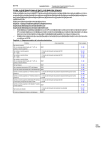
L1, L2, L3 and IDL to make and break the circuit with contact E (ground). The grid which the
contact points slide across is laid out in such a way as to provide signals to the ECT ECU
depicted in the chart below. The voltage signals provided to the ECT ECU indicate throttle
position just as they did in the indirect type of sensor.
If the idle contact or its circuit on either throttle sensor malfunctions, certain symptoms occur. If
it is shorted to ground, lock-up of the torque converter will not occur. If the circuit is open, neutral
to drive squat control does not occur and a harsh engagement may be the result. If the L1, L2,
L3 signals are abnormal, shift timing will be incorrect.
Page 5 © Toyota Motor Sales, U.S.A., Inc. All Rights Reserved.