1
be switched during a test, ALWAYS remove the test leads
from the circuit being measured before switching settings.
•
To avoid possible electric shock, instrument damage, and/or
equipment damage when taking voltage or current measurements, DO NOT exceed the maximum value of the selected
range.
•
If the unit is used near high noise Radio Frequency (RF) generating equipment (spark plug wires, ignition coils or alternator), the display may become unstable or indicate large errors.
If you obtain erratic readings during use, isolate the Multimeter
as far away as possible from these components.
TESTING PROCEDURES
A. AC/DC VOLTAGE MEASUREMENT
WARNING
To avoid possible electric shock, instrument damage
and/or equipment damage, DO NOT attempt to measure
voltages ABOVE 600V AC/DC or take measurements if
the voltage is unknown. 600V AC/DC between the COM
and V jacks is the maximum voltage that this instrument
is designed to measure. The "COM" terminal potential
should not exceed 300V AC/DC measured to ground.
1. Plug the BLACK test lead into "COM" jack of the multimeter;
plug the RED test lead into the "V" jack.
2. Set the meter’s Function/Range Selector Switch to the
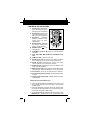
appropriate ACV or DCV position as desired (see Controls
and Indicators, Items 1 and 2).
3. Place the RED test lead onto the positive (+) side of the item
being tested and the BLACK test lead onto the negative (-)
(across the source/load) side of the item. BE CAREFUL not to
touch any energized conductors with any part of your body.
4. Read the results on the display.
B. RESISTANCE MEASUREMENT Ω (OHMS)
WARNING
Resistance measurements must be made on "de-energized" (dead) circuits ONLY. Impressing a voltage across
the multimeter's terminals while set to any resistance
range may result in electric shock, instrument damage
and/or damage to equipment under test. MAKE SURE
equipment is completely de-energized before taking any
resistance measurements.
7
E