1
Lilliputian Measuring System
Does Much, Costs Little
A mainframe costing less than $400, a choice of four functional snap-on
modules including a 500-MHz counter, and an unusual battery pack are the
elements of this rugged, portable, MOS/ LSI/ LED instrument system.
By Ian T. Band, Hans J. Jekat, and Eric E. May
NOT VERY MANY YEARS AGO electronic counters were
strictly laboratory instruments. Nobody needed their
kind of precision in frequency and time measurements
anywhere else. Today, however, what used to be labora
tory precision is now commonplace in all kinds of equip
ment, and as a result electronic counters are in demand
as general-purpose service and maintenance tools.
One only has to look at the communications industry
to see what's happened. The crowded electromagnetic
spectrum has been squeezed to make room for more and
more channels. To guarantee that each transmitter re
mains within its allocated channel, its frequency must be
controlled to within a few parts per million. Measuring
frequency with this degree of accuracy requires an elec
tronic counter. Or look at the vast network of telephone
cable and equipment, over which millions of messages
are transmitted daily. To keep it in working order, carrier
frequencies must be measured and calibrated. Tone bursts
must be counted. Millions of relays must be checked and
timed. These are jobs for electronic counters.
The kind of counter that's needed for service and
maintenance is quite different from the usual laboratory
type. It has to be simple, rugged, and reliable. It has to
be portable — even battery powered — since the equipment
to be serviced is likely to be a communications link on
a distant hilltop or the navigational equipment aboard
a ship. It has to be low enough in cost to be considered
a general service tool. And it has to have sufficient mea
surement capability to fill the majority of service and
test needs.
Mini-System
Hewlett-Packard's answer to these requirements, the
5300 Measuring System, is equally at home on the lab
P R I N T E D
I N
bench or in a maintenance van. Calling it a system may
seem a bit pretentious, since it's the smallest of HP's
counters. Yet its modular design gives it versatility and a
repertoire of measurement capabilities that many fullsize instruments don't have, including frequency mea
surements to 500 MHz, 100 nanosecond time-interval
resolution, autoranging, and battery operation. The 5300
system is one of the first of the new breed of instruments
that rely heavily on the newer technologies: MOS, largescale integration, solid-state light-emitting-diode displays,
high-speed bipolar integrated circuits, read-only memo-
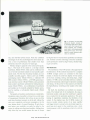
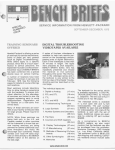
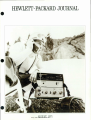
Cover: You probably
wouldn't find a 5300 Measur
ing System among a moun
tain rescue team's standard
equipment. But one could be
used at the base camp for
checking vital radio equip
ment. Shown here is all it
takes: a 5300A mainframe, a
5310 A battery pack, a 5303A
500 MHz counter module,
and a makeshift antenna.
In this Issue:
Lilliputian Measuring System Does
Much, Costs Little, by Ian T. Band,
Hans J. Jekat, and Eric E. May
page 2
A Package for Portability and Ser
v i c e a b i l i t y
p a g e
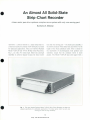
An Almost All Solid-State Strip-Chart
Recorder, by Charles K. Michener
U . S . A .
© Copr. 1949-1998 Hewlett-Packard Co.
9
page 13