1
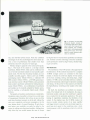
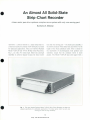
Fig. 1. Compact, low-cost 5300
Measuring System consists of
a mainframe (top half of instru
ment at left), tour snap-on func
tional modules, and a battery
pack (right). Autoranging, serial
BCD digital output, and a highstability crystal reference oscil
lator are standard.
ries, and thin-film hybrid circuits. From the combined
advantages of all these technologies this mini-system de
rives a level of performance that couldn't have been
achieved at such low cost just a few years ago.
Modular design is apparent in the system photograph,
Fig. 1. The heart of the system is a six-digit counter
mainframe, Model 5300A, which can be combined with
any of several functional modules to meet specific appli
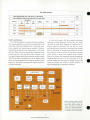
cation needs. The first four functional modules are now
available (see table, page 4). There's a low-cost 10 MHz
autoranging counter (Model 5301 A), a wideband 500
MHz counter (Model 5303 A), a 50 MHz general-pur
pose universal counter (Model 5302A), and a precision
timer-counter specifically optimized for timing measure
ments (Model 5304A). Any combination of mainframe
and module can be instantly adapted for battery opera
tion by inserting a rechargeable battery pack (Model
5310A).
The benefits of modular construction are considerable.
Modularity makes it possible to choose from a wide range
of measurement functions, but to have at any one time
only those functions necessary to do the job, without the
extra cost, complexity, and power consumption (in this
case, battery drain) of unused functions. If and when a
need arises, new capability can easily be added to the
system by adding more functional modules. Adding these
only when they are needed assures the user of always
having the latest in measurement capabilities at minimum
cost. Another economic advantage is that the mainframe
can be produced in relatively high volume, thereby bring
ing its cost down.
The Mainframe
The mainframe of the 5300 system is the upper half of
the instrument. All the elements necessary for a complete
10-MHz six-digit counter are contained in this main
module. It houses the solid-state display for the system,
all the basic counting, storing, and timing logic, a highstability 10 MHz crystal-controlled reference oscillator,
and all the functional control logic for precision counting
and timing. All the power for the system is provided by
the high-efficiency switching power supply in the main
frame.
By itself, the mainframe can perform no measure
ments. The bottom half of the instrument, the snap-on
functional module, calls upon the mainframe's capabili
ties as needed for the particular application. This parti
tioning of capabilities maximizes the flexibility of the
system. In the simplest case, the 10 MHz counter, the
snap-on module consists merely of an input amplifier
and trigger circuit to convert a low-level input signal to a
good logic-level signal for the mainframe, plus a hard
wired program to tell the mainframe what to do with the
signal.
© Copr. 1949-1998 Hewlett-Packard Co.