1
Trouble Shooter
Engineers place diodes in electrical circuits to control the orderly flow of electrons. They didn’t plan for
the misguided efforts of a pair of DIYers, however.
DIY Mop-Up
The son of a long-time customer called to tell
us the floor shifter on his 1996 Pontiac Grand
Am was stuck in Park. He also said the ERLS
fuse blew every time he started the car. And,
by the way, a replacement alternator was on
the back seat of the car.
The car was towed in and we began what we
thought would be a routine electrical diagnosis
and repair. We confirmed that the ERLS fuse
(located in the engine compartment fuse center
near the battery) did indeed blow each time the
car was started. We hooked up an ammeter and
noticed a substantial current spike on startup.
We continued by isolating each circuit routed
through the ERLS fuse. This included the backup lamp switch, the electronic brake control relay and module, the neutral switch, the
transaxle 2-3 control solenoid, the evaporative
emissions canister vent
and purge solenoids,
the digital EGR assembly, the powertrain
control module and the
a/c clutch relay.
Isolating circuits
protected by the ERLS
fuse caused no change
until we got to the a/c
clutch relay. With no
power to the relay, the
fuse would hold while
the engine was cranked.
The a/c relay checked
out fine, leaving only
Most digital multimeters (DMMs) have a
the a/c compressor
Diode Check function that ups the voltage
clutch (we thought).
flow through the test leads to force the
But when we discondiode to “open.” The DMM then displays the
nected the compressor
voltage drop necessary to open the diode
clutch wiring, the short
in the forward direction. When the test
was still present.
leads are reversed, the DMM should indiAfter reviewing the
cate “OL,” or out of limits. If the diode is
diagram, we identified
shorted, the DMM indicates “0” in both dian a/c clutch diode in
rections. If the diode is open, the DMM indithe clutch circuit. We
cates “OL” in both directions.
Photo: Karl Seyfert
Karl Seyfert
6
October 2002
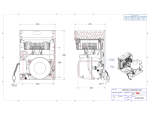
spent several hours unraveling and inspecting
various looms before locating the suspect diode
packaged in an oblong, cream-colored plastic
enclosure that was hard-wired within the harness. When we removed and opened the container, we found the diode had blown apart and
was split along its entire length. We installed a
new diode, which solved the problem.
When our customer arrived to pick up his
car, he confessed that he and his “mechanic
friend” had diagnosed a bad alternator when his
battery went dead and the car wouldn’t start.
Their first attempt at replacing the alternator
was unsuccessful, but they got it right the second time and the new alternator charged normally. However, they traded one problem for
another, as the “stuck in Park” problem appeared immediately afterward. Do you have
any idea how replacing an alternator could have
damaged the a/c compressor clutch diode?
Marvin Tow
Chula Vista, CA
Well, Marvin, to state the obvious, it appears that
someone did something he wasn’t supposed to
do. If you look in any automotive service manual,
nearly every R&R procedure begins with the
words “Disconnect the negative battery cable.” It
would seem that your customer and his friend
skipped right over this step, and possibly grounded one or more of the alternator’s wires. Other
wires may also have been handled improperly,
and it’s anyone’s guess what position the ignition
key might have been in at that time.
The damaged diode you found in the a/c
clutch circuit is a spike-suppression diode, attached to the compressor clutch terminals to
eliminate the potentially damaging voltage
spikes that occur each time power is removed
from the compressor clutch and the clutch
opens. If there were no diode in the circuit,
these voltage spikes could travel through the
circuit, possibly damaging other components
and introducing “noise” into the vehicle’s electrical system, at the very least.
continued on page 8
Trouble Shooter
A diode is the electrical equivalent
of a one-way check valve. It allows the
flow of electrons in one direction but
not the other. A certain amount of
electricity (usually less than .7 volt)
must be flowing in the proper (forward) direction before the diode will
open and allow the circuit to operate.
Electrical flow in the wrong (reverse)
direction is blocked by the diode.
The diode terminals are called the
anode and cathode. The ring marking at
one end of the diode body identifies the
cathode. Under normal conditions, current is allowed to flow through the diode
only when the voltage at the anode is
more positive than at the cathode.
A diode can become damaged in a
couple of different ways. If the forward
current exceeds the diode’s design specifications, the diode’s internal parts may
crack or melt and the contacts may separate. If it melts, the diode may suddenly
allow electrical flow in both directions.
The diode is a one-way check valve,
but it’s designed to hold back only a certain amount of electron flow. So if an excessive amount of electron flow occurs in
the reverse direction, the diode will also
fail and conduct in the wrong direction.
You didn’t mention whether you had
electrically tested the diode before replacing it. Since the ERLS fuse blew
whenever the a/c clutch relay circuit
was powered up, it would appear that
the a/c compressor clutch spike-suppression diode was providing a short
circuit bypassing the compressor clutch
windings. Although it appeared blown
apart, it would seem that your customer’s electrical shenanigans damaged
the diode in such a way that it allowed
current flow at all times. So whenever
the a/c clutch relay circuit was powered
up, the diode provided a direct connection between ground and the a/c relay
supply voltage. With no load in the circuit, the ERLS fuse had no choice but
to blow. If it hadn’t, the rest of the circuit would have melted down, too.
Editor & Publisher
John Lypen, AF-SAE
248-828-0000
Managing Editor
Paul M. Eckstein
Art Director
Harold A. Perry
Detroit Editor
Tom Nash, AF-SAE, STS
248-828-0000
Technical Editor-at-Large
Karl Seyfert, CMAT, L1
Senior Writers
Bob Cerullo, AF-SAE
Mike Dale, SAE
Dan Marinucci, AF-SAE, L1
Thomas Marcy
Mark Warren, AF-SAE, CMAT, L1
Contributing Writers
Ken Layne
Bob O’Connor
Paul Weissler
Contributing Artist
Tough Problem?
Write to Trouble Shooter, MOTOR Magazine, 645 Stewart Ave., Garden City, NY
11530. Or fax to 216-651-3016. Include
your work number and email address.
Russell von Sauers
Production Manager
Jennifer Herrmann
248-312-2700
Research Director
Catherine Smith
Circulation Manager
Dale Boehle
516-227-1401
Classified Advertising Manager
Donna Butera
800-858-3137
Director of Brand Marketing
Lori Aemisegger
248-828-0000
Production Assistant
Ann Ehlert
248-312-2700
PUBLISHED BY
HEARST BUSINESS PUBLISHING, INC.,
A UNIT OF THE HEARST CORPORATION
Victor F. Ganzi
President & Chief Executive Officer
George R. Hearst, Jr.
Chairman
Frank A. Bennack, Jr.
Vice Chairman
Richard P. Malloch
President & Group Head, Hearst Business Media
William M. Wright
Executive Vice President & Deputy Group Head,
Hearst Business Media
William K. Baker
Vice President & General Manager,
Hearst Business Media
Robert D. Wilbanks
Group Controller, Hearst Business Media
Kevin F. Carr
President, Motor Information Systems
5600 Crooks Road, Suite 200, Troy, MI 48098
8
October 2002