1
homeSteam
8. OPERATING PRINCIPLE AND OTHER FUNCTIONS
8.1
Operating principle
In an electrode humidifier the production of humidity is obtained inside a cylinder (boiler) containing water that is heated to
and then held at boiling temperature. The water that evaporates is automatically replaced with water from the mains supply.
The heat required to boil the water is produced by an electrical current that passes through the water among the immersed
electrodes contained inside the boiler and connected to the power supply.
The quantity of current that initially flows depends greatly on the type of water supplied from the mains; nonetheless, over
time the quantity of salts inside the water increases (evaporation in fact does not carry the salts with it). This allows the level
of current required by the machine to provide the quantity of steam requested to be reached.
In normal operating conditions, the level of production required is automatically achieved using the water level control on
the boiler. This is , in fact, reflected in higher or lower levels of current.
The salts introduced by the automatic refilling of the water are partly deposited as lime scale inside the boiler, contributing
to the progressive depletion of the cylinder, and partly remain dissolved in the water. To avoid excessive accumulation of
salts, a quantity of water is periodically and automatically drained and then replaced with fresh water.
8.2
Other functions
8.2.1 Automatic draining
Automatic draining is controlled by the control module: part of the water contained in the cylinder is drained automatically,
and replaced with fresh water to prevent an excessive concentration of salts following the process of evaporation.
The drain electrovalve is opened for a set interval whenever the internal conductivity exceeds the maximum limit allowed;
this situation can also be seen indirectly by evaluating the speed of evaporation.
During automatic draining, the electrodes are not powered, so as to prevent the drained water from carrying electrical
current.
8.2.2 Anti-foam procedure
Some particular types of supply water may give rise to situations in which, during the production of steam, foam forms on
top of the water; this situation must be avoided as it may lead the release of droplets of water together with the steam. For
this purpose, the top of the cylinder is fitted with two detection electrodes. When these electrodes reveal the presence of
foam, a drain procedure is activated to eliminate this problem. The procedure consists of repeated draining up to, in more
critical situations, the automatic complete cleaning of the cylinder.
8.2.3 Automatic emptying of the cylinder for extended shut-down
If the humidifier remains powered but not in production for a continuous period of more than 7 days, the water contained
inside the cylinder is completely drained. This function prevents the corrosion of the electrodes by strongly saline water in
the case where the humidifier is off for extended periods. The function may also be disabled. This is done by moving one of
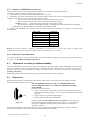
the dip-switches on the electronic control board: locate the block of 4 dip-switches near the screw terminal block (see Fig.
5.3.1) and switch dip no. 1 ON to disable the function. Dip-switches no. 2 and 3 are meaningless in homeSteam and their
positions have no effect.
N.B.: NEVER MODIFY THE POSITION OF THE DIP -SWITCHES NAMED “TA RATE”!
8.2.4 Enable/disable the “Cylinder exhausted” alarm
The “Cylinder exhausted” alarm can be disabled by switching ON dip no. 4 on the block of 4 dip-switches near the screw
terminal block (see Fig. 5.3.1). Dip-switches no. 2 and 3 are meaningless in homeSteam and their positions have no effect.
N.B.: NEVER MODIFY THE POSITION OF THE DIP -SWITCHES NAMED “TA RATE”!
cod. carel +030221900 rel. 2.2 dated 13/0 1/03
44