1
2. Compressor operates, but pressure does not increase
in tank (or increases too slowly):
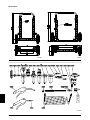
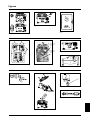
a) The cap on the intake tube has not been removed and replaced by the intake filter (fig. 2).
b) Intake filter is clogged. Replace.
c) Leaks in fittings, tubes or pneumatic equipment. Check with soapy water. Pressure drop is not to exceed 1 bar per hour.
Drain moisture at least once a week.
Alternation/repair
No welding must be made on pressurized parts.
Safety valve
Ensures that PS will not be exceeded.
Never adjust to a higher pressure than PS.
The capacity of the valve must be calculated in accordance with the volume of air supplied by the compressor.
(PS = Maximum working pressure of the receiver)
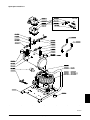
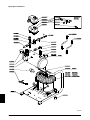
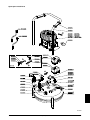
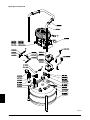
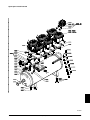
d) Clogged non-return valve or pressure pipe. Clean or replace the parts (fig. 10).
e) Air leaks from the unloader valve when the compressor is operating. Check or replace the unloader valve (fig. 9).
f) Defective valve plate. Contact your JUN-AIR distributor.
GB
3. Loud noise from compressor:
a) Most likely broken suspension spring(s). Replace the spring and ensure that motor position is horizontal.
Declaration of Conformity
b) The internal pressure pipe touches the rib cover or the cylinder block. Dismount the rib cover and bend the pressure pipe away.
NOTE: The declaration of conformity is only valid for units
operating at 230 V/50 Hz, 3x400 V/50 Hz, 12 V DC or
4. Compressor gets very hot and/or uses a lot of oil:
a) Incorrect oil level. The level must appear in the oil level glass (fig. 5).
b) Wrong oil has been filled in the compressor. Use only SJ-27 synthetic lubricant which has the correct viscosity.
c) Leaks. See point 2c.
24 V DC.
The manufacturer, JUN-AIR International A/S, declares that the
products mentioned in this manual are in conformity with:
•
87/404/EEC - 90/488/EEC - 93/68/EEC Council Directive relating to Simple Pressure Vessels
d) Clogged intake filter. See point 2b.
•
89/392/EEC - 91/368/EEC - 93/44/EEC - 93/68/EEC Council Directive of Safety of Machinery e) Too high ambient temperature. Do not install the compressor in a cabinet unless adequately ventilated (fig. 1).
•
89/336/EEC Council Directive of Electric Magnetic Compatibility
f) The compressor is overloaded (i.e. it is operating more than 50% of the operation time). Contact your JUN-AIR distributor.
•
73/23/EEC Low-voltage Directive
5. Compressor starts when no air is being used:
a) Leaks. See point 2c.
6. Compressor starts and stops more frequently than
usual:
Flemming Frisch Andersen
a) Condensate in the air receiver. Empty the receiver by means of the drain cock (fig. 6).
Test and Certification Administrator
b) Leaks. See point 2c.
Pressure vessel
Pressure tested at: 4-25 liter:
40-50 liter:
24
bar
18.3 bar
Directions for use
Application
Receiver for compressed air.
Receiver specifications See name plate.
Installation
Tubes, etc. must be made of suitable materials.
Placement
Observe the working temperature of the receiver.
Ensure that sufficient room for inspection/maintenance is available in a horizontal position.
The receiver must be kept in a horizontal position.
Corrosion protection
The surface treatment must be maintained as required.
Internal inspection at least every 5 years.
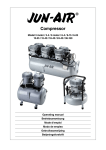
Operating manual