1
ENGLISH
22
2.2.- Arc Welding Hazards
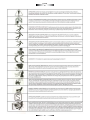
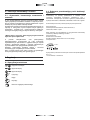
HOT PARTS can cause severe burns.
• Do not touch hot parts bare handed.
• Allow cooling period before working on gun ortorch.
• To handle hot parts, use proper tools and/orwear heavy,
insulated welding gloves andclothing to prevent burns.
Only qualified persons should install, operate,
maintain, andrepair this unit.
During operation,
children, away.
keep
everybody,
FUMES AND GASES can be hazardous.
Welding produces fumes and gases. Breathingthese fumes and
gases can be hazardous to yourhealth.
• Keep your head out of the fumes. Do not breathe the fumes.
• If inside, ventilate the area and/or use local forced ventilation at
thearc to remove welding fumes and gases.
• If ventilation is poor, wear an approved air-supplied respirator.
• Read and understand the Material Safety Data Sheets
(MSDSs)and the manufacturer’s instructions for metals,
consumables,coatings, cleaners, and degreasers.
• Work in a confined space only if it is well ventilated, or
whilewearing an airsupplied respirator. Always have a trained
watch person nearby. Welding fumes and gases can displace air
andlower the oxygen level causing injury or death. Be sure the
breath-ing air is safe.
• Do not weld in locations near degreasing, cleaning, or spraying
operations. The heat and rays of the arc can react with vapors to
formhighly toxic and irritating gases.
• Do not weld on coated metals, such as galvanized, lead,
orcadmium plated steel, unless the coating is removed from
the weldarea, the area is well ventilated, and while wearing an
airsuppliedrespirator. The coatings and any metals containing
these elementscan give off toxic fumes if welded.
especially
ELECTRIC SHOCK can kill.
Touching live electrical parts can cause fatal shocksor severe
burns. The electrode and work circuit iselectrically live whenever
the output is on. The inputpower circuit and machine internal
circuits are alsolive when power is on. In semiautomatic or
automatic wire welding, thewire, wire reel, drive roll housing,
and all metal parts touching thewelding wire are electrically
live. Incorrectly installed or improperlygrounded equipment is a
hazard.
• Do not touch live electrical parts.
• Wear dry, hole-free insulating gloves and body protection.
• Insulate yourself from work and ground using dry insulating
matsor covers big enough to prevent any physical contact with
the workor ground.
• Do not use AC output in damp areas, if movement is confined,
or if there is a danger of falling.
• Use AC output ONLYif required for the welding process.
• If AC output is required, use remote output control if present on
unit.
• Additional safety precautions are required when any of the
follow-ing electrically hazardous conditions are present: in
damplocations or while wearing wet clothing; on metal structures
suchas floors, gratings, or scaffolds; when in cramped positions
suchas sitting, kneeling, or lying; or when there is a high risk of
unavoid-able or accidental contact with the workpiece or ground.
• Disconnect input power or stop engine before installing
orservicing this equipment.
• Properly install and ground this equipment according to
itsOwner’s Manual and national, state, and local codes
• Always verify the supply ground - check and be sure that
inputpower cord ground wire is properly connected to ground
terminal indisconnect box or that cord plug is connected to a
properlygrounded receptacle outlet.
• When making input connections, attach proper grounding
conduc-tor first - double-check connections.
• Keep cords dry, free of oil and grease, and protected from hot
metaland sparks.
• Frequently inspect input power cord for damage or bare wiring replace cord immediately if damaged - bare wiring can kill.
Turn off all equipment when not in use.
• Do not use worn, damaged, undersized, or poorly spliced
cables.
• Do not drape cables over your body.If earth grounding of the
workpiece is required, ground it directlywith a separate cable.
• Do not touch electrode if you are in contact with the work,
ground,or another electrode from a different machine.
• Do not touch electrode holders connected to two welding
machines at the same time since double open-circuit voltage will
bepresent.
• Use only well-maintained equipment. Repair or replace
damagedparts at once. Maintain unit according to manual.
• Wear a safety harness if working above floor level.
• Keep all panels and covers securely in place.
• Keep all panels and covers securely in place.
• Clamp work cable with good metal-to-metal contact to
workpieceor worktable as near the weld as practical.
• Insulate work clamp when not connected to workpiece to
preventcontact with any metal object.
• Do not connect more than one electrode or work cable to
anysingle weld output terminal.
ARC RAYS can burn eyes and skin.
Arc rays from the welding process produce intensevisible and
invisible (ultraviolet and infrared) raysthat can burn eyes and
skin.
• Wear an approved welding helmet fitted with a proper shade
of filter lenses to protect your face and eyes when welding or
watching see ANSI Z49.1, Z87.1, EN175, EN379 listed in Safety
Standards
• Wear approved safety glasses with side shields under your
helmet.
• Use protective screens or barriers to protect others from
flash,glare and sparks; warn others not to watch the arc.
• Wear protective clothing made from durable, flame-resistant
material (leather, heavy cotton, or wool) and foot protection.
WELDING can cause fire or explosion.
Welding on closed containers, such as tanks,drums, or pipes,
can cause them to blow up. Sparkscan fly off from the welding
arc.
The flying sparks, hotworkpiece, and hot equipment can cause
fires andburns. Accidental contact of electrode to metal objects
can causesparks, explosion, overheating, or fire. Check and be
sure the area issafe before doing any welding.
• Remove all flammables within 35 ft (10.7 m) of the welding arc.
If this is not possible, tightly cover them with approved covers.
• Do not weld where flying sparks can strike flammable material.
• Protect yourself and others from flying sparks and hot metal.
• Be alert that welding sparks and hot materials from welding can
easily go through small cracks and openings to adjacent areas.
• Watch for fire, and keep a fire extinguisher nearby.
• Be aware that welding on a ceiling, floor, bulkhead, or partition
can cause fire on the hidden side.
• Do not weld on closed containers such as tanks, drums, or
pipes,unless they are properly prepared according to AWS F4.1.
• Do not weld where the atmosphere may contain flammable
dust,gas, or liquid vapors (such as gasoline).
• Connect work cable to the work as close to the welding area as
practical to prevent welding current from traveling long, possibly
unknown paths and causing electric shock, sparks, and fire
hazards.
22