1
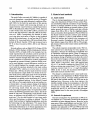
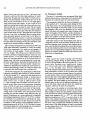
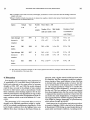
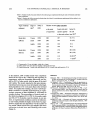
213 ALTITUDE AND AESTIVATION OF GALBA TRUNCATULA (3) 2 snails. Every year, one, two, or five 2 m areas were chosen in each site for their high numbers of snails (more than 40 snails per area) (Table 1). Each area se lected was individually isolated from the rest of the ditch by the construction of two 25 cm high dykes with packed mud and stones. A first count of live snails was performed at mid-June when each area was still covered with a 5 cm layer of water. The live snails and empty shells present on mud were again counted and removed from every area when the soil started to crack (at the onset of July). When the first crack in the soil was 1 cm wide, six hundred litres of spring water were gradually poured in each area for six hours to flood dried substratum and to re-activate aestivating snails. A third count of surviving snails was performed two days after the flooding of each area and their shell heights were measured using a calliper rule. The second investigation was performed in 1997 and 1998 under laboratory conditions to verify the results of the first experiment. Six, eight, or ten samples of soil (surface of each sample : 1 dm , soil thickness : 3-4 cm, weight: 100-150 g) were collected in three lowland and three highland habitats when the soil cracks were 0.7-1.3 cm wide (Table 2). Each sample of dried soil was then placed in a 10 cm deep layer of spring water. All trials were performed in a room sub jected to temperatures diurnally fluctuating from 6°C to 22°C. Soil samples were kept under constant sur veillance to determine the duration of each snail re-ac tivation after placing in water, to count live snails, and to measure their shell height with a calliper rule. 2 The third investigation was performed in 1998 under laboratory conditions and repeated in 1999 to determi ne the percentage of G. truncatula that burrowed in soil during an experimental drying. A lowland and a highland population of snails were used in this experi ment. Every year, a total of 2 0 0 juvenile snails (1-2 mm in height) and 120 adults (4-6 mm) were col lected at mid-June from each population. Breeding boxes of 0.66 m each were constituted with a 5-cm layer of soil, covered with a 2-cm layer of water origi nating from each aforementioned site. One hundred young snails or 60 adults were then placed in each breeding box and the contents were allowed to dry by natural evaporation in a room subjected to diurnally fluctuating temperatures (from 6°C to 22°C). An hour ly surveillance was performed to determine the num ber of snails that buried in the drying soil and the conditions of this process (snail completely buried, or partial burrowing by 50 % or 75 %). Six litres of water were finally poured in each breeding box to flood dried substratum and to re-activate buried snails. 2 2.3. Parameters studied The alive G. truncatula were recognized from dead snails by the presence or the absence of a reaction after the pinch of a tentacle under the stereomicroscope. The parameters studied in the first investigation we re the numbers of G. truncatula noted during the first or the third count, the corresponding survival rates, and the shell height of surviving snails. In the second investigation, they were the numbers of live snails which left dried soil samples after their flooding with water, the height of their shells, and the durations of snail re-activation in water. Lastly, in the third investi gation, the numbers of snails buried into the mud and the corresponding percentages were studied. Individual values for the shell heights in the first in vestigation and for each parameter studied in the se cond investigation were averaged, and standard devia tions were established, taking into account the parame ter, the site studied, and the year of investigation. Com parison test of experimental frequencies and one-way analysis of variance (Stat-Itcf 1988) were used to esta blish levels of significance. 3. Results Table 1 gives the results recorded in the 49 ditch areas during summer drying. In open drainage furrows as well as in road ditches, the survival rates of G. trun catula after flooding were significantly higher (P < 0.01 in each case) in the highland populations than in the lowland ones. Several differences (P < 0.05) could be noted between the rates of the high land populations or those of the lowland ones when snails were living in open drainage furrows. In contrast, in road ditches, there were no significant differences between the rates of the highland populations, those of the lowland ones,-or-between.l99Xand 1998 for each site studied. The shell heights of surviving snails were slightly higher in the case of highland populations. Ho wever, the mean values did not show any significant variation, whatever the mode of comparison. Table 2 gives the number of surviving snails, their shell height, and the duration of snail re-activation when samples of dried soil are placed in spring water. After activation in water, surviving snails were signifi cantly more numerous (F e = 4.77, P < 0.01) in the highland populations of G. truncatula than in the others. The standard deviations of shell heights were greater in the former populations than in the latter ones but there were no significant differences between the mean values. The mean duration of snail re-activation in water ranged from 7.6 to 8.9 hours and did not show any significant variation. 52