1
Bull. Fr. Pêche Piscic. (1993) 331 : 321 -340
— 322 —
RELATIONSHIPS BETWEEN HABITAT FEATURES AND BROWN TROUTS
POPULATIONS (SALMO TRUTTA L.) IN NESTE D'AURE VALLEY.
ABSTRACT
T h e relationships between habitat features and biomass and densitiy of brown trout
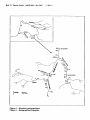
(Salmo trutta L.) were studied in 33 sections of the Neste d'Aure stream and three of its
tributaries: the Neste du Louron, the Neste du Rioumajou and the Espiaube stream in the
Hautes-Pyrénées région. The Habitat Quality Index (HQI) model I (BINNS and EISERMAN,
1979), based on 10 environmental variables, was tested. The biomass predicted by the
model were not linearly related with biomass of trout observed by electrofishing on the 33
sections. The best linear model was obtained after logarithmic transformations of the two
variables. However, the slope of the régression line was significantly différent from 1 (t=2.53
(p<0.01)).The HQI model did not appearto be a good method of assessing the biomass of
brown trout in the Neste d'Aure valley. Corrélations between habitat variables and brown
trout b i o m a s s and density were investigated. Total biomass was significantly related to
élévation (between 1350 and 600 m), cover, maximum summer température (between 10
a n d 16 °C), conductivity, mean bottom velocity, mean depth and width/depth ratio. Total
density was significantly related to the same variables, with the exception of mean depth,
and in addition to water gradient and stream width. The study by age-class showed that the
abundance of young-of-the-year trout is related to élévation, température and conductivity.
O n l y w i d t h w a s t h e h a b i t a t f e a t u r e related to a b u n d a n c e of y o u n g - o f - t h e - y e a r . No
corrélations were found with other physical habitat features. Abundance of one-year-old
trout (1+) was related with the same variables of élévation, température and conductivity in
addition ; their density and biomass were also related to cover. Density of catchable trouts
(length greater than 180 mm) was correlated with cover, depth, température, élévation and
conductivity. The stepwise régression analyses produced combinations of variables that
explained 86 % of the variations in biomass (with 5 variables). This type of work can be very
useful in the management of fishing and of trout populations.
K e y - w o r d s : B r o w n Trout, Salmo
age-class.
trutta,
habitat, corrélation, b i o m a s s , density,
1 . INTRODUCTION
La truite commune {Salmo trutta L.) possède des exigences strictes vis-à-vis de son
environnement (LEWIS, 1969). La nature et l'influence relative de ces facteurs de l'habitat
évoluent selon le stade de développement (HAURY et al., 1991). Les variables les plus
c o u r a m m e n t citées se rapportent à l'habitat physique, la physico-chimie de l'eau et à la
faune benthique. L'échelle d'analyse des relations entre les populations de truites et leur
e n v i r o n n e m e n t c o n s t i t u e é g a l e m e n t un é l é m e n t d é t e r m i n a n t ( H A U R Y et al., 1991).
Certaines variables auront une influence à l'échelle du microhabitat, d'autres à l'échelle du
faciès d'écoulement (macrohabitat) ou de la séquence de faciès d'écoulement.
De nombreuses investigations ont cherché à corréler la densité ou la biomasse de
t r u i t e s a v e c l'habitat p h y s i q u e ou les caractéristiques de débit. F A U S H et al. (1988)
r e c e n s e n t 7 0 modèles permettant d'estimer l'abondance des Salmonidés à partir des
variables de l'habitat. On peut citer, parmi eux, les modèles proposés par CUINAT (1971),
PHILIPPART (1978) in W E L C O M M E (1985), BINNS et EISERMAN (1979), RALEIGH et al.
(1986), LANKA et al. (1987). La méthode d e l'Indice de Qualité d'Habitat (HQI) (BINNS et
E I S E R M A N , 1979) retient 10 variables de l'habitat. Ses applications dans la littérature sont
n o m b r e u s e s (EIFERT et W E S C H E , 1982 ; C O N D E R et A N N E A R , 1987 ; B O W L B Y et
ROFF, 1986 ; SCARNECCHIA et BERGERSEN, 1987 ; HARRIS et al., 1991). La diffusion
d'un manuel d'utilisation (BINNS, 1982) permet l'application standardisée de cette méthode.
La présente étude, conduite de septembre 1990 à janvier 1992, s'est fixée pour
premier objectif de tester la validité du modèle HQI sur une population de truites communes
des Pyrénées. Le test de validité de ce type de modèle ne peut être envisagé que sur un
m i l i e u r é p o n d a n t à d e u x c o n d i t i o n s : ne p a s avoir subi d ' é v é n e m e n t s d e pollution