1
ENGLISH
INSTRUCTIONS PERTAINING TO RISK OF FIRE, ELECTRIC SHOCK, OR INJURY TO PERSONS
IMPORTANT SAFETY INSTRUCTIONS
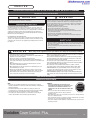
WARNING
WARNING
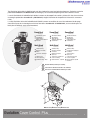
Personal Injury: Do not position your head or body under disposer;
unit could fall during removal or installation.
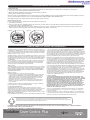
GROUNDING INSTRUCTIONS
For all grounded, cord-connected disposers:
This disposer must be grounded to reduce the risk of electric shock in the
event of a malfunction or breakdown. Grounding provides a path of least
resistance for electric current. This disposer is equipped with a cord having an
equipment-grounding conductor and a grounding plug. The plug must be
plugged into an outlet that is properly installed and grounded in accordance
with all local codes and ordinances.
For permanently connected disposers:
This disposer must be connected to a grounded, metal, permanent wiring
system; or an equipment-grounding conductor must be run with the circuit
conductors and connected to the equipment-grounding terminal or lead on
the disposer.
WARNING
Improper connection of the equipment-grounding conductor can result in
a risk of electric shock. Check with a qualified electrician or serviceman if
you are in doubt as to whether the disposer is properly grounded. If the
plug provided with the disposer does not fit the outlet, do not modify the
plug or attempt to force the plug into the outlet – have a proper outlet
installed by a qualified electrician.
• This disposer must be properly grounded.
• Do not attach ground wire to gas supply line.
• Disconnect power before installing or servicing disposer.
• If three-prong grounded plug is used, plug must be inserted into threehole grounded receptacle.
• All wiring must comply with local electrical codes.
• Do not reconnect electrical current at main service panel until proper
grounds are installed.
NOTICE
• Do not use plumber’s putty on any other disposer connection other than sink
flange. Do not use thread sealants or pipe dope. These may harm disposer and
cause property damage.
• Do not operate disposer without Anti-Vibration Tailpipe Mount™ as water
leaks may result.
When using electric appliances, basic precautions are always to be followed, including:
• Read all instructions before using the appliance.
• To reduce the risk of injury, close supervision is required when an
appliance is used near children.
• Do not put fingers or hands into a waste disposer.
• Turn the power switch to the off position before attempting to
clear a jam, removing an object from the disposer or pressing reset
button.
• When attempting to loosen a jam in a waste disposer, use the
self-service Jam-Buster™ Wrench.
• When attempting to remove objects from a waste disposer, use
long-handled tongs or pliers.
• Do not put the following into a disposer: clam or oyster shells,
caustic drain cleaners or similar products, glass, china, or plastic,
large (whole) bones, metal (such as bottle caps, steel shot, tin
cans, or utensils), hot grease or other hot liquids.
• When not operating a disposer, leave the stopper in place to reduce the
risk of objects falling into the disposer.
• This product is designed to dispose of normal household food waste;
inserting materials other than food waste into disposer could cause
personal injury and/or property damage.
• To reduce the risk of injury and/or property damage, do not use the
sink containing the disposer for purposes other than food preparation
(such as baby bathing or washing hair).
• Do not dispose of the following in the disposer: paints, solvents,
household cleaners and chemicals, automotive fluids, plastic wrap.
• FIRE HAZARD: Do not store flammable items such as rags, paper
or aerosol cans near disposer. Do not store or use gasoline or other
flammable vapors and liquids in vicinity of disposer.
• LEAK HAZARD: Regularly inspect disposer and plumbing fittings for
leaks, which can cause property damage and could result in personal
injury.
SAVE THESE INSTRUCTIONS
OPERATING INSTRUCTIONS
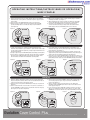
DO...
DON’T...
• First turn on cold water and then turn on the disposer. Continue
running cold water for several seconds after grinding is completed to
flush the drain line.
• Grind hard materials such as small bones, fruit pits, and ice. A
scouring action is created by the particles inside the grind chamber.
• Grind peelings from citrus fruits to freshen up drain smells.
• Use a disposer cleaner, degreaser, or deodorizer as necessary to
relieve objectionable odors caused by grease build-up.
• DON’T POUR GREASE OR FAT DOWN YOUR
Stop and read
DISPOSER OR ANY DRAIN. IT CAN BUILD UP IN
Deténgase
y lea
PIPES AND CAUSE DRAIN BLOCKAGES. PUT
GREASE IN A JAR OR CAN AND DISPOSE IN THE
Arrêter et lire
TRASH.
• Don’t use hot water when grinding food waste. It is
OK to drain hot water into the disposer between
grinding periods.
• Don’t fill disposer with a lot of vegetable peels all at once. Instead, feed into
disposer in multiple batches.
• Don’t grind large amounts of egg shells or fibrous materials like corn husks,
artichokes, etc., to avoid possible drain blockage.
• Don’t turn off disposer until grinding is completed and only sound of motor
and water is heard.
Evolution Cover Control Plus
®
Covered Activation Food Waste Disposer/Triturador de Desperdicios de Alimentos Activado por Tapón/Broyeur de Déchets À Activation Couverte
10