1
ENGLISH
IR2000
Instruction Manual
General Specifications
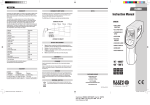
The Klein Tools IR2000 is a professional series infrared thermometer. It
features a wide measurement range, a tight distance-to-spot ratio, a K-type
thermocouple input, dual lasers, and several calculation modes to assist
you in making the best possible measurements.
•
•
•
•
•
•
•
•
•
•
•
•
•
•
•
Operating Altitude: 3000 meters
Relative Humidity: 10~90%, non-condensing
Operating Temperature: 32~122°F (0~50°C)
Storage Temperature: 14~140°F (-10~60°C)
Measurement Range: -76~1022°F (-60~550°C)
Emissivity: 0.10~1.00 adjustable
Optical Resolution (Distance: Spot): 12:1
Dimensions: 4.7 x 1.87 x 6.76”
Weight: 9.0 oz.
Battery Type: 2 x AAA alkaline batteries
Battery Life: 180 hours typical; 140 hours minimum with continuous
use (alkaline batteries, without laser and backlight)
Display Resolution: 0.1°~1.0°
Calibration: Accurate for one year
Laser: FDA and IEC Class II
• Max Output: Less than 1mW
• Wavelength: 635~660nm
• Compliance: 21 CFR, Chapter 1, Subchapter J
Certifications: CE and RoHS
WARNINGS
To ensure safe operation and service of the tester, follow these instructions.
Failure to observe these warnings can result in severe injury or death.
• Do not direct laser beam into eyes, as this can cause permanent
eye damage.
• Do not use the instrument if the case is damaged in any way.
• Replace the batteries as soon as low battery indicator appears.
• Have the instrument serviced immediately if it is acting abnormally.
• Be cautious of readings of reflective materials as they may be
indicated by the instrument as cooler than they actually are
(see Emissivity section).
• Avoid using the instrument around strong electromagnetic fields.
• Do not apply voltage to the thermocouple probe.
Safe Practices
This instrument is designed for professionals who know the hazards
associated with their trade. While this instrument offers no foreseeable
dangers beyond its laser sight, the equipment you are servicing, as well
as the environment you're working in, can be hazardous. These are a few
common safety practices for those working around temperature critical
environments:
• Follow the manufacturer's maintenance procedures when
servicing equipment.
• Before using this instrument to determine if an area is safe to touch
or enter, verify your readings are reasonably accurate by comparison
with known measurements.
• Properly maintain your infrared thermometer and calibrate
it regularly.