1
BRODA 385CS Commode Shower Chair
1)
2)
3)
4)
5)
6)
7)
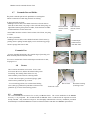
The resident’s arms must be positioned inside the chair frame with their hands on their body.
The resident’s feet must be correctly positioned on the footrests.
All of the chair’s brakes have been applied.
Only one caregiver at a time attempts to operate the chair’s functions.
Only one chair function is operated at a time.
The rear wheels are in the trailing position, behind the chair frame
The resident’s and caregiver’s body are clear of all pinch points
Failure to follow these safety measures can put the resident's or caregiver’s limbs at risk of injury. Residents who
may be unaware of their body position or unable to maintain a safe body position are at the most risk of the danger
from clamping and caregivers should be more cautious with these residents. A second caregiver may be required to
ensure the safety of these residents during these operations.
1.8
Unintended Movement
“Danger of Falling or Collision”
We recommend BRODA chairs for indoor use within a long term care institution and where there is not enough
slope to cause the chairs to move unaided. Chairs used where the surface is uneven or sloped are at risk of
unintended movement and could become a serious danger to the resident, caregiver(s), or a third party. We
recommend that BRODA chairs are located away from stairwells, elevators, and exterior doorways within a long
term care institution.
1.10
Improper Restraint Use
“Risk of Serious Injury”
We recommend that alternatives to physical restraints be used with residents while seated in the chair except under
the specific instructions of the resident’s primary caregiver and with permission of the resident’s family or guardian.
Physical restraints have been identified as a common cause of serious injury to residents while they are seated. We
recommend that the primary caregiver responsible for seating first considers the re-positioning options available in
the chair to reduce the risks of sliding, falling, or self injury.
If a physical restraint is determined to be appropriate to prevent sliding or falling out of the chair, we recommend
that the BRODA seat belt be used. In all cases, it is the resident’s primary caregiver who must take responsibility
for the safety of the resident if restraints are used.
1.11
Improper Use
The improper use of the chair can be dangerous to the resident, caregivers, or third parties through:
1)
2)
3)
4)
5)
6)
7)
8)
9)
10)
11)
Unauthorized operation of the chair’s functions.
Unauthorized movement of the chair.
Inappropriate use of the chair for a resident who has not been assessed by the caregiver
responsible for their seating.
Attempted simultaneous operation of multiple chair functions by one or more caregivers.
Attempting to move the chair with the brake(s) applied.
Leaving the resident unattended in the chair near other objects.
Leaving a potentially agitated resident in an unsupervised area.
Leaving a resident in a chair on a sloping surface.
Leaving a chair unattended on a sloping surface.
Using non-BRODA accessories on the chair.
Using the BRODA chair at temperatures below 0 Celsius (32 Fahrenheit)
6