1
Python-Drive®
INSTALLATION MANUAL
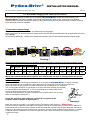
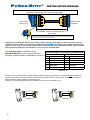
Hub of thrust
bearing unit
Python-Drive
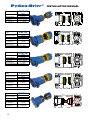
Tip: Measuring of the length of Python-Drive CV drive shafts where models P200 and
larger fit in recesses in the hub and the adaptor flange
Adaptor flange
for gearbox
Net length (as shown in our leaflets and manuals)
for standard versions of P200 and larger CV
drive shafts
Note: when the CV drive shaft is mounted, the length can only be checked by deducting
the 'height' of the rim of the recess of both sides.
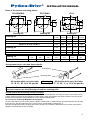
Important; we recommend that the drive shaft “constant velocity” joint angles at either end of the shaft are
installed correctly. Under no circumstance should a Python-Drive flexible drive shaft be installed at Zero
angles (in line). To do so will greatly shorten the life of the CV joint, causing premature failure due to a loss of
bearing efficiency/lubrication. A minimum of 1,5º per joint is recommended.
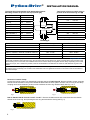
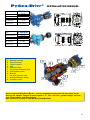
The maximum angle of installation of the
maximum angles and maximum propshaft RPM
Python-Drive CV joint and the maximum
P30 - P140
P200 – P1000
operating propshaft RPM is as indicated by chart No. 8
8º
0 - 1000 rpm.
7º
1500 rpm.
6º
2000 rpm.
5º
2500 rpm.
4º
3500 rpm.
3º
4500 rpm.
4º
1200 rpm.
3.5° 1500 rpm.
3°
1750 rpm.
2.5° 2250 rpm.
2°
3000 rpm.
Chart No. 8
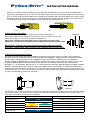
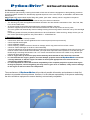
Ideally the CV joints should be mounted at approximately the same angle. If this is not possible ánd the difference
between the angles of the front and rear CV joint would be greater than 5º, the CV-joints could become subject to
abnormal loads, maybe resulting in premature wear.
Drawing No. 9 shows the ideal set-up and drawing No.10 shows a less ideal set-up.
Fig. 3 9
Drawing
6
Fig. 4 10
Drawing