1
0
20
40
60
80
200
400
600
800
1000
1200
1400
RAMAS Metapop file 'seaotter.mp'
0
0.8
0.6
0.4
0.2
0.0
Probability of metapopulation persistence
1.0
Metapopulation expected minumum abundance (females)
RAMAS Metapop file 'seaotter.mp'
0
Number of patches
20
40
60
80
Number of patches
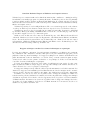
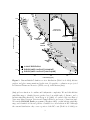
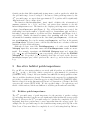
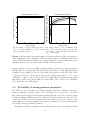
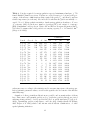
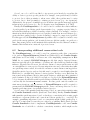
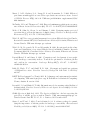
(a) Probability of metapopulation persistence, (b) Metapopulation expected minimum abunPPers . Note that variability (e.g., 50th percentile dance, NMin , and values mentioned in the text.
range) overlaps the median.
Vertical lines: 4 and 60 patches; horizontal line:
NMin = 1 000 females.
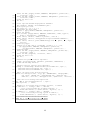
Figure 4. Relationship between the number of habitat patches and the two metapopulation statistics used to quantify relative patch importance for British Columbia sea
otters. Thick lines indicate medians, grey polygons indicate 50th percentile ranges, and
thin lines indicate 95th percentile ranges (nIter = 200 iterations).
stronger influence on the probability of metapopulation persistence (or metapopulation
EMA) than the average patch. The high relative importance of Pop 70 suggests that
it might be more valuable to BC sea otters than other patches on the BC coast. These
5 patches, and the 12 other patches with median relative importance z > 0.5, were
all initially occupied. None of the patches have significantly lower-than-average patch
importance values, and patches with lower importance tend to have more variability
(e.g., wider 95th percentile range).
5.2
Probability of metapopulation persistence
In our BC sea otter case study, our analysis suggests that the probability of metapopulation persistence is always equal to 1.0, even when only one patch (e.g., the most
important patch) is included in the metapopulation (Figure 4a). The secondary statistic (metapopulation EMA) was used to break 99.8% of patch importance ties, and 0.2%
of ties were broken by selecting a patch at random. That is to say, none of the sea otter
patch ranks in our metapopulation model were determined by solely considering the
probability of metapopulation persistence.
The high probability of persistence is not entirely unexpected because extinction risks
13