1
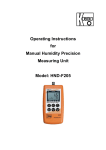
Operating Instructions
for
Manual Humidity Precision Measuring
Unit
Model: HND-F105
HND-F105
1. Contents
1.
2.
3.
4.
5.
6.
7.
8.
9.
10.
11.
Contents ........................................................................................................ 2
Note .............................................................................................................. 3
Instrument Inspection .................................................................................... 3
Regulation Use.............................................................................................. 3
Operating Principle........................................................................................ 4
Electrical Connection .................................................................................... 4
Operation / Configuration / Adjustments ....................................................... 5
7.1 In General ............................................................................................ 5
7.2 Connections ......................................................................................... 6
7.3 Display Elements ................................................................................. 6
7.4 Pushbuttons ......................................................................................... 7
7.5 Device Configuration............................................................................ 7
7.6 Some Basics Of Precision Material Moisture Measuring ..................... 9
7.7 Hints For The Special Functions ........................................................ 12
7.8 Output ................................................................................................ 13
7.9 Fault and System Messages.............................................................. 15
7.10 Inspection of the accuracy / Adjustment Services.............................. 16
Maintenance ............................................................................................... 16
Technical Information .................................................................................. 17
Order Codes ............................................................................................... 18
10.1 Humidity measurement probes .......................................................... 18
10.2 Accessories ....................................................................................... 19
Declaration of Conformance ....................................................................... 20
Manufactured and sold by:
Kobold Messring GmbH
Nordring 22-24
D-65719 Hofheim
Tel.: +49(0)6192-2990
Fax: +49(0)6192-23398
E-Mail: [email protected]
Internet: www.kobold.com
page 2
HND-F105 K01/1107
HND-F105
2. Note
Please read these operating instructions before unpacking and putting the unit
into operation. Follow the instructions precisely as described herein.
The devices are only to be used, maintained and serviced by persons familiar
with these operating instructions and in accordance with local regulations
applying to Health & Safety and prevention of accidents.
When used in machines, the measuring unit should be used only when the
machines fulfil the EWG-machine guidelines.
3. Instrument Inspection
Instruments are inspected before shipping and sent out in perfect condition.
Should damage to a device be visible, we recommend a thorough inspection of
the delivery packaging. In case of damage, please inform your parcel service /
forwarding agent immediately, since they are responsible for damages during
transit.
Scope of delivery:
The standard delivery includes:
• Manual Humidity Precision Measuring Unit
• Operating Instructions
Model: HND-F105
4. Regulation Use
Any use of the Manual Humidity Precision Measuring Unit, model: HND-F105,
which exceeds the manufacturer’s specification may invalidate its warranty.
Therefore, any resulting damage is not the responsibility of the manufacturer. The
user assumes all risk for such usage.
HND-F105 K01/1107
page 3
HND-F105
5. Operating Principle
The KOBOLD manual measuring units HND-F105 were a completely new
development and offer decisive advantages in handling, user-friendliness, scope
of functions, and accuracy during measuring work.
6. Electrical Connection
Mains Operation
Attention: When using a power supply unit please note that
operating voltage has to be 10.5 to 12 VDC. Do not apply over
voltage!! Simple 12 V-power supplies often have excessive noload voltage. We, therefore, recommend using regulated voltage
power supplies. Trouble-free operation is guaranteed by our
power supply HND-Z002.
Prior to connecting the plug power supply with the mains supply
make sure that the operating voltage stated at the power supply
is identical to the mains voltage.
• Treat device and probes carefully. Use only in accordance with above
specification. (do not throw, hit against etc.). Protect plugs and sockets from
soiling.
• To disconnect sensor plug do not pull at the cable but at the plug.
• When connecting the probe the plug will slide in smoothly if plug is entered
correctly.
• Selection of Output-Mode: The output can be used as serial interface or as
analogue output. This choice has to be done in the configuration menu.
6.1.1
Disposal Notice
• Dispense exhausted batteries at destined gathering places.
• Send the device directly to us, if it should be disposed. We will dispose the
device appropriate and non-polluting
page 4
HND-F105 K01/1107
HND-F105
7. Operation / Configuration / Adjustments
7.1
In General
7.1.1
Safety Instructions
This device has been designed and tested in accordance to the safety
regulations for electronic devices.
However, its trouble-free operation and reliability cannot be guaranteed
unless the standard safety measures and special safety advises given in
this manual will be adhered to when using it.
1) Trouble-free operation and reliability of the device can only be guaranteed
if it is not subjected to any other climatic conditions than those stated
under 9 Technical Information.
2) Transporting the device from a cold to a warm environment condensation
may result in a failure of the function. In such a case make sure the device
temperature has adjusted to the ambient temperature before trying a new
start-up.
3) The circuitry has to be designed most carefully if the device should be
connected to other devices. Internal connection in third party devices (e.g.
connection GND and earth) may result in not-permissible voltages
impairing or destroying the device or another device connected.
Warning: Operating the device with a defective mains power
supply (e.g. short circuit from mains voltage to output voltage) may
result in hazardous voltages at the device (e.g. at sensor socket)
4) Whenever there may be a risk whatsoever involved in running it, the
device has to be switched off immediately and to be marked accordingly to
avoid re-starting. Operator safety may be a risk if:
• there is visible damage to the device
• the device is not working as specified
• the device has been stored under unsuitable conditions for a longer time
In case of doubt, please return device to manufacturer for repair or
maintenance.
Warning: Do not use these product as safety or emergency stop
device, or in any other application where failure of the product
could result in personal injury or material damage.
Failure to comply with these instructions could result in death or
serious injury and material damage.
HND-F105 K01/1107
page 5
HND-F105
Risk of injury! The used measuring heads are very sharp, use
thoroughly during your measuring to eliminate a possible risk of
injury.
7.2
Connections
1.
Output: Operation as interface: Connect to optically
isolated interface adapter (accessory: HND-Z031)
Operation as analogue output: Connection via suitable
cable.
Attention: The output mode has to be configured
(see chapter 7.5.7 'Out': Function of the Output)
and influences battery life!
2.
3.
4.
7.3
Sensor-connection: BNC
Temperature-probe-connection: Thermocouple type K
(NiCr-Ni) for temperature-compensation with an external
temperature-probe
The mains socket is located at the left side of the
instrument.
Display Elements
1 = Main Display:
2 = Auxiliary Display:
Currently measured material moisture
[percent by weight]
HLD: Measure value is on hold
(Button 6)
Currently selected material
(or temperature when pressing
Button 3)
Special display elements:
3 = Moisture estimation: Estimation of the material condition:
via top arrows: DRY - MEDIUM - WET
Indicates low battery
4 = Warning triangle:
Appears if an external temperature5 = T external-arrow
probe is connected and automatic
temperature compensation is
activated.
All remaining arrows have no function in this version.
page 6
HND-F105 K01/1107
HND-F105
7.4
Pushbuttons
key 1:
key 4:
key 2, 5:
On/Off key
Set/Menu
press (Menu) for 2 sec.: configuration will activated
During measure: select a material
see chapter: 7.7.2 Pre-selection of favourite materials
('Sort')
List of selectable materials:
Appendix A; Appendix B
With manual temperature compensation:
When displaying temperature (call via button 3 ‚Temp‘):
Input of temperature
up/down for configuration:
to enter values or change settings
Key 6:
Store/↵:
- Measurement:
with Auto-Hold off: Hold current measuring value ('HLD' in display)
with Auto-Hold on: Start a new measure, which is ready when 'HLD'
appears in the display
- Set/Menu or temperature input:
confirming of selected input, return to measure
Key 3:
During the measure: shortly displaying temperature or changing to
temperature input.
7.5
Device Configuration
For configuration of the device press "Menu"-key (key 4) for 2 seconds, the first
menu will be shown.
Choose between the individual values that can be set by pressing the "Menu"key (key 4) again.
The individual values are changed by pressing the keys "5" (key 2) or "6" (key 5).
Use key "Store/↵" (key 6) to leave configuration and to store settings.
7.5.1
'Sort': limitation of the material selection
off:
Unrestricted material selection via key 2 and 5
1...8:
Material selection in-between 1 up to 8 selectable materials.
7.5.2
'Sor.X': selectable materials (not available if Sort = off)
Depending on the number that had been entered at ‚Sort‘ menu settings from
Sor.1 up to Sor.X will be available.
Select the desired material that should be available during the measure
via key 2 and 5, p.r.t: 7.7.2 Pre-selection of favourite materials ('Sort').
HND-F105 K01/1107
page 7
HND-F105
7.5.3
'Unit t': Selection of Temperature Unit °C /°F
°C:
All temperature values are in degrees Celsius
°F:
All temperature values are in degrees Fahrenheit
7.5.4
'ATC': Automatic temperature-compensation
Atc off: Manual input of the temperature for temperatureoFF:
compensation via keys.
Atc on: temperature-compensation via temperature of the internal
on:
temperature measuring or with an external temperature probe.
7.5.5
'Auto-Hold': Automatically freezing the steady measure value
Auto HLD off: continuous measuring.
oFF:
Auto-HLD on: when reaching a stable measuring result, this will be
frozen with-HLD. When pressing the Store-Key a new measure
on:
will be initiated.
7.5.6
'Power.off': Selection of Power-Off Delay
1...120: Power-off delay in minutes.
Device will be automatically switched off as soon as this time has
elapsed if no key is pressed/no interface communication takes
place
Power-off function inactive (necessary for continuous operation,
oFF:
e.g. mains operation)
7.5.7
'Out': Function of the Output
No output function, lowest power consumption
OFF:
Output is serial interface
SEr:
Output is analogue output 0...1 V
dAC:
7.5.8
'Address': Selection of Base Address when Output = Serial Interface
01, 11, 21, ..., 91:
7.5.9
'dAC.0Volt': Output Offset When Output = Analogue Output
0.0...100.0 %
7.5.10
Base address of device for interface communication.
Enter desired moisture value at which the analogue
output potential should be 0 V, e.g. at 0.0 %
'dAC.1Volt': Output Scale When Output = Analogue Output
0.0...100.0 %
Enter desired moisture value at which the analogue
output potential should be 1 V e.g. at 100.0 %
Hint: The settings will be set to the settings ex works, if keys ‘Set‘
and ‘Store‘ are pressed simultaneously for more than 2 seconds.
page 8
HND-F105 K01/1107
HND-F105
7.6
Some Basics Of Precision Material Moisture Measuring
7.6.1
Material Moisture
The material moisture is a measure for the water content of a material:
material moisture = (weight wet – weight dry ) / weight dry *100
7.6.2
Special features of the device
465 wood specimens and 28 building materials are stored directly in the
memory of the device:
Thus more exact measurements could be reached than with common devices
with group selections would ever reach. Even the usage of complex conversion
tables for building materials won’t be necessary any more!
Example: Common wood-moisture-measuring-devices use one single group for
spruce and oak, in reality the deviation of these characteristic curves is more than
3 %! (Base for this statement are complex statistical surveys, considered
measuring range 7-25 %). This random error will not occur for the whole
HND-F105 series, with the help of individual characteristic curves highest
resolution is achieved.
Extreme wide measuring range: 4.0-100.0 % (depending on characteristic
curve) percent by weight in wood.
Moisture estimation: Additionally to the measuring value, an individual moisture
estimation will be displayed simultaneously.
7.6.3
Auto-Hold Function
Particularly when measuring dry wood, electrostatic charges and other similar
noise could dither the measuring value. With activated auto-hold function the
device will acquire an exact measuring value automatically. During that, the
device could be put down to avoid noise through discharge of the clothing etc.
After having acquired the measuring value, the display will change to ‘HLD’: The
value will be frozen as long as a new measuring is initiated by pressing button 6
(store).
7.6.4
Automatic temperature-compensation ('Atc')
An exact temperature compensation is important for a reliable wood-moisturemeasuring. These devices feature a high quality thermocouple-input for type
K thermocouples. Thus you could connect common surface-temperature-probes
– The needed measuring-time ‘afield’ will be drastically lowered compared to
common (non-surface-)temperature-probes. Temperature compensation is done
automatically, depending on the setting and the connected probe.
The corresponding temperature will be shown shortly, by pressing the ‘Temp’
key.
HND-F105 K01/1107
page 9
HND-F105
The used temperature-value therefor is:
Menu
Atc on
Atc off
Temperature-probe
connected
No temperature-probe
connected
Independent from
temperature-probe
Used temperature-value
Aux. Display
Temperature-measuring via connected external Display-arrow
probe
‘T extern‘
Temperature-measuring via device-internal
sensor
Manual input of temperature:
To change value, press Temp-Button, then use
(button 2) or (button 5) to input the
temperature confirm selection with ‘Store‘(button
6)
Attention: When connecting a probe that is non insulated you must
have to observe not touching the wood or the electrodes nearby
the unshielded electrode. We suggest using our insulated probe
HND-FF10 (already included in standard case sets HND-FF12 and
HND-FF13).
7.6.5
Measuring In Wood: Measuring With Two Measuring-Pikes
Normally wood is measured with measuring-pikes. Used electrodes: impactelectrode HND-FF02 or HND-FF03, reciprocating piston electrode HND-FF01.
For measuring wood, punch in the measuring-pikes across to the wood-grain,
having a good contact between the pikes and the wood (measuring along woodgrain deviates minimal)
Select correct wood-sort (refer to Appendix A).
Ensure measuring the correct temperature (see chapter
7.6.4 Automatic temperature-compensation ('Atc')).
Hint: The special HND-FF10 temperature-probe can be stuck
into a hole punched in with the electrode before (see picture
on left).Now read the measuring-value or when having
activated the auto-hold-function initiate a new measuring by
pressing Store/↵ (button 6).
The measured resistance will be extremely high when
measuring dry wood (<15 %) thus the measuring will need
Reciprocating piston
electrode HND-FF01
more time to achieve its final value. Among other things static
with temperature-probe discharge could momentarily falsify the measuring.
HND-FF10
Therefore beware of static discharge and wait long enough until a stable
measuring value is displayed (unstable: „%“ blinking) or use the auto-holdfunction (see chapter 7.6.3 Auto-Hold Function).
Most accurate measurements can be carried out within the range of 6 to 30 %.
Beyond this range the acquirable accuracy will lessen, but the device will deliver
reference values still sufficient for the practitioner.
It is measured between the measuring-pikes insulated among each other.
Requirements for an exact measurement:
• choose right correct place to measure: place should be free of irregularities like
resin–clusters, knurls, rifts, etc.
• choose correct measure depth: Recommendation for trimmed timber: punch in
the pikes up to 1/3 of the material thickness.
page 10
HND-F105 K01/1107
HND-F105
• Perform multiple measurements: the more measurements will be averaged,
the more exact the result will be.
• Pay attention to temperature-compensation: the temperature-probe should be
measuring the temperature of the moisture-measuring-place when measuring
with external temperature-probe (Atc on).
Without temperature-probe: let the device adapt to the temperature of the
wood (Act on) or enter the exact temperature manually (Act off).
Frequent sources of errors:
• Attention with oven-dried wood: the moisture dispersion may be irregular, often
in the core is more moisture than on the edge.
• Surface-moisture: The wood-edge could be more humid than the core if the
wood had been stored outside and e.g. was in rain.
• Wood preservative and other treatment could falsify the measuring.
• Fouling at the connections and round the pikes could result in erroneous
measurement, especially with dry wood.
7.6.6
Measuring Other Materials
7.6.6.1
‘Hard‘ Materials (concrete or similar): Measuring with
brush-type probes (HND-FF05/-FF06)
Drill two holes with Ø6 mm (HND-FF05) or Ø 8 mm
(HND-FF06) at intervals of 8 to 10 cm into the material to
be measured. Do not use edgeless drills: the resulting
heat will evaporate the moisture which will result in faulty
measures. Wait for at least 10 min, blow out the holes to
clean them from dust. Apply conductivity compound on
the brush-type probes and stick them into the holes.
Choose correct material (see Appendix B: Additional
materials), read the measuring value. Observe that the
Measuring concrete with
holes dry out by-and-by, and the device will measure a
brush probe HND-F06
value too low, if you want to use them several times.
This effect can be compensated by using conductivity
compound: insert profuse conductivity compound
between the holes and the brush-type probe, and let the
electrode stick in the hole for about 30 min before
measuring (with the device switched off ). Temperaturecompensation plays no role when using the building
material measuring.
7.6.6.2
‘Soft‘ Materials (polystyrene or similar): Measuring with
Measuring-pikes or -pins
Useable electrodes: impact electrode HND-FF02/-FF03, reciprocating piston
electrode HND-FF01.
Procedure as described in chapter 7.6.5 Measuring In Wood: Measuring With
Two Measuring-Pikes.
HND-F105 K01/1107
page 11
HND-F105
7.6.6.3
Measuring bulk cargo, bales and other special measures
Usable probes e.g. injection probe HND-FF08 or measuring pins HND-FF04
mounted on HND-FF02/-FF03.
Measuring of splints, wood chips, insulating material and similar:
When using injection probes or measuring pins oscillating movements have to be
avoided when pushing in the probes. Otherwise hollows between the probes and
the material may falsify the measuring. The material should be sufficiently
compressed. When in doubt repeat the measuring a few times: the highest
measuring value is the most exact one. Especially when using the injection
probe pay attention having a foulness-free plastic insulator (situated immediately
underneath the measuring-pike).
Measuring bale of straw and hay bale: Always inject the electrodes form the
plain side of the bale, never from the round side, the probe can be inserted much
more slightly.
7.6.7
Measuring of materials, having no characteristic curves stored
Choose the representative universal material group „h.A“, „h.b“, „h.c“ und „h.d“(if
a conversion table exists.
Attention: The moisture evaluation wet/dry of these material
groups is only valid for wood!
Please keep in mind the following when using the temperaturecompensation:
Automatic temperature-compensation should always be activated
when measuring wood (Act on), with all other materials the
automatic temperature-compensation should be switched off (Act
off) and a manual temperature of 20 °C should be entered.
7.7
Hints For The Special Functions
7.7.1
Moisture estimation ('WET' - 'MEDIUM' - 'DRY')
Additionally to the measuring value, an individual moisture estimation will be
displayed simultaneously: The decision either wet or dry has no longer be
affiliated from literature and tables for the most applications. This moisture
estimation is only a guidance value, the final evaluation is depending on the
application of the material e.g:
Cement floor pavement ZE, ZFE without additives:
Readiness without floor heating at 2.3 % with floor heating 1.5 %
Anhydrit floor pavement AE, AFE:
Readiness without floor heating at 0.5 % with floor heating 0.3 %*
Corresponding Standards and Instructions must be observed!
The Device can only complement the skill of a tradesman or investigator but
cannot replace it!
page 12
HND-F105 K01/1107
HND-F105
7.7.2
Pre-selection of favourite materials ('Sort')
A pre-selection of different materials (up to 8) can be selected from the menu for
an effective working with the device. For example you can set the Menu Sort to 4
and save the desired materials in Sor.1, Sor.2, Sor.3 and Sor.4 if you only
measure 4 different materials. Please refer to chapter 7.5.2 'Sor.X': selectable
materials (not available if Sort = off).
Only the 4 desired materials can be selected via the buttons up and down, when
exiting the menu, a changing during the measurement can be done comfortably.
All materials will be available when setting Sort to off. Sor.1 to Sor.4 will still be
available in the ‘background’, when setting the menu Sort to 4 the limited
selection of the 4 entered materials will be active again. You only want to
measure one material: set the menu Sort to 1 you cannot change to another
material, thus a faulty operation is impossible.
7.8
Output
The output can be used as serial interface (for HND-Z031 interface adapters) or
as analogue output (0-1 V). If none of both is needed, we suggest to switch the
output off, because battery life then is extended.
7.8.1
Interface - Base Address ('Adr.')
By using an electrically isolated interface converter HND-Z031 (accessory) the
device can be connected to a PC. In case several devices will be connected via
one interface make sure to configure the base addresses accordingly. In order to
avoid transmission errors, there are several security checks implemented (e.g.
CRC).
The following standard software packages are available for data transfer:
BUS-SW9M:
9-channel software to record and display the measuring values
The Device has 2 Channels:
Channel 1: Material-moisture in % and base-address
Channel 2: Temperature
Note: The measuring and range values read via interface are
always in the selected display unit (°C/°F)!
HND-F105 K01/1107
page 13
HND-F105
Supported Interface-functions:
1 2 Code
x X 0
x X 3
x
12
Name/Function
read nominal value
read system status
read ID-no.
1 2 Code
x x 202
x x 204
x
205
x
x
x
x
x
read min measuring range
read max measuring range
read measuring range unit
read measuring range decimal point
read measuring type
set display unit
read measuring type in display
read min. display range
read max. display range
x
x
x
x
x
x
x
x
x
X
X
X
X
X
X
x X
x X
x X
176
177
178
179
180
194
199
200
201
x
x
x
x
208
214
215
216
217
222
223
240
254
Name/Function
read unit of display
read decimal point of display
read extended measuring type in
display
read channel count
read scale correction
set scale correction
read zero displacement
set zero displacement
read turn-off-delay
Set turn-off-delay
Reset
read program identification
7.8.2
Analogue Output – Scaling with DAC.0 and DAC.1
With the DAC.0 and DAC.1 values the output can be rapidly scaled to Your
efforts.
Keep in mind not to connect low-resistive loads to the output, otherwise the
output value will be wrong and battery life is decreased. Loads above ca
10 kOhm are uncritical.
If the display exceeds the value set by DAC.1, then the device will apply 1 V to
the output
If the display falls below the value set by DAC.0, then the device will apply 0 V to
the output
In case of an error (Err.1, Err.2, no sensor, etc.) the device will apply slightly
above 1 V to the output.
GND
Plug wiring:
Attention! The 3rd contact has to be left floating!
Only stereo plugs are allowed
page 14
HND-F105 K01/1107
HND-F105
7.9
Fault and System Messages
Display
Meaning
Remedy
low battery voltage, device will continue to work replace battery
for a short time
If mains operation: wrong voltage
replace power supply, if fault continues
to exist: device damaged
low battery voltage
replace battery
If mains operation: wrong voltage
Check/replace power supply, if fault
continues to exist: device damaged
low battery voltage
replace battery
No display
If mains operation: wrong voltage
Check/replace power supply, if fault
or
continues to exist: device damaged
weird display
system
error
Disconnect battery or power supply,
Device does not
wait
some time, re-connect
react on keypress
device defective
return to manufacturer for repair
Sensor error: no valid signal, charge at the
Wait until probe has discharged
probe, device will discharge (resp. at dry wood)
---Sensor broken or device defective
return to manufacturer for repair
Value exceeding measuring range
Check: Is the value exceeding the
measuring range specified? >temperature too high!
Wrong
probe
connected
Check
probe
Err.1
Probe or device defective
return to manufacturer for repair
Non-floating probe near the unshielded
Insulate probe or measure at shielded
electrode
electrode
Value below display range
Check: Is the value below the
measuring
range specified? -> temperature too
Err.2
low!
Wrong probe connected
Check probe
Probe, cable or device defective
return to manufacturer for repair
system
error
return to manufacturer for repair
Err.7
HND-F105 K01/1107
page 15
HND-F105
7.10 Inspection of the accuracy / Adjustment Services
Accuracy can be inspected with the testing adapter HND-Z058 (extra equipment).
To check precision select material characteristic curve “.rEF” and plug in testing
adapter.
The device must display the printed value for the HND-F105.
If the precision is no more corresponding to the imprint of the HND-Z058, we
suggest to send the device to the manufacturer for a new adjustment.
8. Maintenance
Battery Operation
The battery has been used up and needs to ! be replaced, if and „bAt“ are
shown in lower display. The device will, however, continue operating correctly for
a certain time. The battery has been completely used up, if ´bAt´ is shown in the
upper display. The battery has to be removed, when storing device above 50 °C.
Hint: We recommend to remove the battery if device is not used
for a longer period of time! Risk of Leakage
page 16
HND-F105 K01/1107
HND-F105
9. Technical Information
Measuring principle:
temperature extern:
Measuring range:
temperature:
Accuracy:
Temperature
compensation:
Resolution:
Display:
Permissible operating
temperature:
Storage temperature:
Storage humidity:
Probe connection:
humidity:
temperature:
humidity: resistive material moisture
measurement in accordance with
DIN EN 13183-2: 2002
temperature intern: NTC
thermocouple
element, NiCr-Ni (type K)
humidity: 0.0 to 100 % weight moisture
(depending upon the respective
material characteristic curve)
-40.0...+200.0 °C (-40.0...+392.0 °F)
(at nominal temperature)
wood: ±0.2 % weight moisture (deviation
from the respective characteristic
curve in the range 6...30 %)
construct.: ±0.2 % weight moisture
(deviation from the resp. char. curve)
temperature (external):
±0.5 % meas. value ±0.3 °C
manually or automatically
0.1 % or 0.1 °C (0.1 °F)
two 4-digit LC-displays
-25 to +50 °C
-25 to +70 °C
0 to 95 % rH (non-condensing)
Material:
Protection:
BNC
NiCr-Ni-plug
that is free of thermoelectric voltage
0-1 V, freely scalable or serial
interface (via 3-pin jack, transformer
on RS232 or USB optional)
9 V-monobloc battery
(included in the scope of delivery),
external 10.5 -12 VDC via jack
housing made of impact-resistant ABS plastic
IP 65
front Dimensions:
Weight:
142 x 71 x 26 mm (HxWxD)
approx. 155 g
Output:
Power supply:
HND-F105 K01/1107
page 17
HND-F105
Scope of functions
Hold-function: »freezing« of the current value
Auto-hold: autom. freezing of a constant measured value
Sort: limitation of the material selection to max. 8 favorites
Automatic-off function: 1...120 min (can be deactivated)
Individual humidity evaluation: wet/moist/dry
Saved weight moisture of 494 materials
10. Order Codes
Order-no.
Housing design
HND-F105
For material moisture, standard
10.1 Humidity measurement probes
Order-no.
Probe type
HND-FF01
Hollow hammer electrode
HND-FF02
Impact electrode
HND-FF03
Modified impact electrode with HND-FF02-front and handle
HND-FF04
Measuring sticks 300 mm long (pair) for woodchips, excelsior,
paper, etc. (for screwing onto HND-FF03)
HND-FF05
Brush probe (pair), short, for depths of up to approx. 100 mm
HND-FF06
Brush probe (pair), long, for depths of up to approx. 300 mm
HND-FF07
HND-FF08
HND-FF09
Flat electrode (for screed, paper, etc.)
HND-FF10
Floating external NiCr-Ni-temperature probes
HND-FF11
Sensor for surface measurement of paper, textiles, etc.
HND-FF12
HND-FF13
page 18
Roller sensor for surface measurement continuous sheets
made of paper, textiles, etc.
Insertion probe 1 m long with handle and 1 m connection cable
(for large excelsior balls, woodchips, etc.
Wood moisture set, contents: HND-Z023 / -Z051 / -Z053 / -FF02 / FF10
Wood and construction moisture set, contents:
HND-Z023 /- Z051 / -Z052 / -Z053 / -FF02 / -FF04 / -FF05 / -FF10
HND-F105 K01/1107
HND-F105
10.2 Accessories
Order-no.
Description
HND-Z002
Plug power supply unit (220/240 VAC, 50/60 Hz), 10.5 VDC / 10 mA
HND-Z015
Protective housing bag, nappa leather, with cut-out for 1 x round / 1x
square sensor connection
HND-Z021*
Case with recess (275 x 229 x 83 mm)
HND-Z022*
Universal case with egg crate foam (275 x 229 x 83 mm)
HND-Z023*
Large case with recess (394 x 294 x 106 mm)
HND-Z031
Interface converter on RS232, galvanically isolated
HND-Z032
Interface converter on USB, galvanically isolated
HND-Z033
Adapter RS 232 converter on USB- interface
HND-Z034
HND-Z051
HND-Z052
Windows software for setting, data read-out, and printing of the data
of housings
of the HND- series with logger function
Measuring cable (BNC on 2 x banana plugs) approx. 1 m long, for
HND-F105/205
100 ml conductivity paste for surface measurement and depth
measurement
in masonry, screed, etc. using brush probes
HND-Z053
Steel pins (3 units each 12 mm, 16 mm, and 25 mm long)
HND-Z054
Surface measuring caps (pair) for screwing onto HND-FF02/03
HND-Z055
Replacement sensor element for HND-FF11
HND-Z056
Measuring cable (2 x banana plugs, on 2 x banana plugs), length
approx. 1 m,
including plug adapter for HND-F110 (not for HND-FF08 and HNDFF10)
HND-Z057
Replacement measuring pins (10 units) for HND-F110
HND-Z058
Testing adapter
HND-Z061
Replacement spring head for HND-FF32
HND-Z063
Replacement spring head for HND-FF33
*observe instrument dimensions
HND-F105 K01/1107
page 19
HND-F105
11. Declaration of Conformance
We, KOBOLD Messring GmbH, Hofheim-Ts, Germany, declare under our sole
responsibility that the product:
Manual Humidity Precision Measuring Unit Model: HND-F105
to which this declaration relates is in conformity with the standards noted below:
EN 61326+A1+A2
Also the following EEC guidelines are fulfilled:
2004/108/EG,92/31/EWG,93/68/EWG
73/23/EWG, 93/68/EWG
Electromagnetic Compatibility Directive
Low Voltage Directive
Hofheim, 01. April 2006
H. Peters
General Manager
page 20
M. Wenzel
Proxy Holder
HND-F105 K01/1107
Appendix A: Sorts of wood
Select kind of wood you want to measure, enter number on the device, e.g. birch = h. 60
Identification
Group A
Group B
Group C
Group D
AS/NZS 1080.1
Group Spruce-Pine-Fir
Fir, Picea abies Karst.
HND-F reference
Abura
Afrormosia
Afzelia
Agba
Albizia / Iatandza, New
Guinea
Albizia / Iatandza,
Solomon Island
Alder, Blush
Alder, Brown
Alder, Common
Alder, Rose
Alerce
Amberoi
Amoora, New Guinea
Andiroba
Antiaris, New Guinea
Apple, Black
Ash Silvertop
Ash, American
Ash, Bennet's
Ash, Crow's
Ash, European
Ash, Hickory
Ash, Japanese
Ash, Red
Ash, Scaly
Ash, Silver (Northern)
Ash, Silver (Queensland)
Ash, Silver (Southern)
Ash, Silver, New Guinea
Aspen, Hard
Ayan
Balau
Balau, red
Balsa
Basralocus / Angelique
Basswood
Basswood, Fijian
Basswood, Malaysian
Basswood, New Guinea
Basswood, Silver
Number
h. A
h. B
h. C
h. D
h. AS
h.402
h.460
.rEF
Comment
Wood-group A
Wood-group B
Wood-group C
Wood-group D
Australian reference characteristic curve
Softwood-Group
applications in the glued timber construction, MPA certified
Internal reference for determining additional characteristic curves /
calculation tables (without temperature-compensation)
Hallea ciliata
Pericopsis elata
Afzelia spp.
Gossweilerodendron
balsamiferum
Albizia falcatara
Albizia falcatara
h.2
h.3
h.4
6..47%
Basswood, Solomon
Island
8..42%
Bean, Black
7..50%
h.426 6..64%
h.8
5..88%
h.9
4..72%
Beech, Myrtle
h.10 5..65%
Caldcluvia paniculosa h.11 7..69%
Alnus glutinosa
h.131 2..107%
Solanea australis
Caldcluvia
australiensis
Fitzroya cupressoides
h.12 6..71%
h.13
Pterocymbium beccarii h.14
Amoora cucullata
h.15
Carapa guianensis
h.16
Antiaris toxicaria
h.7
Planachonella australis h.17
Eucalyptus sieberi
h.27
Fraxinus americana
h.132
Flindersia bennettiana h.18
Flindersia australis
h.19
Fraxinus excelsior
h.133
Flindersia ifflaiana
h.20
Fraxinus mandshurica h.134
Flindersia excelsa
h.21
Ganophyllum falcatum h.22
Flindersia schottina
h.23
Flindersia bourjotiana h.24
Flindersia schottina
h.25
Flindersia amboinensis h.26
Acronychia laevis
h.28
Distemonanthus
benthamianus
Shorea laevis
Shorea guiso
Ochroma pyramidale
Dicorynia guianensis
Tilia americana
Endospermum
macrophyllum
Endospermum
malacense
Endospermum
medullosum
Polyscias elegans
7..61%
5..67%
3..94%
5..59%
6..83%
7..62%
2..90%
5..79%
6..76%
7..69%
7..56%
6..71%
4..79%
5..67%
5..90%
7..70%
6..88%
7..82%
5..82%
5..66%
h.285 7..54%
h.31
h.32
h.33
h.34
h.228
beech, damped
beech, european -
4..54%
4..68%
4..91%
6..55%
4..85%
h.35 4..63%
h.36 5..116%
h.37 5..76%
h.38 7..72%
Range
0..82%
1..95%
2..107%
3..121%
4..91%
6..99%
6..101%
Polyscias elegans
h.39 4..65%
Castanosperum
australe
Fagus sylvatica
h.40 6..87%
Fagus sylvatica
Nothofagus
cunninghamii
Beech, New Zeeland Red Nothofagus fusca
(hearted untreated)
Beech, New Zeeland Red Nothofagus fusca
(sapwood boron)
Beech, New Zeeland Red Nothofagus fusca
(sapwood untreated)
Citronella moorei
Beech, Silky
Nothofagus menziesii
Beech, Silver
Beech, Silver (sapwood Nothofagus menziesii
tanalith)
Beech, Silver (sapwood Nothofagus menziesii
untreated)
Elmerrilla papuana
Beech, Wau
Gmelina vitiensis
Beech, White (Fiji)
Beech, White
Gmelina leichardtii
(Queensland)
Bintangor / Calophyllum, Calophyllum
leucocarpum
Fijian
Bintangor / Calophyllum, Calophyllum curtisii
Malaysian
Bintangor / Calophyllum, Calophyllum
papuanum
New Guinea
Bintangor / Calophyllum, Calophyllum
inophyllum
Phillipines
Bintangor / Calophyllum, Calophyllum kajewskii
Solomon Islands
Octomeles sumatrana
Binuang
Betula lutea
Birch, American
Betula pubescens
Birch, European
Schizomeria ovata
Birch, White
Bischofia javanica
Bishop Wood (Fiji)
Eucalyptus pilularis
Blackbutt
Blackbutt, Western
Eucalyptus patens
Australia
Acacia melanoxylon
Blackwood
Corymbia gunmifera
Bloodwood, Red
Litsea reticulata
Bollywood
Drypetes spp,
Bossime
Eucalyptus moluccana
Box Grey
Eucalyptus bosistoana
Box Grey Coast
h.87 6..55%
h.86 5..85%
h.41 6..76%
h.42 7..87%
h.43 2..97%
h.44 5..84%
h.45 8..66%
h.46 8..58%
h.47 6..76%
h.48 4..92%
h.49 7..96%
h.50 5..77%
h.51 6..81%
h.53 5..81%
h.54 6..76%
h.55 4..98%
h.56 6..78%
h.57 6..85%
h.130
h.59
h.60
h.58
h.61
h.62
5..73%
7..72%
5..96%
7..75%
5..73%
4..92%
h.63 6..88%
h.64
h.66
h.67
h.70
h.75
h.76
6..75%
7..78%
5..78%
7..62%
8..73%
7..76%
Box, Black
Box, Brush (Location
Unknown)
Box, Brush (N.S.W.)
Box, Brush (Queensland
Box, Kanuka
Boxwood, New Guinea
Boxwood, Yellow
Brachychiton
Bridelia
Brigalow
Brownbarrel
Bubinga
Buchanania
Eucalyptus lafgiflorens
h.71 5..92%
Lophostemon
confertus
Lophostemon
confertus
Lophostemon
confertus
Tristania laurina
Xanthophyllum
papuanum
Planchonella
pholmaniana
Brachychiton
carrthersii
Bridelia minutiflora
h.74 5..53%
Acacia harpohylla
Eucalyptus fastigata
Guibourtia demeusii
Buchanania
arborescens
Dakua, Salusalu (Fiji)
h.72 4..55%
h.73 7..46%
h.77 6..78%
h.78 5..69%
h.79
7..62%
h.80 5..55%
h.81
h.82
h.83
h.84
5..103%
5..83%
5..80%
7..70%
h.85 4..76%
Burckella, Solomon
Island
Burckella obovata
h.88 4..59%
Butternut, Rose
Blepharocarya
involucrigera
h.89 5..69%
Cinnamomum spp,
h.90 6..74%
Campnosperma curtisii
h.91 8..95%
Campnosperma
kajewskii
h.92 3..78%
Canagium odoratum
h.93 7..62%
Canarium salomonese
h.97 4..65%
Camphorwood, New
Guinea
Campnosperma
(Malaysia)
Campnosperma
(Solomon Island)
Cananga (Phillipines)
Canarium Solomon
Island
Canarium, African
Canarium, Fijian
Canarium, New Guinea
Candlenut
Carabeen, Yellow
Cathormion, New Guinea
Cedar , Amercan
Cedar, incense
Cedar, White
Cedar, Yellow
Celtis, New Guinea
Celtis, Solomon Island
Cheesewood, White
(Queensland) /Asian
Alstonia
Chengal (Malaysia)
Cherry, American
Cherry, European
Cleistocalyx
Coachwood
Coondoo, Blush
Cordia, New Guinea
Corkwood, Grey
Courbaril
Canarium Scheinfurthii
Canarium oleosum
Canarium vitiense
Aleurites moluccana
Sloanea woollsii
Cathormion
umbellatum
Cedrela odorata
h.94
h.95
h.96
h.98
h.99
7..80%
5..77%
5..75%
0..168%
6..67%
h.100 4..56%
h.102 8..67%
Calocedrus decurrens h.65 5..96%
Melia azedarach
h.101 7..86%
Chamaecyparsis
nootkatensis
Celtis spp,
h.457 4..91%
Dibetou/African walnut
Dillenia (Solomon Island)
Doi (Fiji)
Duabanga, New Guinea
Ebony, african
Ekki
Elm, European
Elm, White
Evodia, White
Figwood (Moreton Bay)
Fir, alpine
Fir, amabilis
Fir, Douglas
Fir, Douglas (New
Zealand) (sapwood
treated)
Fir, Douglas (New
Zealand) (sapwood
untreated)
Fir, Douglas (New
Zealand) (truewood
untreated)
Fir, grand
Fir, Spruce
Fir, white / Fir, silver
Erythrina vespertillio
5..51%
6..57%
Cupiuba
Curupixá
Micropholis
h.114 6..52%
Cypress
Cypress, Northern
Cupressus spp,
h.456 5..89%
h.115 6..78%
Callitris intratropica
7..53%
h.113 7..67%
h.147 6..56%
6..55%
4..73%
7..51%
5..69%
5..60%
7..56%
6..80%
4..91%
5..91%
Pseudotsuga menziesii h.140 6..73%
Pseudotsuga menziesii h.141 5..108%
Pseudotsuga menziesii h.142 3..99%
h.143 5..64%
Garo-Garo
Garuga
Goncalo Alvez
Greenheart
Greenheart, Queensland
Guarea, black
Guarea, white
Guariuba
Gum, Black
Gum, Blue, Sidney
Gum, Blue, Southern
Gum, Grey
Gum, Maiden's
Gum, Manna
Cordia dichotoma
4..72%
h.460 6..101%
h.106 4..76%
6..60%
5..72%
Canarium indicum
Matrixiodendron
pschyclados
Garuga floribunda
Neobalanocarpus
heimii
Prunus serotina
h.109
h.110
h.111
h.112
4..65%
Galip
Gum, Grey, Mountain
h.108 4..84%
7..68%
Abies alba
h.105 5..77%
Ceratopetalum
apetalum
Planchonella laurifolia
h.119
Dillenia salomonese
h.120
Alphitonia zizphoides h.121
Duabanga moluccana h.124
Diospyros spp,
h.125
Lophira alata
h.29
Ulmus spp,
h.374
Ulmus americana
h.373
Melicope micrococca h.135
Ficus macrophylla
h.139
Abies lasiocarpa
h.410
Abies amabilis
h.411
Pseudotsuga menziesii h.122
Picea abies Karst.
Alstonia scholaris
h.216 5..97%
h.217 7..68%
Cleistocalyx mirtoides h.107 5..85%
h.118 6..83%
Fir, MPA
h.103 5..67%
h.104 4..56%
Prunus avium
Decussocarpus
vitiensis
Lovoa trichilioides
h.116 7..80%
h.117 6..86%
h.412 4..91%
h.413 5..97%
h.414 5..93%
Celtis philippinesis
Hymenaea coubaril
Canarium
australasicum
Goupia glabra
Cudgerie, Brown
Cypress, Rottnest Island Callitris preisii
Callitris glaucophylla
Cypress, White
Gum, Mountain
Gum, Pink
Gum, Red, American
Gum, Red, Forest
Gum, Red, River
Gum, Rose / Gum,
Saligna
Gum, Shining
Gum, Spotted (Victoria)
(Lemon-Scented)
Gum, Sugar
Gum, White Dunn's
Gum, Yellow
Abies grandis
Abies magnifica
h.144 5..67%
h.145
h.146
Ocotea rodiaei
h.148
Endiandra compressa h.149
Guarea cedrata
h.68
Guarea cedrata
h.69
Clarisia racemosa
h.150
Nyssa sylvatica
h.162
Eucalyptus saligna
h.152
Eucalyptus globulus
h.151
Eucalyptus punctata
h.153
Astronium spp,
Eucalyptus
cypellocarpa
Eucalyptus maidenii
Eucalyptus viminalis
Eucalyptus
dalrympleana
Eucalyptus fasciculosa
6..53%
6..45%
6..100%
7..82%
7..94%
9..67%
8..57%
7..76%
7..76%
6..79%
5..89%
h.154 6..79%
h.155 7..79%
h.156 4..80%
h.157 3..89%
h.158 6..85%
Liquidambar styraciflua h.166 5..92%
Eucalyptus tereticomis
Eucalyptus
camaldulensis
h.159 7..82%
Eucalyptus grandis
h.161 7..81%
Eucalyptus nitens
h.163 5..83%
Corymbia spp,
h.164 4..72%
h.160 7..94%
h.165 6..79%
Eucalyptus dunnii
h.167 4..72%
Eucalyptus leucoxylon h.168 7..73%
Eucalyptus cladocalyx
Handlewood, Grey
Handlewood, White
Hardwood, Johnstone
River
Hemlock / Hemlock,
Western
Hemlock, Chinesische
Hevea
Hickory
Hollywood, Yellow
Horizontal
Incensewood
Iroko
Ironbark, Grey
Ironbark, Grey
Ironbark, Red
Ironbark, Red, Broad
Leaved
Ironbark, Red, Narrow
Leaved
Jarrah
Jelutong
Jequitibá
Aphanante
phillipinensis
Strebulus pendulinus
h.169 5..66%
Bakhousia bancroftii
Tsuga heterophylla
Tsuga chinensis
Hevea Brasiliensis
Carya spp.
Premna lignum-vitae
Anodopetalum
biglandulosum
Pseudocarapa nitidula
Chlorophora excesla
Eucalyptus
drephanophylla
Eucalyptus paniculata
Eucalyptus botryoides
h.171 5..62%
Mahogany, White
h.172 8..54%
Mahogony Khaya
Mahogony, American
Mahogony, Phillipines
Mahogony, Phillipines
Mahogony, Sapelli /
Sapele
Mahogony, Sipo / Utile
Mahogony, Tiama / gedu
nohor
Mako
Eucalyptus
acmenoides
Khaya spp,
h.170 7..58%
h.173
h.174
h.175
h.176
Keledang
Kempas
Keranji (Malaysia)
Keruing
Kiso
Lacewood, Yellow
Laran
Larch
Larch, American / Larch,
Western
Larch, Japanese
Lauan, Red
Leatherwood
Lightwood
Limba
Lime, European
Louro, Red
Macadamia
Magnolia
7..71%
6..69%
7..67%
h.177 7..84%
h.178 8..58%
h.179 7..46%
h.180 7..88%
Eucalyptus fibrosa
h.183 8..81%
Eucalyptus cerbra
h.184 5..86%
Eucalyptus marginata
h.185 5..92%
h.186 0..104%
h.187 5..64%
Cariniana spp,
Kahikatea (New Zealand) Dacrycarpus
h.188
docrydiodies
(Boron)
Kahikatea (New Zealand) Dacrycarpus
h.189
docrydiodies
(Thanalith)
Kahikatea (New Zealand) Dacrycarpus
h.190
docrydiodies
(untreated)
Eucalyptus deglupta
Kamarere (Fiji)
h.191
Kamarere (New Guinea) Eucalyptus deglupta h.192
Dryobalanops spp,
Kapur
h.193
Eucalyptus diversicolor h.194
Karri
Kermadecia vitiensis h.200
Kauceti
Kauri
5..75%
h.181 5..86%
Eucalyptus sideroxylon h.182 8..79%
Dyera costulata
Agathis australis,
boroneensis
Artocarpus lanceifolius
h.201
6..73%
Maniltoa (Fiji)
Maniltoa (New Guinea)
Mansonia
6..74%
5..66%
5..83%
5..79%
Maple, Scented
4..57%
Mararie
5..78%
Marri
Masiratu
Massandaruba
Matai
Mengkulang
Meranti, Buik from 1999
Meranti, Dark Red
Meranti, Nemesu from
1999
Meranti, Seraya from
1999
Meranti, Tembaga from
1999
Meranti, White
Meranti, Yellow
Merawan
Merbau
Mersawa
Messmate
Moabi
Mora
Moustiqaire
Musizi
Neuburgia
Nutmeg (Fiji)
0..132%
h.220 5..98%
Larix kaempferi
h.222
h.224
h.225
h.226
h.227
h.229
h.231
h.232
Tilia vulgaris
Ocotea rubra
Floyda praealta
Magnolia
acuminata/grandiflora
Geissos benthamii
Mahogany, Brush
Dysoxylum muelleri
Mahogany, Miva
Mahogany, New Guinea Dysoxylum spp,
Maple, Queensland
Maple, Rose
Larix occidentalis
Terminalia superba
Maple, New Guinea
7..73%
h.218 6..54%
Acacia implexa
Makorè
Malas
Malletwood
Malletwood, Brown
Manggachapui
Mango
Mango, Phillipines
Mangosteen (Fiji)
Mangrove, Cedar
Chisocheton
schumannii
Polyalthia oblongifolia
Anthocephalus
chinensis
Larix decidua
Eucryphia lucida
Makoré
7..63%
h.202
Koomapassia excelsa h.203 4..89%
Dialium platysepalum h.204 5..51%
Dipterocarpus spp,
h.205 6..64%
Shorea negrosensis
h.244 7..91%
h.245 7..65%
Eucalyptus botryoides h.246 5..82%
Mahogany, Red
Mahogany, Rose
Mahogany, Southern
h.219 5..68%
h.223 7..67%
h.221 5..69%
5..99%
5..62%
6..79%
7..62%
6..56%
4..78%
5..76%
7..59%
h.233 6..88%
h.242
h.243 8..73%
h.241 6..74%
7..57%
Dysoxylum fraseranum
h.247 6..93%
Shorea almon
h.235
h.234
h.236
h.237
Entandrophragma
cylindricum
h.238 5..99%
Entradrophragma utilie
h.239 6..110%
Entadrophragma
angolense
h.240 10..54%
Trischospermum richii
Thieghemmella
africana
Thieghemella heckelii
h.248 3..68%
Swietenia spp,
Parashorea plicata
h.249
h.250
Rhodamnia argentea h.251
Rhodamnia rubescens h.252
Hopea acuminata
h.253
Mangifera minor
h.254
Mangifera altissima
h.255
Garcinia myrtifolia
h.256
Maniltoa pimenteliana
Mansonia altissima
Flindersia
pimentelianan
Flindersia brayleyana
Cryptocarya
erythroxylon
Flindersia laevicarpa
Pseudoweinwannia
lanchanocarpa
Eucalyptus calophylla
6..84%
5..93%
4..67%
h.123 6..86%
Homalium foetidum
Xylocarpus
australasicus
Maniltoa grandiflora
7..82%
7..80%
5..72%
5..68%
5..70%
6..87%
4..68%
7..93%
5..68%
h.257 6..82%
h.258 6..58%
h.259 6..58%
h.260 7..80%
h.261 6..87%
h.262 5..136%
h.263 6..64%
h.264 7..57%
h.265 8..75%
h.266
h.267
Manilkara kanosiensis h.268
Podocarpus spicatus h.269
Heritiera spp,
h.270
Shorea platiclados
h.271
Shorea spp,
h.272
Degeneria vitiensis
5..64%
5..67%
4..65%
6..73%
5..67%
4..61%
5..94%
Shorea pauciflora
h.274 4..91%
Shura curtisii
h.275 5..62%
Shorea leprosula
h.276 3..72%
h.277
h.273
Hopea sulcala
h.278
Intsia spp,
h.279
Anisoptera laevis
h.280
Eucalyptus obliqua
h.281
Baillonella toxisperma h.282
Mora excelsa
h.283
Cryptocarya spp,
h.284
Maesopsis eminii
h.286
Neuburgia collina
h.287
Myrstica spp,
h.290
Shorea hypochra
4..94%
Shorea multiflora
0..111%
4..90%
6..84%
4..96%
8..75%
6..83%
5..59%
4..77%
7..94%
7..75%
5..74%
Nutmeg (New Guinea)
Nyatoh
Oak, European
Oak, Japanese
Oak, New Guinea
Oak, Red
Oak, Silky, Fishtail
Oak, Silky, Northern
Oak, Silky, Red
Oak, Silky, Southern
Oak, Silky, White
Oak, Tasmanian
Oak, Tulip, Blush
Oak, Tulip, Brown
Oak, Tulip, Red
Oak, Tulip, White
Oak, WhiteObah
Obeche
Odoko
Olive
Olivillo
Opepe
Padauk, African
Palachonella, Fijian
Palachonella, New
Guinea
Palachonella, New
Guinea
Palachonella, Solomon
Island
Paldao
Panga Panga
Papuacedrus
Parinari, Fijian
Penarahan
Peppermint, BroadLeaved
Peppermint, NarrowLeaved
Peroba, White
Persimmon
Perupok (Malaysia)
Perupok (Malaysia)
Pillarwood
Pine / Pine, Stone
Pine, Aleppo
Pine, Austrian
Pine, Beneguet
Pine, Black
Pine, Bunya
Pine, Canary Island
Pine, Celery-Top
Pine, Hoop
Pine, Huon
Pine, King William
Myrstica buchneriana
Palaquium spp,
Quercus robur L.,
Quercus spp,
Castanopsis
acuminatissima
Quercus spp,
h.291
h.292
h.126
h.127
Quercus spp,
Eugenia spp,
Triplochiton
scleroxylon
Scottellila coriancea
Olea hochstetteri
Atextoxicon
puncttatum
Nauclea diderrichii
4..71%
4..87%
4..91%
h.293 4..90%
h.128
Neorites kevediana
h.294
Cardwellia sublimia
h.295
Stenocarpus salignus h.296
Grevillea robusta
h.297
Stenocarpus sinuatus h.298
Eucalyptus regnans
h.299
Argyrodendron
actinophyllum
Argyrodendron
trifoliolatum
Argyrodendron
peralatum
Petrygota horsfieldii
5..78%
5..91%
3..59%
5..83%
6..67%
5..64%
6..64%
7..87%
h.300 6..60%
h.301 9..60%
h.302 9..87%
h.303 5..69%
h.129 5..81%
h.304 5..66%
h.1
5..50%
h.305 6..72%
h.306 7..80%
h.307 5..70%
h.52 7..73%
h.308 4..79%
Planchonella vitiensis h.347 6..61%
Pterocarpus soyauxii
Planchonella
kaernbachiana
h.348 4..71%
Planchonella
thyrsoidea
h.349 2..67%
Planchonia papuana
h.350 4..57%
h.309
Millettia stuhlmannii
h.312
Papuacedrus papuana h.314
Oarinari insularum
h.315
Myristica iners
h.316
4..86%
Eucalyptus dives
h.317
6..94%
Eucalyptus australiana
h.318 8..76%
Dracontomelum dao
6..45%
6..88%
4..78%
6..94%
h.319 7..60%
Diospyros pentamera h.320 5..70%
Kokoona spp,
h.321 1..135%
Paratecoma peroba
Lophopetalum
subovatum
Cassipourea malosano
Pinus pinea
Pinus halepensis
Pinus nigra
Pinus kesya
Prumnoptys amarus
Pinus bidwillii
Pinus canariensis
Phyllocladus
aspenifolius
Araucaria
cunninghamii
Dacrydium franklinii
h.322 8..98%
h.323
h.345
h.324
h.212
h.325
h.326
h.327
h.328
4..79%
6..87%
8..76%
5..106%
8..104%
5..76%
8..69%
6..80%
h.329 7..71%
h.330 7..79%
h.331 8..70%
Athrotaxis selaginoides h.332 7..67%
Pine, Klinki
Pine, LoblollyPine, LongpolePine, Maritime
Pine, Parana Red
Pine, Parana White
Pine, Pitch-, american
Pine, Pitch-, caribbean
Pine, Radiata
Pine, Radiata (New
Zealand) (sapwood aac)
Pine, Radiata (New
Zealand) (sapwood
boliden)
Pine, Radiata (New
Zealand) (sapwood
boron)
Pine, Radiata (New
Zealand) (sapwood
tanalith)
Pine, Radiata (New
Zealand) (sapwoodt
untreated)
Pine, Red
Pine, Scotts
Pine, Shortleaf
Pine, Slash
(Queensland)
Pine, Southern
Pine, Southern, yellow /
Pine, Ponderosa
Pine, Sugar
Pine, western white
Pittosporum (Tasmania)
Planchonia
Pleiogynium / Podo
Podocarp, Fijian
Podocarp, Red
Poplar, Black
Poplar, Pink
Quandong, Brown
Quandong, Silver
Quandong, Solomon
Island
Qumu
Raintree (Fiji)
Ramin
Redwood / Sequoia
Rengas
Resak (Malaysia)
Rimu (non-truewood
boron)
Rimu (non-truewood
tanalith)
Rimu (non-truewood
untreated)
Rimu (truewood
untreated)
Robinia
Roble Pellin
h.333
h.209
Pinus contorta
h.207
Pinus pinaster
h.334
Araucaria angustifolia h.335
Araucaria angustifolia h.336
Pinus palustris
h.211
Pinus caribaea
h.210
Pinus radiata
h.337
Araucaria hunsteinii
4..91%
Pinus taeda
5..91%
5..96%
8..74%
6..39%
7..58%
6..65%
6..93%
5..100%
Pinus radiata
h.338 7..78%
Pinus radiata
h.339 6..85%
Pinus radiata
h.340 6..69%
Pinus radiata
h.341 5..73%
Pinus radiata
h.342 5..91%
Pinus resinosa
Pinus echinata
h.343 2..99%
h.206 6..94%
h.213 5..96%
Pinus elliottii
h.344 6..86%
Pinus echinata
h.214 5..97%
Pinus ponderosa
h.208 5..96%
Pinus sylvestris L.
h.215
h.406
Pittosporum bicolor
h.346
Pleiogynium timorense h.351
Podocarpus neriifolia h.352
Pinus lambertiana
4..97%
Pinus monticola
5..98%
Decussocarpus
vitiensis
Euroschinus falcata
Populus nigra
Euroschinus falcata
Eurocarpus
coorangooloo
Elaecarpus
angustifolius
Elaecarpus spaericus
4..82%
5..73%
7..57%
h.353 6..79%
h.354 6..83%
h.313 4..91%
h.355 6..67%
h.356 5..75%
h.357 5..65%
h.358 3..67%
h.359
h.360
Gonystylus spp,
h.361
Sequoia sempervirens h.362
Gluta spp,
h.363
Acacia Richii
5..67%
Samanea saman
5..49%
6..54%
5..88%
4..85%
Cotylelobium
melanoxylon
h.364 3..94%
Dacrydium cupresinum
h.365 7..65%
Dacrydium cupresinum
h.366 7..65%
Dacrydium cupresinum
h.367 8..69%
Dacrydium cupresinum
h.368 8..44%
Robinia pseudoacacia
h.369 2..72%
h.370 6..72%
Nothofagus obliqua
Rock maple
Rosewood, Brasilian
Rosewood, Indian
Rosewood, New Guinea
Rosewood, Phillippines
Sapupira
Sasauria (Fiji)
Sassafras
Sassafras, Southern
Satinash, Blush
Satinash, Grey
Satinash, New Guinea
Satinash, Rose
Satinay
Satinbox
Satinheart, Green
Satinwood, Tulip
Scentbark
Schizomeria, New
Guinea
Schizomeria, Solomon
Island
Sepetir
Sheoak, Fijian Beach
Sheoak, River
Sheoak, Rose
Sheoak, Western
Australia
Silkwood, Bolly
Silkwood, Silver
Simpoh (Phillippines)
Sirus, White
Sirus, White
Sloanea
Spondias
Spruce, European
Spruce, Norway /Norway
Spruce
Spruce, Sitka
Sterculia, Brown
Stringybark, Brown
Stringybark, Darwin
Stringybark, Yellow
Suren
Sweet chestnut
Sycamore
Sycamore, Satin
Acer saccharum
Dalbergia nigra
Dalbergia latifolia
Pterocarpus indicus
Pterocarpus indicus
Hymenolobium
excelsum
Dysoxylum
quercifolium
Doryphora sassafras
Atherospherma
moschatum
Acmena Hemilampra
Syzygium gustavioides
Syzygium
butterneranum
Syzygium francisii
Syncarpia hilii
Phenbalium
saquameum
Geijera salicifolia
Rhodosphaera
rhodanthema
Eucalyptus
aromapholia
h.6
h.311
h.310
h.371
h.372
5..66%
Tawa (sap & heart
untreated)
Teak
Terap
10..54%
Terentang
5..92%
5..58%
4..91%
h.375 5..68%
h.376 4..69%
h.377 6..70%
h.378 7..66%
Eucalyptus jacksonii
Eucalyptus guilfolei
Cedrelinga
catenaeformis
Podocarpus totara
Calophyllum
constatum
Tristiropsis canarioides
Tristiropsis, New Guinea
Harpullia pendula
Tulipwood
h.384 5..92%
Turat
h.385 8..51%
Turpentine
Vaivai-Ni-Veikau
Vatica, Phillippines
Vitex, New Guinea
Vuga
Vutu
Walnut, American
h.386 6..94%
h.387 5..70%
h.390 1..88%
h.391 6..71%
h.392
7..59%
h.393 8..58%
h.394 7..64%
h.395
Flindersia acuminata h.396
Dillenia philippinensis h.397
Ailainthus peekelii
h.398
Ailainthus triphysa
h.399
Sloanea spp,
h.400
Spondias mariana
h.401
Picea abies Karst.
h.136
8..53%
7..71%
5..86%
5..74%
7..70%
5..77%
4..72%
6..101%
h.138
Sterculia spp,
h.230
Eucalyptus capitellata h.403
Eucalyptus tetrodonta h.404
Eucalyptus muelleriana h.405
Toona cilata
h.407
Castanea sativa
h.199
Acer pseudoplatanus h.5
5..98%
4..91%
6..83%
5..81%
9..77%
6..103%
2..107%
7..57%
h.408 7..63%
h.409
h.30
h.195
h.196
h.197
h.198
h.415
h.416
Totara
Walnut, Blush
Walnut, European
Walnut, Queensland
Walnut, Rose
Walnut, White
Walnut, Yellow
Wandoo
Wattle, Hickory
Wattle, Silver
Wengé
Western Red Cedar
Whitewood, American
Woolybutt
Yaka
h.137 6..105%
Picea sitchensis
Tallowwood
Bagassa guianesis
Tatajuba
Pometia pinnata
Taun Maleisien
Pometia pinnata
Taun New Guinea
Pometia pinnata
Taun Phillipines
Pometia pinnata
Taun Solomon Island
Beilschmiedia tawa
Tawa
Tawa (sap & heart boron) Beilschmiedia tawa
Tetrameles nudiflora
Touriga, Red
Cryptocarya ablata
Ceratopetalum
succirubrum
Eucalyptus microcorsis
Terminalia complanata
h.382 5..59%
h.383 4..92%
h.389 4..60%
Picea abies
h.418 6..80%
h.419 2..169%
Artocarpus elasticus
Campnosperma
brevipetiolata
Terminalia microcarpa
h.381 5..68%
Schizomeria serrata
Allocasuarina
fraserana
Tectona grandis
Tornillo
h.388 5..81%
Casuarina nodiflora
Casuarina
cunninghamiana
Casuarina torulosa
h.417 7..64%
h.379 3..84%
h.380 5..82%
Schizomeria serrata
Sindora coriaceae
Terminalia Braun
Terminalia Gelb
Tetrameles
Tingle, Red
Tingle, Yellow
Beilschmiedia tawa
4..92%
7..44%
0..105%
6..103%
7..99%
4..70%
8..51%
6..61%
Yasi-Yasi I (Fiji)
Yasi-Yasi II (Fiji)
Yate
Yertschuk
Eucalyptus
gomophocephala
Syncarpia glomulifera
h.420 5..77%
h.421
h.422
h.423
h.424
h.425
Endiandra muelleri
Cryptocarya obovota
Beilschmiedia
bancroftii
Eucalyptus wandoo
5..105%
h.430 6..70%
h.432 7..76%
h.431 7..71%
5..91%
5..61%
7..63%
5..78%
6..56%
4..55%
5..87%
h.439 8..64%
h.289
h.440
h.441
h.442
7..59%
6..101%
3..78%
7..63%
h.443 5..66%
h.444
h.445
Acacia dealbata
h.446
Millettia laurentii
h.448
Thuja plicata
h.449
Liriodendron tulipifera h.447
Eucalyptus longifolia h.450
7..87%
7..64%
7..73%
7..55%
6..56%
5..99%
7..80%
h.451 6..69%
h.452
h.453
Eucalyptus cornuta
h.454
Eucalyptus considenia h.455
Syzygium spp,
5..110%
h.429 8..73%
Acacia penninervis
Dacrydium
nausoriensis/nidilum
Syzygium effusum
5..70%
h.428 7..63%
h.433
h.434
Vatica, manggachopi h.435
Vitex cofassus
h.436
Metrosideros collina
h.437
Barringtonia edulis
h.438
Juglans nigra
h.288
Endiandra palmerstonii
3..87%
h.427 5..71%
Serianthes myriadenia
Beilschmiedia
obtusifolia
Junglans regia
3..71%
4..71%
5..82%
6..73%
7..88%
Appendix B: Additional materials
Select material you want to measure, enter number on the device, e.g. concrete b25 = b. 6
Measuring of building materials
Material
Concrete
Concrete 200kg/m³ B15 (200 kg Concrete per 1m³ sand)
Concrete 350kg/m³ B25 (350 kg Concrete per 1m³ sand)
Concrete 500kg/m³ B35 (500 kg Concrete per 1m³ sand)
gas-aerated concrete (Hebel)
gas-aerated concrete (Ytong PPW4, gross density 0,55)
Screed
Anhydrit screed AE, AFE
Ardurapid screed-concrete
Elastizell screed
Screed-plaster
Wood-concrete screed
Screed-concrete ZE, ZFE without additives
Screed-concrete ZE, ZFE with bitumen additives
Screed-concrete ZE, ZFE with synthetic additives
Miscellaneous
Asbestos cement panels
Bricks clay bricks
Plaster
Plaster synthetic
On-wall plaster
Lime mortar KM 1:3
Lime sand bricks (14 DF (200), gross density 1,9)
Limestone
MDF
Cardboard
Stone-timber
Polystyrene
soft-fibre-panel-wood, bitumen
Concrete mortar ZM 1:3
Concrete bounded fake boards
Number
Range
Moisture
estimation
b. 5
b. 6
b. 7
b. 9
b. 27
0,7..3,3%
1,1..3,9%
1,4..3,7%
1,6..173,3%
1,6..53,6%
yes
yes
yes
yes
yes
b. 1
b. 2
b. 8
b. 11
b. 13
b. 21
b. 22
b. 23
0,0..30,3%
0,6..3,4%
1,0..24,5%
0,4..9,4%
5,3..20,0%
0,8..4,6%
2,8..5,5%
2,4..11,8%
yes
no
yes
yes
yes
yes
yes
yes
b. 3
b. 4
b. 10
b. 12
b. 20
b. 14
b. 28
b. 15
b. 16
b. 17
b. 18
b. 25
b. 26
b. 19
b. 24
4,7..34,9%
0,0..40,4%
0,3..77,7%
18,2..60,8%
0,0..38,8%
0,4..40,4%
0,1..12,5%
0,4..29,5%
3,3..52,1%
9,8..136,7%
10,5..18,3%
3,9..50,3%
0,0..71,1%
1,0..10,6%
3,3..33,2%
no
no
yes
yes
no
yes
yes
yes
yes
yes
yes
yes
yes
yes
yes
The accuracy of measuring building materials depends on manufacturing and using. The used additives may vary from
manufacturer to manufacturer, therefore deviating measure results may occur. The given measuring-range is the
theoretically measurable range.
Estimation of additional materials
Following materials may be well estimated with the help of the device, but you won’t reach such high accuracy than
with materials listed in appendix A and B.
Material
Number Comment
Hay, flax
h. 458
Injection probe HND-Z058
Straw, grain
h. 459
Injection probe HND-Z058
Cork
Fibre board
Wood fibre insulating wall panel
Wood fibre hard disks
Kauramin-fake boards
Melamine-fake boards
Paper
Phenolic resin-fake boards
h. A
h. C
h. C
h. C
h. C
h. A
h. C
h. A
Textiles
h. C (D)