1
Processing ISOLUTE® SLE+ Products
Processing ISOLUTE® SLE+ Products
Processing Conditions
Processing ISOLUTE® SLE+ columns and well plates is largely performed under gravity, with a pulse of
vacuum or positive pressure used to initiate loading of the sample, and to maximize solvent recovery
(leading to more reproducible analyte recovery) after elution. Both manual and automated, vacuum or
positive pressure systems can be used.
Volume Guidelines
Internal Standards
Unlike SPE, where the sample is loaded onto the column and
flows through the sorbent to waste, in SLE the ENTIRE sample
volume is absorbed onto the extraction bed. It is therefore
vital to use a format with sufficient capacity to absorb the
whole sample volume.
When using internal standards, they should be added to the
raw sample, mixed, and allowed to equilibrate prior to any other
sample pre-treatment. When standards are added in water
miscible organic solvents, ensure that the volume added is as
low as possible (for example, 10 µL standard solution in 200 µL
sample). For optimum performance, even when higher sample
volumes are used, the volume of internal standard solution
should be kept as low as possible.
Note: the ‘sample volume’ refers to the aliquot of raw sample
matrix plus any dilution buffer used. For example, to extract
200 µL of plasma, diluted 1:1 with buffer, a 400 µL capacity
product should be used.
Table 2 below provides guidelines for sample load and elution
volume for each ISOLUTE SLE+ format.
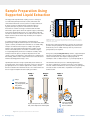
The recommended workflow for processing ISOLUTE® SLE+
columns and plates is shown below
1. Pre-treat sample as required (including internal
standard addition)
2. Ensure appropriate collection vessel is in place
3. Load sample onto ISOLUTE SLE+ column or plate
4. Apply vacuum (-0.2 bar) or pressure (3 psi) for
2–5 seconds to initiate loading
5. Wait 5 minutes for sample to completely absorb and form
extraction layer
6. Apply water immiscible extraction solvent and allow to flow
for 5 minutes under gravity
This will minimize any solvent bridge effect, avoiding matrix
effects due to increased transfer of water soluble matrix
components into the elution solvent.
Scalability
A method developed on one ISOLUTE SLE+ format can easily be
transferred to other formats if larger or smaller sample volumes
are to be extracted (see below).
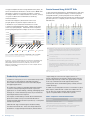
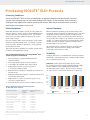
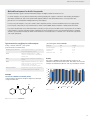
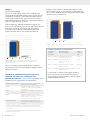
β-blockers: A suite of β-blockers (Figure 8) was used in
recovery experiments from plasma using the relevant sample
volumes diluted 1:1 (v/v) 0.5M NH4OH and eluted with
recommended elution volumes. As can be seen, consistent
recoveries in excess of 80% were evident across all formats.
100.0
80.0
7. Apply vacuum (-0.2 bar) or pressure (10 psi) for 10–30
seconds to complete elution
60.0
8. Evaporate eluate to dryness and reconstitute as required.
20.0
40.0
0.0
Table 2: Maximum Sample and Elution Volumes
for ISOLUTE® SLE+ Products
Product Capacity
Maximum
Load
Volume
Elution Protocol/
Volume
200 µL 96-well plate
200 µL
1 x 1 mL
400 µL 96-well plate
400 µL
2 x 900 µL
1 mL 48-well plate
1 mL
5 x 1 mL
200 µL Array column/plate
200 µL
2 x 600 µL
400 µL Array column/plate
400 µL
3 x 750 µL
400 µL column
400 µL
2 x 900 µL
1 mL column
1 mL
2 x 2.5 mL
2 mL column
2 mL
2 x 5 mL
5 mL column
5 mL
3 x 8 mL
10 mL column
10 mL
2 x 20 mL
200 µL Sample
2 x 650 µL
Elution
400 µLSample
3 x 800 µL
Elution
Oxprenolol
1 mL Sample
2 x 2.5 mL
Elution
Propranolol
2 mLSample
2 x 5 mL
Elution
5 mL Sample
2 x 10 mL
Elution
Alprenolol
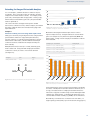
Figure 8. Scalability of columns using β-Blocker analyte suites.
Table 2. The elution volumes described represent a starting point for method
development, and may be reduced during method optimization, particularly
for freely soluble analytes.
7