1
,QVWDOOLQJDQG2SHUDWLQJ,QVWUXFWLRQV
formed, far from heaters or from the warmest place during defrost, to prevent
premature defrost termination.
8.1 DOOR SWITCH INPUT (i1F = dor)
It signals the door status and the corresponding relay output status through the
“odc” parameter:
no, Fan = normal (any change);
CPr, F_C = Compressor OFF;
Since the door is opened, after the delay time set through parameter “did”, the door
alarm is enabled, the display shows the message “dA” and the regulation restarts.
The alarm stops as soon as the external digital input is disabled again. With the
door open, the high and low temperature alarms are disabled.
11. HOW TO USE THE HOT KEY
11.1 HOW TO PROGRAM A HOT KEY FROM THE
INSTRUMENT (UPLOAD)
1.
2.
8.2 GENERIC ALARM (i1F = EAL)
3.
4.
As soon as the digital input is activated the unit will wait for “did” time delay before
signalling the “EAL” alarm message. The outputs status don’t change. The alarm
stops just after the digital input is de-activated.
Program one controller with the front keypad.
When the controller is ON, insert the “Hot key” and push
key; the "uPL"
message appears followed a by flashing “End”
Push “SET” key and the End will stop flashing.
Turn OFF the instrument remove the “Hot Key”, then turn it ON again.
9
8.3 SERIOUS ALARM MODE (i1F = bAL)
NOTE: the “Err” message is displayed for failed programming. In this case push
again
key if you want to restart the upload again or remove the “Hot key” to abort
the operation.
When the digital input is activated, the unit will wait for “did” delay before signalling
the “CA” alarm message. The relay outputs are switched OFF. The alarm will stop
as soon as the digital input is de-activated.
11.2 HOW TO PROGRAM AN INSTRUMENT USING A HOT KEY
(DOWNLOAD)
8.4 PRESSURE SWITCH (i1F = PAL)
1.
2.
9
If during the interval time set by “did” parameter, the pressure switch has reached
the number of activation of the “nPS” parameter, the “CA” pressure alarm message
will be displayed. The compressor and the regulation are stopped. When the digital
input is ON the compressor is always OFF.
If the nPS activation in the did time is reached, switch off and on the
instrument to restart normal regulation.
3.
4.
5.
Turn OFF the instrument.
Insert a programmed “Hot Key” into the 5 PIN receptacle and then turn
the Controller ON.
Automatically the parameter list of the “Hot Key” is downloaded into the
Controller memory, the “doL” message is blinking followed a by flashing
“End”.
After 10 seconds the instrument will restart working with the new parameters.
Remove the “Hot Key”..
NOTE the message “Err” is displayed for failed programming. In this case turn the
unit off and then on if you want to restart the download again or remove the “Hot
key” to abort the operation.
8.5 SWITCHING SECOND RELAY ON (i1F = LHt)
With oA1= LHt it switches on and off the second relay.
8.6 START DEFROST (i1F = dFr)
12. ALARM SIGNALS
It starts a defrost if there are the right conditions. After the defrost is finished, the
normal regulation will restart only if the digital input is disabled otherwise the
instrument will wait until the “MdF” safety time is expired.
Message
Cause
“P1”
Room probe failure
8.7 INVERSION OF THE KIND OF ACTION: HEATINGCOOLING (i1F = Htr)
“HA”
“LA”
“dA”
“EA”
“CA”
“CA”
This function allows to invert the regulation of the controller: from cooling to heating
and viceversa.
8.8 DIGITAL INPUTS POLARITY
The digital input polarity depends on the “i1P” parameter.
i1P=CL: the input is activated by closing the contact.
i1P=OP: the input is activated by opening the contact
Maximum temperature alarm
Minimum temperature alarm
Door open
External alarm
Serious external alarm (i1F=bAL)
Pressure switch alarm (i1F=PAL)
Outputs
Compressor output according
to par. “Con” and “COF”
Outputs unchanged.
Outputs unchanged.
Regulation restarts
Output unchanged.
All outputs OFF.
All outputs OFF
12.1 ALARM RECOVERY
Probe alarm “P1” starts some seconds after the fault in the related probe; it
automatically stops some seconds after the probe restarts normal operation. Check
connections before replacing the probe.
Temperature alarms “HA” and “LA” automatically stop as soon as the thermostat
temperature returns to normal values and when defrost starts.
Alarms “EA” and “CA” (with i1F=bAL) recover as soon as the digital input is
disabled.
Alarm “CA” (with i1F=PAL) recovers only by switching off and on the instrument.
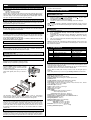
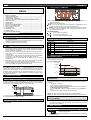
9. INSTALLATION AND MOUNTING
Instrument XR30C shall be mounted on vertical
panel, in a 29x71 mm hole, and fixed using the
special bracket supplied.
To obtain an IP65 protection grade use the front
panel rubber gasket (mod. RG-C) as shown in
figure.
13. TECHNICAL DATA
Housing: self extinguishing ABS.
Case: XR30C frontal 32x74 mm; depth 60mm;
Mounting: XR30C panel mounting in a 71x29mm panel cut-out
Protection: IP20.
Frontal protection: IP65 with frontal gasket RG-C (optional).
2
Connections: Screw terminal block ≤ 2,5 mm wiring.
Power supply: according to the model: 12Vac/dc, ±10%; 24Vac/dc, ±10%; 230Vac
±10%, 50/60Hz, 110Vac ±10%, 50/60Hz
Power absorption: 3VA max
Display: 3 digits, red LED, 14,2 mm high.
Inputs: 1 NTC or PTC probe.
Digital input: free contact
Relay outputs
compressor: SPST relay 8(3) A, 250Vac or
SPST relay 20(8)A; 250Vac
second relay: SPDT relay 8(3) A, 250Vac or
Data storing: on the non-volatile memory (EEPROM).
Kind of action: 1B; Pollution grade: normal; Software class: A.
Operating temperature: 0÷60 °C.
Storage temperature: -30÷85 °C.
Relative humidity: 20÷85% (no condensing)
Measuring and regulation range:
NTC probe: -40÷110°C (-40÷230°F)
PTC probe: -50÷150°C (-58÷302°F)
Resolution: 0,1 °C or 1°C or 1 °F (selectable).
Accuracy (ambient temp. 25°C): ±0,7 °C ±1 digit
The temperature range allowed for correct operation is 0÷60 °C. Avoid places
subject to strong vibrations, corrosive gases, excessive dirt or humidity. The same
recommendations apply to probes. Let air circulate by the cooling holes.
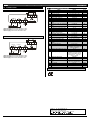
10. ELECTRICAL CONNECTIONS
The instrument is provided with screw terminal block to connect cables with a cross
section up to 2,5 mm2. Before connecting cables make sure the power supply
complies with the instrument’s requirements. Separate the probe cables from the
power supply cables, from the outputs and the power connections. Do not exceed
the maximum current allowed on each relay, in case of heavier loads use a suitable
external relay.
10.1 PROBE CONNECTION
The probes shall be mounted with the bulb upwards to prevent damages due to
casual liquid infiltration. It is recommended to place the thermostat probe away from
air streams to correctly measure the average room temperature. Place the defrost
termination probe among the evaporator fins in the coldest place, where most ice is
1592007220 XR30C GB r1.0 15.05.2003.doc
;5&
3/4