1
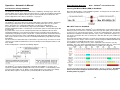
The Langelier (Calcium) Saturation Index (LSI):
The calculation of the Index value is simplified by using a number of pre-calculated factors
that can be added/subtracted to give a value. It should be noted that poolshop water reports
generally use the LSI in their water balance. Some systems do not include the TDS and this
is necessary for salt water pools. A negative LSI indicates corrosive water and a positive LSI
indicates scaling water. It is better for pool water to be slightly scaling than corrosive.
LSI = pH + TAF + CF – TDSF – TF – 9.3
where pH is the pool water pH, TAF is
the Total Alkalinity Factor, CF is the Calcium Factor, TDSF is the *TDS Factor, TF is the
Temperature Factor *Total Dissolved Solids includes salt level
Total Alkalinity
Calcium Hardness
Temperature
TDS Factor
Factor
Factor
Factor
Hardness
TDS
TAF
CF
TDSF
TF
TA (ppm)
Temp (°C)
(ppm)
(ppm)
60
1.78
40
1.20
500
0.17
12
2.34
70
1.84
50
1.30
1000
0.20
14
2.30
80
1.9
60
1.38
2000
0.23
16
2.26
90
1.95
80
1.50
2500
0.24
18
2.22
100
2.00
100
1.60
3000
0.25
20
2.18
110
2.04
120
1.68
3500
0.25
22
2.15
120
2.08
140
1.75
4000
0.26
24
2.11
130
2.11
160
1.80
4500
0.26
26
2.07
140
2.15
180
1.86
5000
0.27
28
2.03
150
2.18
200
1.90
5500
0.27
30
1.99
160
2.20
250
2.00
6000
0.28
32
1.96
170
2.23
300
2.08
6500
0.28
34
1.92
180
2.26
400
2.20
7000
0.28
36
1.88
190
2.28
500
2.30
7500
0.29
38
1.84
200
2.30
600
2.38
8000
0.29
40
1.81
In general if the LSI in the range of –0.5 < LSI < 0.5 then the water can be considered
balanced.
An example: a salt pool has a TDS of 4500ppm, is at a temperature of 26°C, has a TA of
100ppm and a calcium hardness of 80ppm. What should its minimum pH be ?
The minimum pH will be when the LSI is at its minimum ie –0.5:
–0.5 = pH + 2 + 1.5 – 0.26 – 2.03 – 9.3
which simplifies to:
–0.5 = pH – 8.09
(ie pH = 7.6)
The minimum pH for balance is 7.6. If perfectly balanced water were required the LSI must
be 0. In this case the pH would need to be 8.09, which is too high for a pool as the chlorine
would not be very effective. If an LSI of 0 were required a change would need to be made to
the pool balance. If we take the example above and want the pH to be 7.8 (for LSI = 0) the
simplest change we can make is to increase the TA:
0 = 7.8 + TAF + 1.5 – 0.26 – 2.03 – 9.3
which simplifies to:
0 = TAF – 2.29
(ie TA = 190)
In the above case the TA would need to be very high and so some calcium may need to be
added.
If we make the TA 130ppm and add 40ppm to the calcium hardness the pool will be
balanced.
30
Some Pool Additive Information:
Algaecides
These additives either kill algae or remove the conditions required for growth.
®
Copper based algaecides – these pose minimal risk to the Cell of your SaltiGem . However
copper (and a lot of other metals) can be precipitated from pool water as the pH rises. This
means that if copper is added and your pool pH rises well above the recommended range
there may be staining to the pool surfaces. Should not affect the Cell.
Quaternary ammonium compounds – usually benzalkonium chloride. This compound is
generally an algae preventive treatment. It is a surfactant (similar to a detergent) and can
cause foaming in pools and spas. Care should be exercised when using this compound as it
can turn cloudy in water when exposed to high chlorine residuals. If a pool has a slower
water flow it may turn cloudy in the Cell Housing due to the high level of chlorine present
there. Should not affect the Cell.
Phosphate Removers – usually lanthanum salts. This compound will precipitate all phosphate
from the pool water and so there will be no essential nutrient for the algae to grow. It is
recommended that the Cell be turned off for several days while the pool is being treated.
Citric Acid (black spot remover) – using this additive will stop a chlorine residual from being
measured for up to 4 – 6 weeks. Should not affect the Cell.
Polyhexanide Hydrochloride – this is the same as polyhexamethylene biguanide (previously
sold under the name “Baquacil”). This is not compatible with chlorine. It is used in nonchlorine sanitiser systems (with use of oxygen based shock compounds).
Shock Treatments
These compounds are based around chlorine or oxygen (usually peroxides). They act to
increase the chlorine residual or impart peroxide to the water. A common oxygen-based
additive is potassium monopersulphate (monopersulphate for short). In the presence of salt
this will activate chloride to free chlorine. Should not affect the Cell.
Pool Flock (coagulants)
These compounds are used to bind small particles together so that they can be filtered from
the pool water. Common ones are alum (aluminium sulphate) and polymer-based
surfactants. Should not affect the Cell.
Anti-Stain & Anti-Scale Compounds
Anti-stain compounds are used to remove mineral/metals from the water before they can
cause staining. They are usually chelating agents, and usually EDTA:
ethylenediaminetetraacetic acid. These agents bind certain types of metal ions.
Anti-scale compounds are designed to work on calcium – usually to stop it forming a hard
scale. They will not stop scale forming on a Cell, but may modify it.
31