1
Three-phase Motors
For transport reasons the mixers are supplied
as individual component parts which have to
be assembled before starting operation.
Please refer to mounting instructions on page 8 and 9.
Installation of three-phase motors should only be carried out
by suitably qualified personnel only.
Only use three-phase motors with a starter including an
overload cut-out.
Make sure that the supply voltage corresponds to the voltage
Safety Instructions
indicated on the name plate.
Check direction of rotation of the motor.
In case of protable use, check direction of rotation before each
operation. Direction of rotation according to the arrow on the motor.
The mixers/agitators are not approved for use with
flammable liquids class AI, AII and B.
Only use the mixer/agitator for its intended purpose.
Install the mixer/agitator in a way that ensures that it
cannot fall into the container.
( Please refer to mounting instructions on page 8 and 9 ).
Installation Instructions
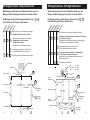
To prevent the liquid from rotating within a cylidrical
container, at least 2 baffles have to be installed
in the container.
Comply with all relevant safety instructions.
Wear appropriate protective clothing.
(Face shield, protective gloves, etc. ).
An off-centered installation of the mixer/agitator may
also be sufficient.
Comply with the operating instructions of the motor.
The velocity of the mixing blade should be:
propeller type:
2-15 m/sec.
skew blade type:
4-10 m/sec.
( Some three-phase motors have their safety instructions contained with
the terminal box ).
The mixer/agitator should not be exposed to the weather.
Never store the mixer/agitator in areas in which corrosive
vapours exist.
Never start the mixer/agitator unless the mixing blade
has been immersed into the liquid.
Baffle
Propeller type :
d2 ~ ( 0,2 to 0,4 ) x d1
h2 ~ ( 1 to 1,5 ) x d2
b2 ~ 0,1 x d1
b3 ~ 0,02 x d1
d2
h2
b2
b3
Skew blade type :
d2 ~ ( 0,3 to 0,4 ) x d1
h2 ~ ( 0,5 to 1 ) x d2
b2 ~ 0,1 x d1
b3 ~ 0,02 x d1
outer diameter of mixer
distance to bottom of container
width of baffle
distance to container wall of baffle
The above values are experimental values which prooved to be useful
during test runs. (According to DIN 28 131, Sep 1992).
6
7