1
Chapter 2: Overview
4
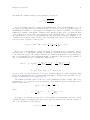
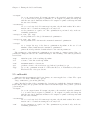
and finally the estimated value for the parameter a is given by
s
−1/b
a=b
M2 Γ(1/b)
.
Γ(3/b)
A second possible approach consists in the maximization of the empirical likelihood, i.e. in
the method generally known as maximum likelihood estimation. More specifically, instead of
maximizing the likelihood of the sample, we minimize the negative log-likelihood, computed
taking the logarithm of the likelihood function and chancing it sign. Moreover, using the first
order conditions is easy to derive the expression of the estimated value of the parameter a as
an explicit function of b and m. Substituting this expression in the negative log-likelihood one
obtains an object function that depends only on 2 parameters, b and m. We call this function
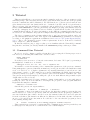
reduced negative log-likelihood and it reads
N
1 X
1 1
b
+ log(
|xj − m| ) .
b
b
N j=1
L(a, b) = log(2b1/b Γ(1 + 1/b)) +
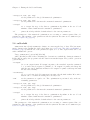
In the case of the asymmetric density, the method of moments is not so attractive. Indeed
it is impossible to obtain simple expressions relating the parameters characterizing the density
to the various moments of the sample. Then the use of numerical methods becomes mandatory,
and one is naturally led toward maximum likelihood estimation. The (negative) log-likelihood
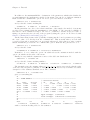
(per observation) in the case of asymmetric density reads
L(bl , br , . . .) = log(A) +
1 X m − xj bl
1 X xj − m br
+
N bl xj <m
al
N br xj >m
ar
1/bl
A = al bl
,
r
Γ(1 + 1/br ) .
Γ(1 + 1/bl ) + ar b1/b
r
As can be seen, both L(a, b) and L(bl , br , ...) are not analytic functions of their arguments. This
is way their minimization is a non-trivial task that must be handled with particular care, see
Chapter 5 [Fitting Subbotin Density], page 11.
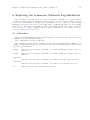
The situation is much easier for the case of the asymmetric Laplace density. Indeed by
substituting bl = br = 1 in the previous expression one obtains the reduced log likelihood as a
function of the mean m
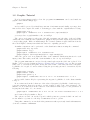
L(m) = −2 log
p
Sl +
p
Sr =
1 X
xj − m
N xj >m
Sr − 1
where
Sl =
1 X
m − xj
N xj <m
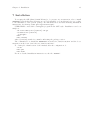
It is easy to see that the function above posses a single global minimum. Once the central
parameter m has been estimated the value of the other two parameters are directly obtained al
and ar are determined by the relations
al = Sl +
p
Sl Sr
ar = Sr +
p
Sl Sr