1
•
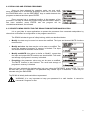
High pass filter/low pass filter: allows you to adjust the frequency, type of filter (Bessel,
Butterworth and LR) and the slope by octave (12 dB, 18 dB, 24 dB and 48 dB) of the high-pass or
low-pass filter needed for the channel selected.
•
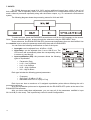
Limiter/compressor: allows you to adjust the threshold (-20 dBV to 10 dBV), level of
compression (1.2 to inf.), attack time (from 0.5 ms to 50 ms) and release time (from 10 ms to 1 s).
Proper adjustment of the limiter/compressor can be very important in the event that the
loudspeakers need to be protected against signal clipping or an excess of power.
When an amplifier receives an input level higher than its nominal input level, the input stage can
become saturated, resulting in an amplified clipped output signal. This clipped signal has a strong DC
voltage component that can easily damage the loudspeakers.
To avoid this, the limiter/compressor should be adjusted to avoid saturation of the amplifier in
order to prevent damage to the loudspeakers.
On the other hand, if the amplifier has a larger power output than the loudspeakers can handle or
the system must operate during long periods at full power, the limiter/compressor must be adjusted such
that the signal delivered by the amplifier does not damage the speakers.
The limiter threshold level also serves as the reference for the output VU-meter, such that the
levels displayed always bear relation to the adjusted limiter threshold. For example, if the limiter is set to
2.0 dBV, the LIMIT indication on the output VU-meter will be +2 dBV higher, as follows:
VU-METER
Limit
-3dB
-6dB
-12dB
OUTPUT LEVEL
+2,0dBV
-1dBV
-4dBV
-8dBV
After you have made these adjustments, you can copy all of the parameters modified in one
channel to another. This is particularly useful for stereo configurations.
14