1
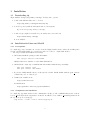
--size <sizes> A comma-separated list of sizes that alg should consider. You can also specify a size
interval of the form m-n . For example, 1,2,5-8 would mean that we consider sizes 1, 2, 5, 6, 7, 8.
--count Do not print out the models, just report the counts.
--format <format> Output in the given format. Supported formats are text, html, latex, and json.
--indecomposable Output only indecomposable models, i.e., those that are not products of smaller models.
--axiom Add an extra axiom to the theory. Use the option several times to add several axioms. Note that
on a command-line the axiom should be enclosed in quotes.
--no-products Do not try to generate models as products of smaller models. Use this option if you know
that a model cannot be a product of smaller ones. For example, a field can never be a product of two
fields. The option is assumed if the theory contains predicates or relations. If all of your axioms are
equations, then you should not use this option.
--no-source Do not include the theory in the output.
--output <filename> Output to the given file rather than to screen.
--paranoid Perform additional checks to verify that the models really satisfy the axioms. Use this option
if you think there is a bug in alg.
--sat Use the alternative algorithm based on satisfying the axioms rather than intelligent filling-in of
multiplication tables. It works well with theories that have predicates and relations. For theories
with unary and binary operations the standard algorithm typically performs better.
--version Print out version information and exit.
--help Print help.
7
How to use alg efficiently
You should always keep in mind the fact that alg performs a brute force search with a few optimizations. In
2
the worst case its running time is doubly exponential in the size of the models because there are nn tables
for a binary operation on a set of size n.
Alg contains two diffrent algorithms, the default and the alternative one. As a rule of thumb you should
use the default algorithm, unless the signature of your theory consists mostly of predicates and relations. In
any case, since the performance is not easily predicted, you should try both algorithms and experiment by
rewriting the theory in various equivalent ways.
7.1
The default algorithm
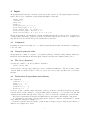
The default alg algorithm is optimized for equational theories, i.e., those whose axioms are equations (semigroups, monoids, groups, rings, lattices, etc., but not integral domains and fields). Alg takes advantage of
commutativity, associativity and idempotent laws, and to a smaller extent of other kinds of equational laws,
such as absorption and distributivity.
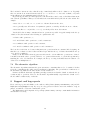
Alg performs few optimizations based on non-equational axioms. Thus you should try to reduce their
number. Furthermore, in non-equational axioms the quantifiers should always be pushed inside as much as
possible. For example, instead of
Axiom : forall x , exists y , x <> 0 -> x * y = 1.
you should write
Axiom : forall x , x <> 0 -> exists y , x * y = 1.
9