1
15
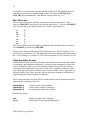
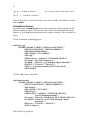
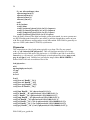
read(itide,'(8f10.6)') (u1(j,i),j=1,nubc)
read(itide,'(8f10.6)') (u2(j,i),j=1,nubc)
read(itide,'(8f10.6)') (v1(j,i),j=1,nubc)
read(itide,'(8f10.6)') (v2(j,i),j=1,nubc)
enddo
from unit itide=14. z1 and z2 are the cosine and sine components of the elevation of each
constituent (similarly for velocity, u and v)
If LONGBCFORM is used data is read according to
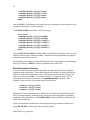
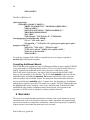
do i=1,ncond
read(itide,'(8f10.6)') (z1(j,i),j=1,nobdZ)
read(itide,'(8f10.6)') (z2(j,i),j=1,nobdZ)
read(itide,'(8f10.6)') (u1(j,i),j=1,nobdUV)
read(itide,'(8f10.6)') (u2(j,i),j=1,nobdUV)
read(itide,'(8f10.6)') (v1(j,i),j=1,nobdUV)
read(itide,'(8f10.6)') (v2(j,i),j=1,nobdUV)
enddo
where nobdZ=2l+2m, nobdUV=(2(l+1)+2(m+1) and the data is ordered east to west and
north to south along the southern, northern, eastern then western boundaries (irrespective
of whether points are land or sea).
The boundary tidal currents are then calculated from these constituents at each barotropic
time step. If directive ZBAR is used the equilibrium tide is also used.
Residual/combined forcing
As well as tidal forcing time series of barotropic elevation and current can be applied
around the model boundaries. These either represent the residual, in which case they are
additive with the tidal component, or they can be used to provide the full forcing. The
Data are read from unit nrm=77 at a format (default is *, boundzuv_form=’unf’ for
unformatted) and frequency (in hours) set in parameters.dat (less than 1 hour
currently causes an error). At each time data is read in using
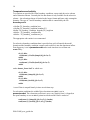
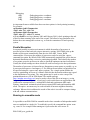
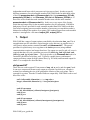
read(nrm,*) (z1(j),j=1,nzbc)
read(nrm,*) (u1(j),j=1,nubc)
read(nrm,*) (v1(j),j=1,nubc)
and similarly for the unformatted case. z1, u1, v1 are boundary currents and elevations.
These are ramped linearly in time between concurrent values and applied as boundary
conditions as described above. A LONGBCFORM is also available in a similar format
to the tidal constituents.
If only elevations are available these can be imposed using a relaxation condition (set
using (READ_ZET; this has not been extensively tested).
POLCOMS_user_guide.doc