1
Case Study 1.11
Incorrect Feed Characterization Leads to Impossible Product Specifications
of the light-boiling component in the final product was 0.5%. It should have been
(and was in previous runs) 200 ppm.
Investigation The feed was analyzed by GC per normal procedure. The concentration levels of different components looked good. No significant deviation was
found. Then some changes in the distillation were performed, such as
• increasing the "lights fraction" in the batch distillation,
• increasing the reflux ratio during the lights fraction, and
• decreasing the vapor load during the lights fraction.
These changes yielded no significant improvement.
The off-specification product was redistilled. The purity was improved, but still
the specification could not be met. The GC analysis was checked (recalibrated) again.
Everything was OK.
As all of the above-mentioned actions did not improve the product quality, it
seemed that something was wrong with the column. After long discussions it was
decided to open the handhole at the top of the column and to have a closer look at the
feed distributor. Nothing suspicious was found.
Then it was decided to have a closer look at the analysis again. A gas
chromatography-mass spectrometry (GC-MS) analysis was performed. This method
showed that the impurity was not the light-boiling component as presumed. This
component was a remainder from the previous run in the multipurpose plant. Having
a boiling point much closer to the end product, this component could not be separated
in the column.
Moral It is a good idea to check the analysis with GC-MS before shutting down a
column.
CASE STUDY 1.11 INCORRECT FEED
CHARACTERIZATION LEADS TO IMPOSSIBLE
PRODUCT SPECIFICATIONS
Contributed by Chris Wallsgrove
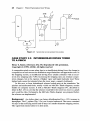
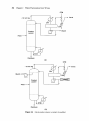
Installation A new, entirely conventional depentanizer, recovering a C5 distillate
stream from a C5/C6/C7 raffinate mixture from a catalytic reformer/aromatics extraction unit, with some light pyrolysis gasoline feed from an adjacent naphtha-cracking
ethylene plant. The column had 30 valve trays, a steam-heated reboiler, and a condenser on cooling water.
Problem The C5 distillate was guaranteed by the process licensor to contain a
maximum of 0.5% wt. C^s. Laboratory testing by the on-site laboratory as well
13