1
18
Pierre Martinon , Joseph Gergaud
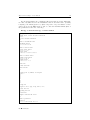
Notes:
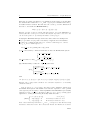
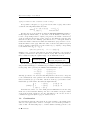
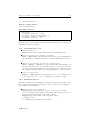
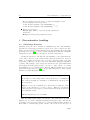
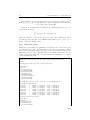
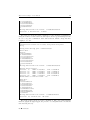
- the use of variational equations instead of external differentiation is activated
by setting the Jacobian mode parameter in the initialization file to 1.
- if switchings are expected, switching detection MUST be enabled !
- this option uses the hybrj solver instead of hybrd.
3.3
3.3.1
Sample problem: Orbital transfer
Problem statement
We study here an orbital transfer problem, originally submitted by CNES4 . We
consider a satellite with a mass of 1500 kg and low thrust electro-ionic propulsion (with thrusts ranging from 10 Newtons to 0.1 Newton). We want to transfer
it from a strongly elliptic, slightly inclined orbit, to a circular, equatorial, geostationary orbit. The objective is to maximize the payload, i.e., to minimize
the fuel consumption during the transfer (this is not a minimum-time problem).
This kind of problems was studied for instance in [3, 16], and this specific family
of problems in [11, 9, 10].
Model
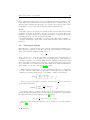
We consider that the forces applied to the satellite are the Earth attraction
(central force) and the engine thrust:
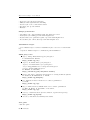
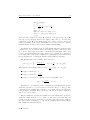
r̈ = −µ
r
T
+
krk3
m
with r the position vector in R3 , T the thrust also in R3 (ie the control), m the
mass of the satellite, µ the gravitational constant of the Earth.
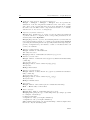
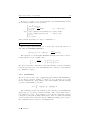
State
In order to avoid the strong oscillations that would result from the high number of revolutions, we use orbital parameters instead of Cartesian coordinates
to define the state variables:
❼ Orbit parameter P
❼ Eccentricity vector (ex , ey ), in the orbit plane, oriented towards perigee
❼ Rotation vector (hx , hy ), in the equatorial plane, collinear to the intersection
of orbit and equatorial planes
❼ True longitude L = Ωn + ω + w
❼ Mass m
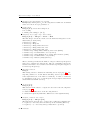
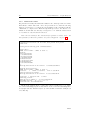
Control
The normalized three-dimensional control u such that T = Tmax u is expressed in the moving reference frame attached to the satellite, as radial thrust
q, transverse thrust s and normal thrust w.
Optimal Control Problem
4 Centre
National d’Etudes Spatiales
INRIA