1
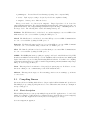
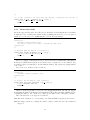
Compile Smews setting the target to linux and the content to be embedded helloWorld as
below:
$ scons target=linux apps=helloWorld ipaddr=192.168.1.2
Then run the ELF file from the /bin/linux directory. You can now access the server at
http://192.168.1.2/helloWorld/hello.html. Keep in mind that the linux target is a particular
case where Smews binary file is a process, that is why it can be launched directly. If tested on
different target, refer to the instructions in Section 2.4.
3.2
Dynamic Content
Smews can serve content generated by native code, which we will refer to as Dynamic Content.
Any C file containing XML specific code (as C comment) will considered as a Web resource and
associated to an URL. The XML meta-data are interpreted in the pre-processing phase, thus
generating some C code. We describe here the role of the XML markers available (a detailed list
is given in Table 3.1, page 19).
3.2.1
Defining handlers
Web applications are scheduled by Smews via a pre-defined set of handler functions (a detailed
list is given in Table 3.2, page 20):
• init – function executed during Smews initialization;
• initGet – function executed when a Get request is received ;
• doGet – function used to generate the HTTP response.
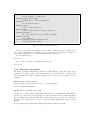
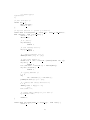
The XML meta-data allows to associate C functions to these handlers. As an example, create
a new file containing the following code and save it in apps/helloWorld2/hello.c:
/∗
<g e n e r a t o r >
<h a n d l e r s doGet=” d o h e l l o ”/>
</g e n e r a t o r >
∗/
/∗ s i m p l e c o n t e n t s g e n e r a t o r ∗/
s t a t i c char d o h e l l o ( struct a r g s t ∗ a r g s ) {
o u t s t r ( ” Generated H e l l o World ! ” ) ;
return 1 ;
}
You can now access the server at http://192.168.1.2/helloWorld2/hello. On the server
side, the doHello function will be called by Smews when a the response to the client request has
to be generated. The out_str function outputs a string as the HTTP response (a detailed list of
the functions provided by Smews to Web applications is given in Table 3.3, page 21).
3.2.2
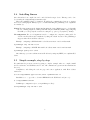
Parsing URL arguments
Smews allows to parse URL arguments before calling the doGet handler. This parsing is processed
in the kernel, so it is quite efficient and requires few memory. The format of the arguments are
defined statically. At compile-time, a parsing automaton is generated for every dynamic Web
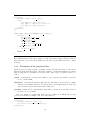
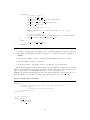
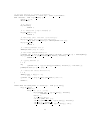
resources, allowing an efficient arguments parsing. Here is an example where URL arguments are
parsed then sent as an HTTP response:
9