1
ANALITE NEP9000 and NEP9500 Series Turbidity Probe User Manual
Introduction
Thank you for purchasing an ANALITE NEP9000 or NEP9500 series turbidity probe. It will give you years of service if
you install and maintain it according to guidelines set out in this Manual.
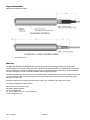
The ANALITE NEP9000 and NEP9500 series of turbidity probes are an enhanced version of our successful ANALITE
190 and 195 series probes. They offer better performance, more output options and greater ease of deployment yet
are available in the same mechanical package (G version).
The ANALITE NEP9000 and NEP9500 series turbidity probes are designed for monitoring and process applications
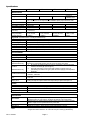
where turbidity levels of up to 3,000NTU may be encountered. Standard ranges are 100NTU, 400NTU and 1,000NTU,
but custom ranges are available.
Specifically, the ANALITE NEP9000 probes are designed for applications that will not allow bio-fouling to build up such
as short monitoring deployment or placement in fast and cold running water. The ANALITE NEP9500 probes however,
with their integral wiper assembly, are designed where bio-fouling or sedimentation buildup is likely. The ANALITE
NEP9000 and NEP9500 series of probes with a stainless steel case may be submerged to a depth of 100 meters
(approx. 330 feet). The composite case version is rated to 30 meters (approx 100 feet).
The ANALITE NEP9000 and NEP9500 probes use 90° optics and employs infrared light in accordance with ISO7027.
All probes use a unique modulation technique that ensures almost total rejection of ambient light conditions as well as
a unique microprocessor controlled differential sample and hold circuit for enhanced performance particularly at low
turbidity levels.
Applications
The applications that the ANALITE NEP9000 and NEP9500 probes are so extensive and too numerous to elaborate
on in this document but generally they include:
1) Monitoring of streams and rivers.
2) Monitoring of water storage bodies including stratification studies.
3) Intermediate and final effluent treatment monitoring.
4) Hydrological run off studies.
5) Ground and bore water analysis.
6) Drinking water filtration efficiency.
7) Industrial process monitoring.
8) Sludge and dredge monitoring.
9) Sediment load monitoring.
Which model is best used is dependent on the application, the measuring environment, the logging equipment and the
monitoring period (deployment times) required.
The ANALITE turbidity probes are not suitable in situations where they may be abraded by large particles such as
sand and under these circumstances the reading may become erratic due to the large particles passing the optic
sensor. Measuring turbidity under these circumstances will require a stilling well to allow the sand particles to settle
away from the optic sensor in the probe tip.
Page V2.21 © 2007