1
-i
-o
-p
-s
-t
-x
it.polito.spi2java.spiWrapperSR
./testCode/andrew/andrewPBGeneratedJava/
andrewPBGeneratedJava
./testData/andrew/andrewPB.css
./data/javaGenerator/
./testData/andrew/andrewPBFinal.xml
In this case, the generated files are:
pB 0 Main.java : contains the main that starts a server process, listening for
clients.
pB 0 Callback.java : contains the code that is called once a client request has
been accepted. This code initializes the parameters of the protocol and
invokes the protocol and then the application.
pB 0 Protocol.java : contains the implementation of a protocol session.
pB 0 Application.java : contains the skeleton of an application that is invoked after each protocol session execution.
It is worth noting that the Java code generator does not know what are
the values of the protocol parameters and, hence, their initialization must be
manually provided. Therefore, if you try to run the generated code without
providing parameters, the generated code execution stops, even before the code
actually implementing the spi calculus model is run. So, in order to initialize
the parameters, with respect to the client process of the Andrew protocol, the
pA 0 Main.java file needs to be modified. In particular, it is necessary to change
these statements
Message M_0 = null;
Identifier A_0 = null;
Identifier B_0 = null;
with, for example, the following statements
Message M_0 = new MessageSR("My message".getBytes());
Identifier A_0 = new IdentifierSR("A Role");
Identifier B_0 = new IdentifierSR("B Role");
It is worth noting that the new operators used in these statements refer
to target classes that provide concrete data types, i.e. classes that include the
implementation of an encoding layer (e.g. the MessageSR and the IdentifierSR).
Classes belonging to the it.polito.spiWrapper package, such as Message, cannot
be instantiated, because they are abstract classes. In this case, the classes using
Java Serialization as the default encoding layer have been used (i.e. classes
belonging to the it.polito.spiWrapperSR package). The names of these classes
slightly differ from those included in the it.polito.spiWrapper package, because
their name ends with the SR post-fix.
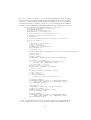
Let us now show how the protocol logic expressed in spi calculus translates into Java code. As an example, an excerpt of the code (part of the
performHandshake() method body) emitted by the spi2Java code generator
is reported below. This code implements the refined spi calculus model of the
client in its prototype version, that uses the default encoding layer. It is worth
noting that the spi2Java code generator has automatically added comments to
21