1
Chapter 2. Reference
2.5 NMR Menu
2.5.1 Dipolar Second Moment
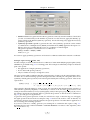
This program option calculates dipolar second moments for single crystal or powder samples, using
coordinates supplied in a separate file or in the editor window of Trafo. The coordinates must be
Cartesian coordinates (p. 20).
First, it is necessary to specify the spin system in question. For that purpose, you need to specify
the isotope corresponding to the observed nucleus. It is assumed that the first atom specified in the
input data by a coordinate triple corresponds to this observed nucleus.
Secondly, the isotope of the coupled nucleus is specified. The abundance of this isotope is then
automatically set to the natural abundance of this isotope, but can be modified to reflect the actual
level of enrichment, if any. It is assumed that all coordinates after the first atom, the observed nucleus,
belong to this coupled nucleus. The dipolar second moment of a system where only a fraction f of
the crystal sites is occupied by nuclear spins is proportional to this fraction f [6].
If desired, a cutoff distance can be specified. Any nucleus that is more remote than the cutoff distance
is not included in the calculation. This is useful if the convergence of the calculation is to be tested
but only one input file is used.
The type of moment calculation specifies whether the calculation should be performed for a powder
or single crystal sample.
Single Crystals
In the case of a single crystal sample, the orientation of the magnetic field needs to be specified. This
is done in a way suitable for single−crystal NMR rotation patterns.
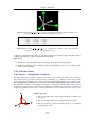
The orientation of the rotation progress in the Cartesian frame of reference is specified by Euler
angles (p. 24), where α and β could also be considered as polar angles describing the orientation of
the rotation axis, the z axis, while γ marks the rotation progress, where the direction of the external
magnetic field is parallel to the y axis. An additional constant phase angle φ for γ can be specified;
this phase angle is not considered in the output. The actual value of γ is calculated according to:
γ = γ(start) + i ∗ γ(incr) + φ
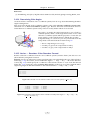
The sense of rotation specifies whether the field moves as in a single−crystal NMR experiment, i.e.
the physical, counter−clockwise rotation of the crystal actually corresponds to a clockwise rotation
of the magnetic field B0 in the interaction frame.
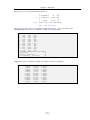
The dipolar second moment for a heteronuclear spin system is calculated according to:
— 29 —
May 14, 2015