1
d. Equalize to complete a recharge of the battery in a minimum length of time following an emergency discharge.
NOTE: Time periods listed in Tables d and E are for cell
temperatures from 70°F (21°C) to 90°F (32°C). For temperatures 55°F (13°C) to 69°F (20.5°C) double the number of
hours. For temperatures 40°F (4°C) to 54°F (12°C) use four
times the number of hours.
E. If accurate quarterly records are maintained (See
Section 14.0) and the individual cell voltages and teperature corrected specific gravities show no increase
instead from the previous quarterly readings, equalizing
may be deferred. (See Section 11.2)
F.
10.3 Equalizing Individual Cells
When only a few cells in a battery require equalizing, and
system voltage limitations do not permit raising the battery
voltage up to a recommended equalizing voltage, a separate voltage regulated charger may be used on the affected
cells.
Equalize once a year even though preceding conditions
did not require. (lead-calcium types floated per paragraph A, may not require annual equalizing).
10.2 Equalizing Charge Method
Constant voltage charging is the preferred method for giving
an equalizing charge. determine the maximum voltage that
may be applied to system equipment. This voltage, divided
by the number of cells connected in series, will establish the
maximum voltage per cell that may be used to perform the
equalizing charge in the shortest period of time.
The charger must have complete AC line isolation and
should be paralleled across the below normal cell. Select
the equalizing voltage values listed in Tables d or E for the
type cell involved. The hours of equalizing may have to be
increased from listed values before stabilization of cell voltage and specific gravity is achieved, especially where below
normal condition has existed for a prolonged period.
For lead-antimony types, refer to Table d and for lead-calcium type, refer to Table E to obtain various voltage and associated time period recommended.
CAUTION!
The recommended time periods below are considered minimum. raise the voltage to the maximum value permitted by
the system equipment. When charging current has tapered
and stabilized (no further reduction for three hours), charge
for the hours shown in the appropriate table and for the battery temperature, at the time of stabilization, until the lowest
cell voltage ceases to rise. Monitoring of cell voltages
should be started during the latter 10% of the applicable
time period to determine the lowest cell in battery.
WhEN INdIvIdUAl ChArGEr IS rEMovEd
FroM CEll WhICh hAS BEEN EQUAlIZEd,
A droP IN volTAGE BEloW ThE AvErAGE
STrING volTAGE MAy oCCUr. ThIS IS
NorMAl, dUE To ThE EXCESS INTErNAl
CEll GASES PrESENT. AS ThESE EXCESS
GASES dISlodGE FroM INTErNAl CEll
CoMPoNENTS, ThE CEll volTAGE WIll
rISE GrAdUAlly, WhICh MAy TAKE FroM
TWo To FoUr WEEKS.
EQUALIZING CHARGE
recommended voltages and Time Periods
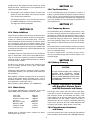
TABLE D
lead-Antimony Types
Cell volts
2.24
2.27
2.30
2.33
2.36
2.39
2.42
2.45
2.48
Cell volts
2.24
2.27
2.30
2.33
2.36
2.39
2.42
2.45
2.48
Time-hrs.
1.215
sp. gr.
80
60
48
36
30
24
—
—
—
TABLE E
lead-Calcium Types
Time-hrs.
1.215
sp. gr.
222
166
105
74
50
34
—
—
—
Time-hrs.
1.250
sp. gr.
—
—
—
166
118
80
54
36
—
Time-hrs.
1.250
sp. gr.
—
—
—
58
51
39
29
26
24
Time-hr.s
1.300
sp. gr.
—
—
—
—
200
134
91
62
42
10.4 Equalizing Charge—Electrolyte
Levels
A battery which has electrolyte levels at the high level line
while on a float and then placed on equalizing charge will
result in a rise in electrolyte above the high level line. This
is a normal condition. do NoT remove any electrolyte as
the levels will return to their former condition when the battery is returned to normal float. removal of the electrolyte
with subsequent restoration to proper electrolyte levels by
water addition could result in variations or sub-normal specific gravity values.
SECTION 11
11.0 Specific Gravity
9
In a lead-acid cell, the electrolyte is a dilute solution of water
and sulfuric acid. Specific gravity is a measure of the weight
of acid in the electrolyte as compared to an equal volume of
water. Therefore, electrolyte with a specific gravity of 1.215
means it is 1.215 times heavier than an equal volume of
water which has a specific gravity of 1.000.