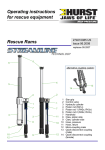
1
Operating instructions for rescue equipment
Electrically insulated
Cutters and Combi Tools
2
3
LKS 35 FI:
7
1
8
9
14
Mono-coupling
system:
4
10
Quick-disconnect
coupling system:
1
7
8
9
2
6
LS 330 FI:
3
12
11
4
LS 311 FI:
13
5
1
2
3
4
5
6
7
Star grip
Tool body
Handle
Protection hose
Blade arm
Combi blade arm
Handhold
8
9
10
11
12
13
14
Pressure hose line
Return hose line
Mono-coupling nipple
Plug coupling nipple
Plug coupling sleeve
Protection box for plug coupling
Protection box for mono-coupling
5
172075085 GB
Edition 10.2010
(Translation of the original operating instructions)
Contents
Page
1. Hazard classes
4
2. Product safety
5
3. Proper use
8
4. Description of the functions
9
4.1 Description 9
4.2 Circuit diagram 9
4.3 Control of working movements
9
4.4 Hydraulic supply
10
4.5 Hose lines
10
5. Connecting the equipment
10
5.1 General points 5.2 Coupling the mono-couplings
11
5.3 Coupling the plug couplings
12
10
6. Operation
13
6.1 Preparatory actions
13
6.2 Operating the star grip (Item 1 on cover sheet)
13
7. Cutting, spreading, pulling and squeezing
14
7.1 Safety instructions 14
7.2 Cutting 14
7.3 Spreading (combi tools only)
15
7.4 Pulling (combi tools only)
16
7.5 Squeezing (combi tools only)
16
8. Dismantling the equipment / deactivation following operation
17
8.1 Cutting or combi tool
17
8.2 Hydraulic unit 17
8.3 Hose lines
17
9. Maintenance and service
17
9.1 Cutting / combi tool, complete
18
9.2 Safety guards
18
10. Repairs
19
19
10.1 General points 10.2 Preventative service
20
10.3 Repairs
21
11. Troubleshooting
21
2
12. Technical Data
24
12.1 Cutting tools 24
12.2 Combi tools 26
12.3 Tightening torques for pivot bolt
26
12.4 Cutting performance 27
12.5 Hydraulic fluid recommendations
27
12.6 Operating and storage temperature ranges
27
13. EC Declarations of conformity
28
13.1 Cutting tools
28
13.2 Combi tools
30
14. Notes
31
3
1. Hazard classes
We distinguish between various categories of safety notes. The table below gives you an
overview of the assignment of symbols (pictograms) and key words to the specific hazard
and possible consequences.
Damage / injury to Key word
Definition
Consequences
DANGER!
Immediate
danger
Death or major
injury
WARNING!
Potentially
dangerous
situation
Potential death or
major injury
CAUTION!
Less dangerous
situation
Minor or slight
injury
Danger of
damage
to device /
environment
Damage to the
equipment,
damage to the
environment,
damage to
surrounding
materials
device
human
Pictogram
-
CAUTION!
Advice for
application
and other
REMARK
important / useful
information and
advice
Wear helmet with face protection
Wear safety gloves
Wear safety shoes
Proper recycling
Observe principles of environmental protection
Read and observe operating instructions
4
No injury /
damage to
persons /
environment /
equipment
2. Product safety
LUKAS products are developed and manufactured in order to guarantee the best performance
and quality when used properly.
Operator safety is the most important aspect of the product design. Moreover, the operating
instructions are intended to help the safe use of LUKAS products.
The generally applicable, legal and other binding regulations pertaining to the prevention of
accidents and protection of the environment apply and are to be implemented in addition to
the operating instructions.
The equipment may only be operated by persons with appropriate training in the safety
aspects of such equipment – otherwise, there is a danger of injury occurring.
We would like to point out to all users that they should read carefully the operating instructions
and the instructions contained therein before they use the equipment, and that they should
carefully follow such.
We further recommend that a qualified trainer train you in the use of the product.
WARNING / CAUTION!
The operating instructions for the hoses, the accessories and the connected
hydraulic equipment must also be observed!
Even if you have already received instructions on how to use the equipment, you should still
read the following safety notes through again.
WARNING / CAUTION!
Ensure that the accessories and connected equipment used are suitable for
the max. operating pressure!
Please ensure that no body
parts or clothing get stuck
between the visibly moving
parts (e.g. blade arms).
Wear protective clothing,
safety helmet with visor,
protective gloves
It is prohibited to work under
load if this load is lifted
exclusively by hydraulic
equipment. If this work
is absolutely imperative,
additional mechanical
supports must be used.
Inspect the equipment before
and after use for visible
defects or damage
The responsible department
is to be informed immediately
of any changes (including to
the operating behaviour)! If
necessary, the equipment is
to be deactivated immediately
and secured!
Inspect all cables, hoses
and screwed connections
for leaks and externally
visible damage! If necessary,
repair immediately! Squirting
hydraulic fluid can result in
injuries and fires.
5
In the event of malfunctions,
immediately deactivate the
equipment and secure it. The
malfunction is to be repaired
immediately.
Do not carry out any changes
(additions or conversions)
to the equipment without
obtaining the prior approval of
LUKAS.
Observe all safety and danger
notes on the equipment and
in the operating instructions.
All safety and danger notes
on the equipment are to be
kept complete in a legible
condition.
Any mode of operation which
impairs safety and/or stability
of the equipment is forbidden!
Comply with all specified
dates or dates specified in
the operating instructions
pertaining to regular controls /
inspections on the equipment.
Safety devices may never be
deactivated!
The maximum permitted
operating pressure noted on
the equipment must not be
exceeded.
Before the equipment is
switched on/started up, and
during its operation, it must
be ensured that nobody is
endangered by the operation
of the equipment.
Only original LUKAS
accessories and spare parts
may be used for repairs.
Please ensure that, when
working with this equipment
or during transportation of
such, you don’t get stuck in
the looped hoses and trip.
Please note that, when
cutting or spreading, tearing
or breaking can cause
falling material, or sudden
removal of such can cause
it to suddenly catapult off:
necessary precautions need
to be taken.
Only touch any broken-off
parts or the cut-off parts
wearing protective gloves,
since the torn / cut edges can
be very sharp.
The equipment is filled
with a hydraulic fluid.
These hydraulic fluids can
be dangerous to health if
swallowed or their vapours
inhaled. Direct contact with
the skin is to be avoided for
the same reason. Please also
note that hydraulic liquids can
also have a negative effect on
biological systems.
6
When working with or storing
the equipment, ensure that
the function and the safety
of the equipment are not
impaired by the effects of
stark external temperatures
or that the equipment is
damaged in any way. Please
note that the equipment can
also heat up over a long
period of use.
Ensure adequate lighting
when you are working.
Before transporting the
equipment, always ensure
that the accessories are
positioned such that they
cannot cause an accident.
Always keep these operating
instructions within reach
where the equipment is used.
Ensure the proper disposal of
all removed parts, left-over oil
and hydraulic fluid as well as
packaging materials!
The generally applicable, legal and other binding national and international regulations
pertaining to the prevention of accidents and protection of the environment apply and are to
be implemented in addition to the operating instructions.
WA R N IN G / C A U T I O N!
The equipment is to be used exclusively for the purpose stated in the operating
instructions (see chapter “Proper Use”). Any other or further use is not considered
proper use. The manufacturer / supplier is not liable for any damages resulting from improper
use. The user bears sole responsibility for such.
Observance of the operating instructions and compliance with the inspection and maintenance
conditions are part of the proper use.
Never work when you are overtired or intoxicated!
7
3. Proper use
The electrically insulated LUKAS "LKS" combi tools and electrically insulated LUKAS "LS"
cutters are designed specifically for rescuing victims of traffic, rail or air accidents and for
making rescues from buildings. They serve the purpose of freeing injured people in accidents
e. g. by cutting doors, roof bars and hinges. By using the LUKAS combi tools, trapped
persons can also be freed e. g. by spreading doors and / or by removing obstacles with the
aid of a chainset. Basically, the combi tools can be used to cut, pull, spread, squeeze and lift.
Basically, LUKAS cutters can only be used to cut objects.
All objects which are to be worked on are to be secured using stable supports or
substructures.
The electrically insulated LUKAS tools are protected against power arcing (between the
object being worked on and the operator) of up to 1,000 V (AC) or 1,500 V (DC). This means
that objects under live voltage can be cut, squashed or spread providing this maximum
electrical voltage is not exceeded.
When working on such objects you must ensure that you do not come directly into contact
with metallic components of the rescue tool (e.g. the cutter) as these may be live.
A protection box is provided specially for the couplings of the electrically insulated tools to
protect the operator from power surges at these points.
LUKAS cutting and combi tools can, in principle, be used underwater at depths of up to 40m
(131 ft), but live parts must not be cut or crushed underwater.
CAUTION!
When working underwater you must however be extremely careful not to cause
leaks as this can damage the environment.
WARNING / CAUTION!
All objects which are to be worked on are to be secured using stable supports or
substructures.
WARNING / CAUTION!
The following may not be cut / squeezed:
- current carrying cables whose electrical voltage is higher than the dielectrical strength of the electrically insulated tools.
- pretensioned and hardened parts such as springs, spring steels,
steering columns and rollers
- tubes / hoses under gas or liquid pressure,
- compound materials (steel/concrete)
- explosive bodies such as airbag cartouches
NEVER operate the rescue equipment at a higher operating pressure than that
stated in the chapter “Technical data”. A higher setting can result in material
damage and/or injuries.
You can obtain accessories for the rescue tools from your authorisied LUKAS dealer!
8
4. Description of the functions
4.1 Description
The equipment is designed such that, via a hydraulically activated piston, two equal, opposite
blade arms are symmetrically opened / closed by mechanical joints, thereby spreading,
squeezing, pulling or cutting objects.
All cutters and combi tools ensure full load-holding function when disconnected from the
hydraulic supply (e. g. when being unintentional decoupled; defective hose, and so on).
The tools are protected by special handles, the special protection hose and protection box
for the couplings that protect the operator from power arcing.
4.2 Circuit diagram
To enable comprehension of the function, a simplified hydraulic cylinder of the rescue
equipment (A) + hand valve (B) are depicted here.
cut / close / pulling /
squeezing
A
spreading /
opening
B
4.3 Control of working movements
The movement of the piston is controlled via the star grip for the fitted valve (see cover sheet
Item 1 and Figure 3 below).
Fig. 3
star grip
9
4.4 Hydraulic supply
A LUKAS motor pump or hand pump only may be used to drive the equipment.
If the pump unit is a different make, you must make sure that it complies with LUKAS
specifications, otherwise potential dangers may occur which are not the responsibility of
LUKAS. Ensure in particular that the authorised operating pressure for LUKAS equipment
is not exceeded.
REMARK:
Before you use pumps from a different manufacturer, you must contact LUKAS
or an authorised dealer.
4.5 Hose lines
The pump unit and rescue tool are connected via special hose lines that also prevent power
arcing.
5. Connecting the equipment
5.1 General points
The tool is equipped with two hose lines; they are connected to the pump unit via two hoses.
All hose assemblies are marked with a colour and have couplings to enable unmistakable
connection.
WARNING / CAUTION!
To protect from electrical power arcing, the coupling parts must be always be
enclosed inside an appropriate LUKAS protection box before starting the rescue
work!!
REMARK:
The devices can be equipped with different coupling systems.
They differ only by the article number and not by the designation.
Of course the coupling systems can also be reequipped at a later time.
10
WARNING / CAUTION!
Before connecting the equipment you have to pay attention that all
used components are suitable to the max operation pressure of
the pump unit! In the case of doubt you have to inquire LUKAS
directly!
5.2 Coupling the mono-couplings
The equipment is connected to the hydraulic pump via mono-coupling halves (male and
female).
dust protection caps
mono-coupling halve
(male)
mono-coupling halve
(female)
Before coupling, remove dust protection caps, then connect male and female, and turn the
locking sleeve of the female to direction „1“ until the locking sleeve locks into place. The
connection has now been established and secured. Decoupling is by turning the locking
sleeve to direction „0“.
The equipment can also be coupled under pressure provided the connected equipment is
not activated.
REMARK:
We recommend coupling the coupling halves in a pressureless state, when
working in areas with low ambient temperature and the usage of extension hose
assemblies / hose reels, otherwise coupling could need very high expenditure
of force.
To protect them from dust, the accompanying dust protection caps must be put back on.
WARNING / CAUTION!
The mono-couplings may not be screwed off the hose assemblies and / or the
hose assemblies be confused!
11
5.3 Coupling the plug couplings
The equipment is connected to the hydraulic pump via quick-disconnect-coupling halves
(male and female).
X
Y
Before coupling unlock the connect socket by turning the sleeve into position X. Retract sleeve
and connect plug and socket. Release sleeve and turn it into position Y. The connection has
now been established and secured. Uncoupling is done in the reverse order.
CAUTION!
Always connect the return line first and afterwards the supply line!
REMARK:
Coupling of the devices is only possible, when the hoses are depressurized.
To protect them from dust, the accompanying dust protection caps must be put back on.
WARNING / CAUTION!
Some of the plug couplings have special functions and must therefore not be
unscrewed from the hose lines and/or swapped round!
12
6.1 Preparatory actions
6.1.1
6. Operation
Initial commissioning
Before commissioning and following repairs, the equipment must be deaerated.
- Connect the equipment to the hydraulic pump (see chapter “Connecting the equipment”).
- Open / close the blade arms of the equipment without any load at least twice (see
chapter “Operation of the star grip”).
REMARK:
We recommend that during the deaeration, the attached aggregate for the hydraulic
supply should stand on a higher level than the body of the rescue tool.
Recommended procedure for the deaeration of the rescue tool:
1.) Fully open and close the tool once with the blade arms pointing upwards.
2.) Fully open and close the tool once with the blade arms facing downwards.
3.) Fully open and close the tool once with the blade arms pointing upwards.
4.) Fully open and close the tool once with the blade arms facing downwards.
6.1.2
Checking the pump unit
See separate operating instructions for the relevant unit (or the hand pump).
REMARK:
Before each start-up of the hydraulic unit you have to make sure that the actuating
valves are set to depressurized circulation.
REMARK:
Before coupling the quick-disconnect couplings, the actuating valves of the
hydraulic unit are set to depressurized circulation.
If you use mono-couplings, you can also couple when the hoses are pressurized!
6.2 Operating the star grip (Item 1 on cover sheet)
Opening the tool (
):
Turn the star grip in a clockwise direction (in the direction of the
relevant symbol) and keep in this position.
Closing the tool (
):
Turn the star grip in an counterclockwise direction (in the
direction of the relevant symbol) and keep in this position.
“Dead-man’s” function:
Following release, the star grip automatically returns to the
central position, guaranteeing the full load-holding.
13
7. Cutting, spreading, pulling and squeezing
7.1 Safety instructions
Before rescue works can commence, the position of the obstacle must be stabilised.
You must ensure an adequate substructure and / or adequate support of the object.
World-wide, safety guidelines pertaining to the specific country are to be observed and
complied with. In the Federal Republic of Germany, regular safety inspections according
to the GUV legal accident insurance regulations (Gesetzlichen Unfallversicherung) are
mandatory.
In the event of a potentially explosive situation, it is not permitted to use motor pumps (danger
of the formation of sparks). In such cases, hand pumps are to be used.
The following are to be worn when working with the rescue equipment:
- protective clothing,
- safety helmet with visor or protective goggles,
- protective gloves
- and, if necessary, ear protection
Before activating the rescue equipment, always ensure that there is no danger to persons
either involved / uninvolved in the action by the movement of the rescue equipment or by
flying fragments. Further avoid unnecessary damage to property belonging to others, objects
not involved by the rescue equipment / flying fragments.
Reaching between the blade arms is strictly forbidden!
WARNING / CAUTION!
The particular effect of the force of the rescue equipment during operation could
cause pieces of the vehicle to break off or fly off, posing a danger to persons.
Those not involved in the rescue operation should therefore keep at a distance
appropriate to the situation.
7.2 Cutting
The blades must be positioned at a 90° angle to the object to be cut.
90°
FALSE
RIGHT
Higher cutting capacities can be achieved by cutting as close as possible to the blade’s pivot
point.
FALSE
RIGHT
14
During cutting, the gap between the blade tips (in the crosswise direction) may not be
exceeded, otherwise the blade is in danger of breaking:
Cutter / combi tool
LS 311 FI STREAM
LS 330 FI STREAM
LKS 35 FI STREAM
max. gap on the blade tips
[mm] / [in.]
3 / 0.12
3 / 0.12
3 / 0.12
CAUTION!
Avoid cutting particularly high-strength parts of the vehicle’s bodywork (e.g.
side-impact protection): this almost always causes damage to the cutter /
combi tool!
7.3 Spreading (combi tools only)
Use the front area of the tips for increasing the gap only. Full spreading capacity can be
achieved when approximately half of the grooved area of the tips is used. The greatest force
is created in the rear area of the spreading range of the combi blade.
Working surface is too
small, tips slip off.
Only for increasing
the size of a gap (not
suitable for spreading).
Tips get a safe grip.
15
Work with the tips only.
Do not damage the
arms.
7.4 Pulling (combi tools only)
You may only use LUKAS chain sets for pulling purposes.
Before the pulling process can be performed, ensure that the bolt and hook fit correctly to
prevent the chain from slipping.
Only chain sets in perfect condition may be used!
The pull chains are to be inspected at least once per year by an expert!
See separate operating instructions for the relevant LUKAS chain set in order to
correctly attach, affix and use the chain sets.
A
The connection pieces of the LUKAS
chain sets are affixed to the boreholes
A on the blades using load bolts (see
figure, right).
Chain sets:
for LKS 35 FI:
KSV 8
7.5 Squeezing (combi tools only)
Basically, squeezing can only be carried out in the area of the tips (see figure below).
Squeezing area
16
8. Dismantling the equipment / deactivation following operation
8.1 Cutting or combi tool
Once work has been completed, the blade arms are to be closed so that there is a tip distance
of just a few mm. This relieves the hydraulic and mechanical strain on the equipment.
REMARK:
Never store the cutter / combi tool with fully closed blade arms! The complete
closure of the blade arms can cause hydraulic and mechanical stress to build
up again.
Free the rescue equipment of any stubborn dirt which may have become attached
during use.
If the equipment is to be stored for a longer period of time, the exterior is to be
cleaned completely and the mechanically mobile parts are to be lubricated.
Avoid storing the rescue equipment in a damp environment.
See also the chapter “Safety regulations for hoses”.
8.2 Hydraulic unit
Upon completion of work, the unit must be deactivated.
8.3 Hose lines
First of all, decouple the pressure hose then the return hose as described in chapter
“Connecting the equipment”.
Ensure that you put the dust protection caps back on to the couplings.
9. Maintenance and service
The equipment are subject to very high mechanical stresses. A visual inspection is to be
carried out after every use: however, at least one visual inspection is to be carried out every
six months. These inspections enable the early detection of wear and tear, which means
that punctual replacement of this wearing parts prevents breakages from occurring. Also
regularly check the torque of the pivot bolt. (Torque MA see “Technical Data”).
Every three years also a crack test of the blades are essential. Therefore a special crack
testing kit is is available.
Every three years or if there is any doubt regarding the safety or reliability of the equipment,
a function test must also be performed. (Please also observe the relevant valid national and
international regulations pertaining to service intervals of rescue equipment). In the Federal
Republic of Germany, regular safety inspections according to the GUV legal accident
insurance regulations (Gesetzlichen Unfallversicherung) are mandatory.
CAUTION!
Clean off any dirt before controlling the equipment!
WARNING / CAUTION!
In order to carry out maintenance and repair works, tools appropriate for the job
and personal protecting equipment are essential.
17
9.1 Cutting / combi tool, complete
Inspections to be carried out:
Visual inspection
Cutter / combi tool
• Opening width of the blade arms on the tips (see chapter “Technical data”),
• General tightness (leaks),
• Operability of the star grip,
• Existence and stability of handle,
• Labels completely existent and legibly,
• Covers in perfect condition,
• Torque control of the pivot bolt (torque MA see "Technical data"),
• Couplings must be easy to couple,
• Dust protection caps must be available.
Blade arms
• Blade arms free of tears and without any chipped spots or deformations on the cutting
surfaces,
• Cutting surfaces go on top of each other without making contact,
• Bolts and retaining rings of the blade arms must be present and in correct working order,
• Grooving of the tips must be clean and squared, and not have any tears (applies to combi
tools).
Hoses (see also “Safety regulations for hydraulic hoses”)
• Visual control for visible damage,
• Control for leaks.
Function test
• Opening and closing function flawlessly upon activation of the star grip,
• no suspicious noises,
• no further movement of the blade arms upon interruption of the valve activation during the
process (“dead-man’s” function).
9.2 Safety guards
• Control of the protective equipment on / around the rescue equipment, especially the
hand guard of the moveable parts (they must be free of tears!).
• If there is any doubt concerning the power arcing resistance, or in the event of damage to
the protection hose, an additional insulation test is required. This test must be carried out
taking all applicable laws, standards and regulations into consideration.
WARNING / CAUTION!
Insulation tests must be carried out using appropriate measuring equipment and
in compliance with the applicable laws, standards and regulations, or must be
carried out by LUKAS directly.
18
10.1 General points
10. Repairs
Servicing may only be carried out by the manufacturer or personnel trained by the
manufacturer and by authorised LUKAS dealers.
Only LUKAS spare parts may be used to replace all components (see spare parts list) since
special tools, assembly advice, safety aspects, inspections might have to complied with (see
also chapter “Maintenance and Service”).
During assembly, ensure the complete cleanliness of all components, since dirt can
damage the rescue equipment!
WARNING / CAUTION!
Protective clothes must be worn when repairs are being carried out, since parts
of the units can also be pressurised in an idle state.
REMARK:
Please always return the guarantee registration card to LUKAS Hydraulik GmbH.
Only then are you entitled to the extended guarantee.
REMARK:
Before you use couplings from a different company, you must contact LUKAS or
an authorised dealer.
REMARK when using the quick-disconnect-coupling system:
Overpressure protection of the rescue equipment
(model with yellow coupling nipple on the return hose)
If the equipment’s short hoses are not connected to a unit, temperature
increases can inadvertently cause pressure to build up in the equipment. Hence,
the return hose of the equipment is equipped with a safety coupling (quickdisconnect coupling male, yellow). Unwanted overpressure (approx. 1.5 Mpa) is
automatically released via this nipple: hydraulic fluid leaks.
Should an hydraulic fluid leak on the coupling male be more frequent, please
contact your dealer or LUKAS itself.
If couplings from a different company are used which do not have this function,
the overpressure protection can react in the valve of the rescue equipment.
Hydraulic fluid leaks in the area of the star grip. Following the reduction in
pressure, the valve is once again tight.
Should the valve leak permanently, please immediately contact your dealer or
LUKAS itself.
CAUTION!
Because LUKAS rescue equipments are appropriate for highest achievements,
only components may be exchanged, which are specified in the spare parts list
of the appropriate equipment.
Further components of the equipment may only be exchanged, when:
- you have participated on a appropriate LUKAS service training.
- you have the express permission of LUKAS customer service (after inquiry,
assessment prior to granting of permission. All cases must be assessed
individually!)
19
10.2 Preventative service
10.2.1 Note concerning care
The exterior of the equipment is to be cleaned from time to time in order to protect it from
external corrosion. Oil is to be applied to the metallic surfaces.
10.2.2 Functional and loading test
If there is any doubt regarding the safety or reliability of the equipment, a function and load
test must also be performed.
LUKAS offers appropriate test equipment to this end.
10.2.3 Replacing the hydraulic fluid
- The hydraulic fluid must be changed after the equipment has been used approx. 200
times / after three years at the latest.
- It must always be changed when the hydraulic fluid for the accompanying pump (motor/
hand pump) is changed. This ensures that the fresh fluid is not contaminated by used fluid
in the rescue tool.
Procedure:
1. Close blade arms (until the tips are almost touching).
2. Change the hydraulic fluid of the pump. Please observe the separate operating instructions
for the pump being used!
3. Screw off the return hose on the pump:
- if the hose is connected to the pump directly:
completely unscrew the connection nut of the connection piece of the blue return hose.
- if the hose is connected to the pump via a mono-coupling:
remove the cover from the mono-coupling (male).
completely unscrew the connection nut of the blue returnhose on the mono-coupling (male).
- if the hose is connected to the pump using a plug coupling:
completely release the union nut of the hose line from the plug coupling nipple
of the blue return line.
4. Put the return hose into a separate collecting basin for the hydraulic fluid still in the equipment.
5. Slowly open the tool (the pump must be working during this time). The old hydraulic fluid
from the ring space side runs via the return hose into the separate collecting basin, and is
to be disposed of in the same manner as the old hydraulic fluid of the pump.
6. Switch the pump off (motor pump) / no longer activate it (e.g. hand pump).
7. Reconnect the return hose to the pump:
- if the hose is connected directly to the pump:
screw the connection nut of the connection piece of the blue return hose
(Please observe the necessary torque of MA = 40 Nm!)
- if the hose is connected to the pump via a mono-coupling:
screw the connection nut of the blue return hose
(Please observe the necessary torque of MA = 40 Nm!)
Pull back the cover on the couplings as far as the limit stop.
- if the hose is connected to the pump using a plug coupling:
Screw the union nut of the hose line back onto the plug coupling nipple
of the blue return line.
(Please observe the necessary torque of MA = 35 Nm!)
8. Deaerate the rescue tool as described in the chapter “Preparatory measures”.
20
10.3 Repairs
Since repairs to the electrically insulated rescue tools must always be concluded by testing
and confirmation of the minimum electrical arcing resistance, repairs may only be carried out
by authorised specialised dealers or by LUKAS directly.
11. Troubleshooting
Trouble
Control
Blade arms move
Are the hoses
slowly or jerkily when connected
activated
properly?
Does the pump
unit work?
Device doesn’t
Check the
perform at its given
hydraulic fluid level
power
in the supplying
pump
Following release,
Cover damaged
the star grip doesn’t
or star grip hard to
return to the central
move?
position
Cause
Solution
Air in the hydraulic Deaerate pump
system
system
Insufficient
hydraulic fluid in
the pump
Top up hydraulic fluid,
deaerate
Damage to the
torsion spring for
reset
Soiled valve or
star grip
Repair by an
authorised dealer, by
personnel specially
trained by LUKAS, or
by LUKAS itself
Defective valve
Other mechanical
damage (e. g. star
grip)
Pressure too high
(e.g. caused by
too-high ambient
temperature)
with mono-couplingsystem: Hoses
cannot be coupled
Set hydraulic pump
to pressureless
circulation
Coupling defective Coupling needs to be
replaced immediately
with monocoupling-system:
It is frequently not
possible to couple
hose assemblies
with quickdisconnect-couplingsystem: Hoses
cannot be coupled
Hydraulic fluid leak
on the hoses or the
fixing-ins
Control the
degree of viscosity
and application
temperature of
the used hydraulic
fluid
Hydraulic fluid
not adapted to
the application
situation
Hydraulic fluid
must be replaced
(see chapter
“Recommended
Hydraulic fluids”)
Is the pump
working?
Pressurized
Relieve pump
Coupling defective Coupling needs to be
replaced immediately
Are the hoses
defective?
Leak, possible
damage
Coupling defective Coupling needs to be
replaced immediately
21
Replace hoses
Trouble
Damages on the
surface of the
hydraulic hoses
Control
Hydraulic fluid leaks
on the piston rod
Leak on the handhold Increase load?
(combi tool when
spreading)
Cause
Solution
Mechanical
Replace hoses
damages or
contact with
aggressive agents
Defective rod seal Repair by an
authorised dealer, by
personnel specially
Damage to the
trained by LUKAS, or
piston
by LUKAS itself
Secure the loads and
Load increase
(e.g. something
move them by using
has fallen onto the other tools
part to be lifted,
Move the load
thereby suddenly somewhere else,
increasing the
where the moving
load)
load is lighter
Use supporting
equipment to move
the load.
Does the pressure Pressure release
in the Rescue tool.
set on the pump
comply with
the maximum
permissible
pressure on
the rescue
equipment?
Following the
reduction in pressure,
no further leak is
present.
Should, however,
there be a further
leak on the handhold,
immediately
deactivate the rescue
equipment, and
contact an authorised
dealer or LUKAS
itself.
Hoses in handhold Hoses in handhold Tighten hoses.
loose?
not tightened
Check the
Supply and return Reconnect the
connections of the connection of the hoses of the monomono-coupling
mono-coupling
cooupling (female) in
(female)
(female) inverted the right way
Especially by usage
of quick-disconnectcouplings: Leak on
the handhold
Is the return
hose connected
correctly?
Return hose is not Re-connect the return
coupled correctly hose and secure it.
or not connected.
22
Trouble
Control
Cause
Especially by usage check the
hose connection
of mono-couplings:
connections of the to the couplings
Leak on the handhold hoses
interchanged
Solution
reconnect the hoses
to the coupling in the
right way
Returnline
disabled
with mono-couplingsystem: Leak in the
couplings
with quickdisconnect-couplingsystem: Leak in the
couplings
Is the coupling
damaged?
disconnect the
returnline from the
coupling, clean it and
reconnect it.
coupling damaged Coupling must be
replaced immediately
Is the coupling
coupling damaged
damaged?
Is the leak only
Safety valve
on the coupling
reacted
male (in uncoupled
status)?
Coupling must be
replaced immediately
After pressure
release there is no
more leakage.
If it isn’t possible to rectify the malfunctions, inform an authorised LUKAS dealer or the
LUKAS customer service department immediately!
The address for the LUKAS customer service department is:
LUKAS Hydraulik GmbH
Weinstraße 39,
Postfach 2560,
D-91058 Erlangen
D-91013 Erlangen
Tel.: (+49) 09131 / 698 - 348
Fax.: (+49) 09131 / 698 - 353
23
12. Technical Data
Since all values are subject to tolerances, minor differences may occur between the data on
your equipment and the data in the following schedules!
12.1 Cutting tools
type
LS 330 FI STREAM
LS 330 FI STREAM
112070000
172070000
ref.no.
dimensions l x w x h
(w/o connection hoses)
max. cutting opening
733 x 210 x 195
[in.]
28.85 x 8.27 x 7.68
[mm]
228
[in.]
8.98
max. cutting force
(rear end of the cutting
surface)
[kN]
616
[lbf.]
138,489
weight incl. hydraulic
fluid
[kg]
17,7
[lbs.]
39.0
max. operating pressure
min. needed volume
of hydraulic fluid
coupling system
*
**
[mm]
[Mpa] *
70
[psi.]
10,153
[l] **
0,098
[gal.-US]
0.026
quick-disconnectcoupling
mono-coupling
1 MPa = 10 bar
Required volume of hydraulic fluid in the hydraulic power pack for operating the tool (differential volume piston/rod side)
24
type
LS 311 FI STREAM
LS 311 FI STREAM
112075000
172075000
ref.no.
dimensions l x w x h
(w/o connection hoses)
697 x 210 x 195
[in.]
27.44 x 8.27 x 7.68
[mm]
150
[in.]
5.91
max. cutting force
(rear end of the cutting
surface)
[kN]
642
[lbf.]
144,335
weight incl. hydraulic
fluid
[kg]
16,9
[lbs.]
37.26
max. cutting opening
max. operating pressure
min. needed volume
of hydraulic fluid
coupling system
*
**
[mm]
[Mpa] *
70
[psi.]
10,153
[l] **
0,098
[gal.-US]
0.026
quick-disconnectcoupling
mono-coupling
1 MPa = 10 bar
Required volume of hydraulic fluid in the hydraulic power pack for operating the tool (differential volume piston/rod side)
25
12.2 Combi tools
type
ref.no.
LKS 35 FI
LKS 35 FI
113070000
173070000
[mm]
dimensions l x w x h
(w/o connection hoses)
762 x 210 x 195
[in.]
30.00 x 8.27 x 7.68
[mm]
max. cutting opening
265
[in.]
10.43
[kN]
max. cutting force
(rear end of the cutting surface) [lbf.]
93,975
[mm]
max. spreading distance
(on the blade tips)
weight incl. hydraulic fluid
min. needed volume
of hydraulic fluid
14.17
[kN]
49,5
[lbf.]
11,129
[kg]
17,0
[lbs.]
37.5
[Mpa] *
70
[psi.]
10,153
[l] **
0,066
[gal.-US]
0.017
coupling system
*
**
360
[in.]
max. spreading force
(25mm from the tips)
max. operating pressure
418
quick-disconnect-coupling
mono-coupling
1 MPa = 10 bar
Required volume of hydraulic fluid in the hydraulic power pack for operating the tool (differential volume piston/rod side)
12.3 Tightening torques for pivot bolt
type
pivot bolt
wrench size
torque
[mm]
LS 311 FI
LS 330 FI
LKS 35 FI
M 24 x 1,5
M 24 x 1,5
M 24 x 1,5
36
36
36
[in.]
1.42
1.42
1.42
[Nm]
120 +10
120 +10
120 +10
[lbf.in.]
1,062 + 89
1,062 + 89
1,062 + 89
26
12.4 Cutting performance
Cutting material
Cutting material dimensions
LS 311 FI
LS 330 FI
LKS 35 FI
max.
max.
max.
[mm]
[mm]
[mm]
[in.]
[in.]
[in.]
Round material steel
(acc. to EN 13204)
33
33
30
1.30
1.30
1.18
Round material steel
(acc. to NFPA 1936)
33
33
30
1.30
1.30
1.18
12.5 Hydraulic fluid recommendations
Mineral oil DIN ISO 6743-4 for LUKAS hydraulic equipment and others
Oil code
HM 10
Viscosity rating
VG 10
Remarks
A
Oil temperature range
-20 .... +55°C
Oil temperature range
-4.0 .... +131°F
Oil code
HM 10
Viscosity rating
VG 10
Remarks
A
recommended viscosity range: 10...200 mm²/s
Supplied with HM 10 DIN ISO 6743-4.
(10…200 cSt.)
CAUTION!
Before using hydraulic fluids, which do not correspond to the above-mentioned
specifications and/or are not purchased from LUKAS, you have to contact
LUKAS itself!
12.6 Operating and storage temperature ranges
Operating temperature
[°C]
-20
…
+55
Ambient temperature
(device in operation)
[°C]
-25
…
+45
Storage temperature
(device not in operation) [°C]
-30
…
+60
[°F]
-4
…
+131
Operating temperature
Ambient temperature
(device in operation)
[°F]
-13
…
+113
Storage temperature
(device not in operation) [°F]
-22
…
+140
27
13. EC Declarations of conformity
13.1 Cutting tools
28
29
13.2 Combi tools
30
14. Notes
31
Please dispose all packaging materials and
dismantled parts properly
LUKAS Hydraulik GmbH
A Unit of IDEX Corporation
Tel.: (+49) 0 91 31 / 698 - 0
Fax.: (+49) 0 91 31 / 698 - 394
e-mail: [email protected]
www.lukas.com
Made in GERMANY
FI_Geräte_BA_GB_172075085_1010.indd
© Copyright 2010 LUKAS Hydraulik GmbH
subject to revision
Weinstraße 39, D-91058 Erlangen