1
S H A R P
Date Revised: Apr. 8. 2008
Date Issued :May. 28.1998
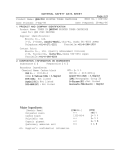
MATERIAL SAFETY DATA SHEET (3/4)
MSDS
No. B-1020
Partition Coefficient, n-Octanol/Water: Not applicable
(*=Based on data for other products with similar ingredients)
Section 10. Stability and Reactivity
Stability: Stable [ X ]
Unstable [ ]
Hazardous Reactions: Dust explosion, like most finely divided organic powders.
Conditions to avoid: Electric discharge, throwing into fire.
Materials to Avoid: Oxidizing materials.
Hazardous Decomposition Products: CO, CO2
Section 11. Toxicological Information
Health Effects from Exposure: No symptoms expected with intended use.
Toxicological Data
Acute Toxicity:
Inhalation, LC50(mg/l): >0.74 (Rat,4hour) *
(This was the highest attainable concentration.)
Ingestion(oral), LD50(mg/kg): >5000 (Rat) *
Dermal, LD50(mg/kg): >2000 (Rat) *
Eye irritation: Non irritant (Rabbit) *
Skin irritation: Non irritant (Rabbit) *
Skin sensitizer: No data available
Mutagenicity: Negative * (AMES test)
(*= Based on data for other products with similar ingredients)
Local Effects: see Chronic Toxicity or Long term Toxicity
Chronic Toxicity or Long Term Toxicity: Prolonged inhalation of excessive dust may cause lung damage. It is attributed to
“lung overloading”, a generic response to excessive amounts of any dust retained in the lungs for a
prolonged interval. Use of this product, as intended, does not result in inhalation of excessive dust.
In a study in rats by chronic inhalation exposure to a typical toner, a mild to moderate degree of lung
fibrosis was observed in 92% of rats in the high concentration(16mg/m³) exposure group, and a minimal
to mild degree of fibrosis was noted in 22% of the animals in the middle(4mg/m³) exposure group. But no
pulmonary change was reported in the lowest(1mg/m³) exposure group, the most relevant level to
potential human exposures.
Carcinogenicity
IARC Monographs: Not listed
NTP(USA): Not listed
OSHA Regulated(USA): Not listed
In 1996 the IARC reevaluated carbon black as a Group 2B carcinogen (possible human carcinogen). This
evaluation is given to Carbon Black for which there is inadequate human evidence, but sufficient animal
evidence. The latter is based upon the development of lung tumors in rats receiving chronic inhalation
exposures to free carbon black at levels that induce particle overload of the lung.
Studies performed in animal models other than rats have not demonstrated an association between carbon
black and lung tumors. Moreover, a two-year cancer bioassay using a typical toner preparation containing
carbon black demonstrated no association between toner exposure and tumor development in rats.
Section 12. Ecological Information
No data are available on the adverse effects of this material on the environment.
Section 13. Disposal Consideration
Appropriate Methods of Disposal
Preparation(community provisions): Waste may be disposed or incinerated under conditions which meet all federal, state and
local environmental regulations.
Contaminated Packaging: Waste may be disposed or incinerated under conditions which meet all federal, state and local