1
Bulletin 71.4:LR128
and plug assembly. Force from the main spring, in
addition to inlet pressure bleeding through the
Type 112 restrictor, provides a downward loading
pressure to keep the main valve diaphragm and plug
assembly tightly shutoff.
When the inlet pressure rises above the set pressure,
the pressure on the pilot diaphragm overcomes the
pilot control spring and opens the pilot valve plug. The
pilot then exhausts the loading pressure from the top
of the main valve diaphragm and plug assembly. The
inlet pressure unbalance overcomes the main spring
force and opens the diaphragm and plug assembly.
The pilot continuously exhausts process fluid when the
inlet pressure is above the set pressure.
As the inlet pressure drops below the set pressure,
the pilot control spring closes the pilot valve plug and
the exhaust to atmosphere stops. Force from the main
spring, along with pilot loading pressure, pushes the
diaphragm and plug assembly onto the tapered edge
seat, producing tight shutoff.
Backpressure Regulator
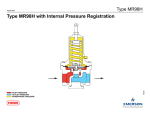
As long as inlet pressure remains below set pressure,
the Type MR98H pilot control spring keeps the pilot
valve plug closed. Force from the main spring,
in addition to inlet pressure bleeding through the
Type 112 restrictor, provides downward loading
pressure to keep the main valve diaphragm and plug
assembly tightly shutoff.
When inlet pressure rises above the set pressure,
pressure on the pilot diaphragm overcomes the control
spring to stroke the valve plug open. The pilot then
exhausts loading pressure from the top of the main
valve diaphragm. Inlet pressure unbalance overcomes
the main spring force to open the main valve
diaphragm and plug assembly.
As inlet pressure drops below set pressure, the pilot
control spring overcomes the diaphragm force to
stroke the valve plug down to close. Force from the
main spring, along with pilot loading pressure, pushes
the diaphragm and plug assembly onto the tapered
edge seat, producing tight shutoff.
Installation
The robust design of the Type LR128 allows this relief
valve or backpressure regulator to be installed indoors
or outdoors. Type LR128 is designed to withstand
the elements. The powder paint coating protects
against minor impacts, abrasions and c orrosion. When
installed outdoors, the Type LR128 does not require
protective housing. However, the Type MR98H pilot
should be oriented so that the pilot spring case vent
is pointed down. Otherwise, make sure the vent is
protected so that rain, moisture, insects or any debris
will not accumulate inside or block the vent assembly.
When installed indoors, install remote venting of the
pilot spring case as required by applicable codes
and regulations.
Cavitation Sizing
Note
The cavitation sizing graph in Figure 4 applies to water only. For cavitation
sizing for other liquids, contact your
local Sales Office.
Use Figure 4 to determine cavitation sizing of
Type L
R128. The Cavitation Prediction Curve depicts
P1 and P2 combinations where cavitation is likely
to occur. The curve shape was determined through
analysis and lab confirmation on water. Determine the
desired inlet pressure and outlet pressure of the system
and find the intersection of those values on the graph.
Continuous Service Region – Cavitation is not
expected in this region. Damage to regulator
components and piping is highly unlikely as a result
of cavitation.
Intermittent Service Region – Cavitation may
occur. Damage to regulator components and piping
is possible. This region is only suitable for intermittent
service. The risk of damage increases as P2
decreases and P1 increases or down and to the right
on the graph.
Note
Emerson™ denies responsibility for
damage and voids the warranty if
the product is used within the Full
Cavitation Region (see Figure 4).
Full Cavitation Region – Full cavitation expected.
This region is NOT recommended for service because
damage to regulator components can be expected
over time. Cavitation damage can be avoided by
dividing the total pressure drop into separate stages
that lie within the “Continuous Service Region”.
7