1
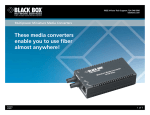
Go the distance with fiber. The converters using multimode fiber support distances of up to 984.2 feet (300 m) or 1.2 miles (2 km)—enough distance for most LAN applications. For more extensive campus applications, choose Single-Mode or Single-Mode, Single-Strand models for long-distance runs of up to 6.2, 12.4, 24.8, or 43.5 miles (10, 20, 40, or 70 km). More power to you. Power Tray (LHC018A-AC-R2) filled with Industiral MultiPower Media Converters. Industrial MultiPower Media Converters can be powered one of four ways: by an external AC power supply included with each unit, by using 5–50-VDC terminal block power, by an optional USB Power Adapter Cable that plugs into a PC’s USB port, or by an optional rackmount PowerTray. Plus, Industrial MultiPower Media Converters are designed for use in harsh industrial environments. The AC power supply is a universal external transformer that requires a nearby AC power outlet. The PowerTray provides power for up to 18 converters in only 1.5U of rack space. Rackmount ears are included. You can even use multiple power options at the same time to provide maximum redundancy and ensure that your mission-critical applications remain up and running. For instance, you can connect a converter to a 5–50-VDC power source while also using AC adapter power and USB bus power. Then, if any one of these power sources fails, the other sources will continue to supply power to the converter seamlessly. The converters come with DIN clips, so you can attach them to a DIN rail. When installing multiple Industrial MultiPower Media Converters on a DIN rail, use one DC input source, then cascade from one DC block to the next until you reach the maximum current available. Technically Speaking 100-Mbps Ethernet. Industiral MultiPower Media Converters. installed on a DIN rail 100BASE-T: an overview. 100BASE-T, also known as Fast Ethernet, is a high-speed version of the 10BASE-T Ethernet standard. 10BASE-T data and 100BASE-T data are essentially the same: The only difference is that to attain higher data throughput, the 100BASE-T standard reduces the latency period between data bits. This increases data throughput from 10 to 100 Mbps. You can build a network that’s entirely Fast Ethernet, you can use it as a VLAN, or you can deploy Fast Ethernet as an “island” within your 10-Mbps Ethernet network. Here are the most common 100BASE-T standards endorsed by the Institute of Electrical and Electronic Engineers (IEEE): 100BASE-TX. 100BASE-TX is the most popular Fast Ethernet standard. 100BASE-TX operates over Category 5 or higher cable and uses two pairs of wires, which enables it to support both half- and fullduplex operation. Because Category 5 or higher cable is used in many existing 10BASE-T networks, 100BASE-TX is also the most convenient way to implement Fast Ethernet into an existing 10-Mbps network. As with 10BASE-T, distances between devices in a 100BASETX network cannot exceed 100 meters (328 ft.), though the use of extenders and line drivers can increase this distance somewhat. This distance limitation applies to both full- and half-duplex operation. 10/2/2012 #27201 724-746-5500 100BASE-FX. 100BASE-FX, the fiber version of Fast Ethernet, supports halfand full-duplex network operation over single-mode or multimode duplex fiber optic cable. Because fiber optic cable has such a high performance capacity, 100BASE-FX is ideally suited for use as a backbone cable or an extra-long Ethernet connection—for example, a building-tobuilding link. Over fiber, the maximum distance for a cable is 412 meters (1351.7 ft.) in half-duplex mode and 2 kilometers (1.2 mi.) in full-duplex mode. 100BASE-T4. This is the least popular of the 100BASE-T standards. 100BASE-T4 uses only three pairs of wires for data transfer and one for collision detection. So, unlike 100BASE-TX and 100BASE-FX, 100BASE-T4 can only support half-duplex network operation. This significantly limits its use because 100-Mbps islands are normally added to networks to support high-bandwidth, full-duplex network applications. According to some sources, less than 1% of 100BASE-T applications use 100BASE-T4 and many manufacturers have completely discontinued 100BASE-T4 product lines. The advantage of 100BASE-T4 is that it operates over Category 3, 4, and 5 cable and functions quite well in noisy environments—giving the standard an element of flexibility in UTP Fast Ethernet applications not shared by 100BASE-TX (continued on page 4) blackbox.com 3 of 7 BLACK BOX ®