1
Chapter 1
AL
Relational Database Fundamentals
In This Chapter
▶ Defining “database” in digital terms
▶ Deciphering DBMS
▶ Comparing database models
MA
▶ Defining “relational database” (can you relate?)
TE
RI
▶ Organizing information
D
▶ Considering the challenges of database design
S
RI
GH
TE
QL (pronounced ess-que-ell, not see’qwl, though database geeks still
argue about that) is a language specifically designed with databases
in mind. SQL enables people to create databases, add new data to them,
maintain the data in them, and retrieve selected parts of the data. Introduced
in 1970, SQL has grown and advanced over the years to become the industry
standard. It is governed by a formal standard maintained by the International
Standards Organization (ISO).
PY
Various kinds of databases exist, each adhering to a different model of how
the data in the database is organized.
CO
SQL was originally developed to operate on data in databases that follow the
relational model. Recently, the international SQL standard has incorporated
part of the object model, resulting in hybrid structures called object-relational
databases. In this chapter, I discuss data storage, devote a section to how the
relational model compares with other major models, and provide a look at
the important features of relational databases.
Before I talk about SQL, however, I want to nail down what I mean by the
term database. Its meaning has changed, just as computers have changed the
way people record and maintain information.
8
Part I: Basic Concepts
Keeping Track of Things
Today people use computers to perform many tasks formerly done with
other tools. Computers have replaced typewriters for creating and modifying
documents. They’ve surpassed electromechanical calculators as the best
way to do math. They’ve also replaced millions of pieces of paper, file folders,
and file cabinets as the principal storage medium for important information.
Compared to those old tools, of course, computers do much more, much
faster — and with greater accuracy. These increased benefits do come at a
cost, however: Computer users no longer have direct physical access to their
data.
When computers occasionally fail, office workers may wonder whether
computerization really improved anything at all. In the old days, a manila file
folder only “crashed” if you dropped it — then you merely knelt down, picked
up the papers, and put them back in the folder. Barring earthquakes or other
major disasters, file cabinets never “went down,” and they never gave you an
error message. A hard-drive crash is another matter entirely: You can’t “pick
up” lost bits and bytes. Mechanical, electrical, and human failures can make
your data go away into the Great Beyond, never to return.
Taking the necessary precautions to protect yourself from accidental data
loss allows you to start cashing in on the greater speed and accuracy that
computers provide.
If you’re storing important data, you have four main concerns:
✓ Storing data has to be quick and easy, because you’re likely to do it
often.
✓ The storage medium must be reliable. You don’t want to come back later
and find some (or all) of your data missing.
✓ Data retrieval has to be quick and easy, regardless of how many items
you store.
✓ You need an easy way to separate the exact information you want now
from the tons of data that you don’t want right now.
State-of-the-art computer databases satisfy these four criteria. If you store
more than a dozen or so data items, you probably want to store those items
in a database.
Chapter 1: Relational Database Fundamentals
What Is a Database?
The term database has fallen into loose use lately, losing much of its original
meaning. To some people, a database is any collection of data items (phone
books, laundry lists, parchment scrolls . . . whatever). Other people define
the term more strictly.
In this book, I define a database as a self-describing collection of integrated
records. And yes, that does imply computer technology, complete with
programming languages such as SQL.
A record is a representation of some physical or conceptual object. Say, for
example, that you want to keep track of a business’s customers. You assign a
record for each customer. Each record has multiple attributes, such as name,
address, and telephone number. Individual names, addresses, and so on are
the data.
A database consists of both data and metadata. Metadata is the data that
describes the data’s structure within a database. If you know how your
data is arranged, then you can retrieve it. Because the database contains a
description of its own structure, it’s self-describing. The database is integrated
because it includes not only data items but also the relationships among data
items.
The database stores metadata in an area called the data dictionary, which
describes the tables, columns, indexes, constraints, and other items that
make up the database.
Because a flat file system (described later in this chapter) has no metadata,
applications written to work with flat files must contain the equivalent of the
metadata as part of the application program.
Database Size and Complexity
Databases come in all sizes, from simple collections of a few records to
mammoth systems holding millions of records.
A personal database is designed for use by a single person on a single computer.
Such a database usually has a rather simple structure and a relatively small
size. A departmental or workgroup database is used by the members of a single
department or workgroup within an organization. This type of database is
generally larger than a personal database and is necessarily more complex;
such a database must handle multiple users trying to access the same data at
the same time. An enterprise database can be huge. Enterprise databases may
model the critical information flow of entire large organizations.
9
10
Part I: Basic Concepts
What Is a Database
Management System?
Glad you asked. A database management system (DBMS) is a set of programs
used to define, administer, and process databases and their associated
applications. The database being managed is, in essence, a structure that you
build to hold valuable data. A DBMS is the tool you use to build that structure
and operate on the data contained within the database.
You can find many DBMS programs on the market today. Some run only on
mainframe computers, some only on minicomputers, and some only on
personal computers. A strong trend, however, is for such products to
work on multiple platforms or on networks that contain all three classes of
machines. An even newer trend is to distribute data over a storage area
network (SAN) or even to store it out on the Internet.
A DBMS that runs on platforms of multiple classes, large and small, is called
scalable.
Whatever the size of the computer that hosts the database — and regardless
of whether the machine is connected to a network — the flow of information
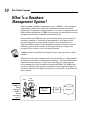
between database and user is always the same. Figure 1-1 shows that the
user communicates with the database through the DBMS. The DBMS masks
the physical details of the database storage so that the application only has
to concern itself with the logical characteristics of the data, not with how the
data is stored.
User
Figure 1-1:
Block
diagram of
a DBMSbased
information
system.
User
Interface
Application
Program
DBMS
Database
Chapter 1: Relational Database Fundamentals
The value is not in the data, but in the structure
Years ago, some clever person calculated that
if you reduce human beings to their components of carbon, hydrogen, oxygen, and nitrogen atoms (plus traces of others), they would be
worth only 97 cents. However droll this assessment, it’s misleading. People aren’t composed
of mere isolated collections of atoms. Our
atoms combine into enzymes, proteins, hormones, and many other substances that would
cost millions of dollars per ounce on the pharmaceutical market. The precise structure of
these combinations of atoms is what gives them
greater value. By analogy, database structure
makes possible the interpretation of seemingly
meaningless data. The structure brings to the
surface patterns, trends, and tendencies in the
data. Unstructured data — like uncombined
atoms — has little or no value.
Flat Files
Where structured data is concerned, the flat file is as simple as it gets. No, a
flat file isn’t a folder that’s been squashed under a stack of books. Flat files
are so called because they have minimal structure. If they were buildings,
they’d barely stick up from the ground. A flat file is simply a collection of
data records, one after another, in a specified format — the data, the whole
data, and nothing but the data — in effect, a list. In computer terms, a flat file
is simple. Because the file doesn’t store structural information (metadata),
its overhead (stuff in the file that is not data but takes up storage space) is
minimal.
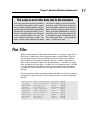
Say that you want to keep track of the names and addresses of your company’s
customers in a flat file system. The system may have a structure something
like this:
Harold Percival
Jerry Appel
Adrian Hansen
John Baker
Michael Pens
Bob Michimoto
Linda Smith
Robert Funnell
Bill Checkal
Jed Style
26262 S. Howards Mill Rd
32323 S. River Lane Rd
232 Glenwood Court
2222 Lafayette St
77730 S. New Era Rd
25252 S. Kelmsley Dr
444 S.E. Seventh St
2424 Sheri Court
9595 Curry Dr
3535 Randall St
Westminster
Santa Ana
Anaheim
Garden Grove
Irvine
Stanton
Costa Mesa
Anaheim
Stanton
Santa Ana
CA92683
CA92705
CA92640
CA92643
CA92715
CA92610
CA92635
CA92640
CA92610
CA92705
11
12
Part I: Basic Concepts
As you can see, the file contains nothing but data. Each field has a fixed
length (the Name field, for example, is always exactly 15 characters long), and
no structure separates one field from another. The person who created the
database assigned field positions and lengths. Any program using this file
must “know” how each field was assigned, because that information is not
contained in the database itself.
Such low overhead means that operating on flat files can be very fast. On
the minus side, however, application programs must include logic that
manipulates the file’s data at a very detailed level. The application must
know exactly where and how the file stores its data. Thus, for small systems,
flat files work fine. The larger a system is, however, the more cumbersome a
flat-file system becomes.
Using a database instead of a flat-file system eliminates duplication of effort.
Although database files themselves may have more overhead, the applications
can be more portable across various hardware platforms and operating
systems. A database also makes writing application programs easier because
the programmer doesn’t need to know the physical details of where and how
the data is stored.
Databases eliminate duplication of effort, because the DBMS handles the
data-manipulation details. Applications written to operate on flat files must
include those details in the application code. If multiple applications all
access the same flat-file data, these applications must all (redundantly)
include that data-manipulation code. If you’re using a DBMS, however, you
don’t need to include such code in the applications at all.
Clearly, if a flat-file-based application includes data-manipulation code that
only runs on a particular hardware platform, migrating the application to a
new platform is a headache waiting to happen. You have to change all the
hardware-specific code — and that’s just for openers. Migrating a similar
DBMS-based application to another platform is much simpler — fewer
complicated steps, fewer aspirin consumed.
Database Models
Different as databases may be in size, they are generally always structured
according to one of three database models:
✓ Hierarchical: These databases arrange their data in a simple hierarchical
structure that allows fast access. They suffer from redundancy problems
and their structural inflexibility makes database modification difficult.
✓ Network: Network databases have minimal redundancy but pay for that
advantage with structural complexity.
Chapter 1: Relational Database Fundamentals
✓ Relational: These databases store their data in tables that are related
to each other. Nowadays, new installations of database management
systems are almost exclusively of the relational type. Organizations that
already have a major investment in hierarchical or network technology
may add to the existing model, but groups that have no need to maintain
compatibility with such so-called legacy systems nearly always choose
the relational model for their databases.
The first databases to see wide use were large organizational databases that
today would be called enterprise databases, built according to either the
hierarchical model or the network model. Systems built according to the
relational model followed several years later. SQL is a strictly modern
language; it applies only to the relational model and its descendant, the
object-relational model. So here’s where this book says, “So long, it’s been
good to know ya,” to the hierarchical and network models.
New database management systems that aren’t based on the relational model
probably conform to the (newer) object model or the (hybrid) object-relational
model.
Relational model
Dr. E. F. Codd of IBM first formulated the relational database model in 1970,
and this model started appearing in products about a decade later. Ironically,
IBM did not deliver the first relational DBMS. That distinction went to a small
start-up company, which named its product Oracle.
Relational databases have almost completely replaced earlier database types.
That’s largely because you can change the structure of a relational database
without having to change or modify applications that were based on the old
structures. Suppose, for example, that you add one or more new columns to
a database table. You don’t need to change any previously written applications
that process that table — unless, of course, you alter one or more of the
columns that those applications have to use.
Of course, if you remove a column that an existing application has to use, you
experience problems no matter what database model you follow. One of the
quickest ways to make a database application crash is to ask it to retrieve a
kind of data that your database doesn’t contain.
Why relational is better
In applications written with DBMSs that follow the hierarchical or network
model, database structure is hard-coded into the application. That is, the
13
14
Part I: Basic Concepts
application is dependent on the specific physical implementation of the
database. If you add a new attribute to the database, you must change your
application to accommodate the change, whether or not the application
uses the new attribute. An unmodified application will expect the data to
be arranged according to the old layout, so it will produce garbage when it
writes data into the file that now contains the new attribute.
Relational databases offer structural flexibility; applications written for
those databases are easier to maintain than similar applications written for
hierarchical or network databases. That same structural flexibility enables
you to retrieve combinations of data that you may not have anticipated
needing at the time of the database’s design.
Components of a relational database
Relational databases gain their flexibility because their data resides in tables
that are largely independent of each other. You can add, delete, or change
data in a table without affecting the data in the other tables, provided that
the affected table is not a parent of any of the other tables. (Parent-child
table relationships are explained in Chapter 5, and no, they don’t involve
discussing allowances over dinner.) In this section, I show what these tables
consist of and how they relate to the other parts of a relational database.
Dealing with your relations
At holiday time, many of my relatives come to my house and sit down at my
table. Databases have relations, too, but each of their relations has its own
table. A relational database is made up of one or more relations.
A relation is a two-dimensional array of rows and columns, containing singlevalued entries and no duplicate rows. Each cell in the array can have only one
value, and no two rows may be identical. If that’s a little hard to picture, here’s
an example that will put you in the right ballpark. . . .
Most people are familiar with two-dimensional arrays of rows and columns,
in the form of electronic spreadsheets such as Microsoft Excel. A majorleague baseball player’s offensive statistics, as listed on the back of baseball
card, are an example of such an array. On the baseball card are columns for
Chapter 1: Relational Database Fundamentals
year, team, games played, at-bats, hits, runs scored, runs batted in, doubles,
triples, home runs, bases on balls, steals, and batting average. A row covers
each year that the player has played in the Major Leagues. You can also store
this data in a relation (a table), which has the same basic structure. Figure
1-2 shows a relational database table holding the offensive statistics for a
single major-league player. In practice, such a table would hold the statistics
for an entire team — or perhaps the whole league.
Figure 1-2:
A table
showing
a baseball
player’s
offensive
statistics.
Player
Roberts
Roberts
Roberts
Year
Team
1988 Padres
1989 Padres
1990 Padres
At
Game Bat Hits Runs
RBI
2B
3B
HR
Walk
Steals
Bat.
Avg.
3
9
329 99
556 172
0
25
44
0
15
36
0
8
3
0
3
9
1
49
55
0
21
46
.333
.301
.309
5
117
149
1
81
104
Columns in the array are self-consistent: A column has the same meaning in
every row. If a column contains a player’s last name in one row, the column
must contain a player’s last name in all rows. The order in which the rows
and columns appear in the array has no significance. As far as the DBMS is
concerned, it doesn’t matter which column is first, which is next, and which
is last. The same is true of rows. The DBMS processes the table the same way
regardless of the organization.
Every column in a database table embodies a single attribute of the table,
just like that baseball card. The column’s meaning is the same for every row
of the table. A table may, for example, contain the names, addresses, and
telephone numbers of all an organization’s customers. Each row in the table
(also called a record, or a tuple) holds the data for a single customer. Each
column holds a single attribute — such as customer number, customer name,
customer street, customer city, customer state, customer postal code, or
customer telephone number. Figure 1-3 shows some of the rows and columns
of such a table.
The relations in this database model correspond to tables in any database
based on the model. Try to say that ten times fast.
15
16
Part I: Basic Concepts
Row
Columns
Figure 1-3:
Each database row
contains
a record;
each
database
column
holds a
single
attribute.
Enjoy the view
One of my favorite views is of the Yosemite Valley from the mouth of the
Wawona Tunnel, late on a spring afternoon. Golden light bathes the sheer
face of El Capitan, Half Dome glistens in the distance, and Bridal Veil Falls
forms a silver cascade of sparkling water, while a trace of wispy clouds
weaves a tapestry across the sky. Databases have views as well — even if
they’re not quite that picturesque. The beauty of database views is their
sheer usefulness when you’re working with your data.
Tables can contain many columns and rows. Sometimes all that data
interests you, and sometimes it doesn’t. Only some columns of a table may
interest you, or perhaps you want to see only rows that satisfy a certain
condition. Some columns of one table and some other columns of a related
table may interest you. To eliminate data that isn’t relevant to your current
needs, you can create a view — a subset of a database that an application can
process. It may contain parts of one or more tables.
Views are sometimes called virtual tables. To the application or the user, views
behave the same as tables. Views, however, have no independent existence.
Views allow you to look at data, but views are not part of the data.
Chapter 1: Relational Database Fundamentals
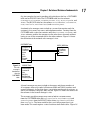
Say, for example, that you’re working with a database that has a CUSTOMER
table and an INVOICE table. The CUSTOMER table has the columns
CustomerID, FirstName, LastName, Street, City, State, Zipcode, and
Phone. The INVOICE table has the columns InvoiceNumber, CustomerID,
Date, TotalSale, TotalRemitted, and FormOfPayment.
A national sales manager wants to look at a screen that contains only the
customer’s first name, last name, and telephone number. Creating from the
CUSTOMER table a view that contains only the FirstName, LastName, and
Phone columns enables the manager to view what he or she needs without
having to see all the unwanted data in the other columns. Figure 1-4 shows
the derivation of the national sales manager’s view.
CUSTOMER Table
Customer ID
FirstName
LastName
Street
City
State
Zipcode
Phone
Figure 1-4:
The sales
manager’s
view derives
from the
CUSTOMER
table.
SALES_MGR View
FirstName
LastName
Phone
INVOICE Table
InvoiceNumber
CustomerID
Date
TotalSale
TotalRemitted
FormOfPayment
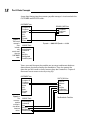
A branch manager may want to look at the names and phone numbers of
all customers whose zip codes fall between 90000 and 93999 (southern and
central California). A view that places a restriction on the rows it retrieves, as
well as the columns it displays, does the job. Figure 1-5 shows the sources for
the columns in the branch manager’s view.
The accounts-payable manager may want to look at customer names
from the CUSTOMER table and Date, TotalSale, TotalRemitted, and
FormOfPayment from the INVOICE table, where TotalRemitted is less
than TotalSale. The latter would be the case if full payment hasn’t yet
been made. This need requires a view that draws from both tables. Figure 1-6
17
18
Part I: Basic Concepts
shows data flowing into the accounts-payable manager’s view from both the
CUSTOMER and INVOICE tables.
CUSTOMER Table
Figure 1-5:
The branch
manager’s
view
includes
only
certain rows
from the
CUSTOMER
table.
Customer ID
FirstName
LastName
Street
City
State
Zipcode
Phone
BRANCH_MGR View
FirstName
LastName
Phone
Zipcode > = 90000 AND Zipcode < = 93999
INVOICE Table
InvoiceNumber
CustomerID
Date
TotalSale
TotalRemitted
FormOfPayment
Views are useful because they enable you to extract and format database
data without physically altering the stored data. They also protect the
data that you don’t want to show, because they don’t contain it. Chapter 6
illustrates how to create a view by using SQL.
CUSTOMER Table
Customer ID
FirstName
LastName
Street
City
State
Zipcode
Phone
Figure 1-6:
The
accountspayable
manager’s
view draws
from two
tables.
INVOICE Table
InvoiceNumber
CustomerID
Date
TotalSale
TotalRemitted
FormOfPayment
ACCTS_PAY View
FirstName
LastName
Date
Total Sale
TotalRemitted
FormOfPayment
TotalRemitted < TotalSale
Chapter 1: Relational Database Fundamentals
Schemas, domains, and constraints
A database is more than a collection of tables. Additional structures, on
several levels, help to maintain the data’s integrity. A database’s schema
provides an overall organization to the tables. The domain of a table column
tells you what values you may store in the column. You can apply constraints
to a database table to prevent anyone (including yourself) from storing invalid
data in the table.
Schemas
The structure of an entire database is its schema, or conceptual view. This
structure is sometimes also called the complete logical view of the database.
The schema is metadata — as such, it’s part of the database. The metadata
itself, which describes the database’s structure, is stored in tables that are
just like the tables that store the regular data. Even metadata is data; that’s
the beauty of it.
Domains
An attribute of a relation (that is, a column of a table) can assume some finite
number of values. The set of all such values is the domain of the attribute.
Say, for example, that you’re an automobile dealer who handles the newly
introduced Curarri GT 4000 sports coupe. You keep track of the cars you
have in stock in a database table that you name INVENTORY. You name one
of the table columns Color, which holds the exterior color of each car. The
GT 4000 comes in only four colors: blazing crimson, midnight black, snowflake
white, and metallic gray. Those four colors are the domain of the Color
attribute.
Constraints
Constraints are an important, although often overlooked, component of a
database. Constraints are rules that determine what values the table attributes
can assume.
By applying tight constraints to a column, you can prevent people from
entering invalid data into that column. Of course, every value that is legitimately
in the domain of the column must satisfy all the column’s constraints. As I
mention in the preceding section, a column’s domain is the set of all values
that the column can contain. A constraint is a restriction on what a column
may contain. The characteristics of a table column, plus the constraints
that apply to that column, determine the column’s domain. By applying
constraints, you can prevent users from entering data into a column that falls
outside the column’s domain.
19
20
Part I: Basic Concepts
In the auto dealership example, you can constrain the database to accept
only those four values in the Color column. If a data entry operator then
tries to enter in the Color column a value of, for example, forest green,
the system refuses to accept the entry. Data entry can’t proceed until the
operator enters a valid value into the Color field.
You may wonder what happens when the Curarri AutoWerks decides to
offer a forest-green version of the GT 4000 as a mid-year option. The answer
is (drum roll, please) job security for database-maintenance programmers.
This kind of thing happens all the time and requires updates to the database
structure. Only people who know how to modify the database structure
(such as you) will be able to prevent a major snafu.
The object model challenges
the relational model
The relational model has been fantastically successful in a wide variety of
application areas. However, it does not do everything that anyone would ever
want. The limitations have been made more visible by the rise in popularity
of object-oriented programming languages such as C++, Java, and C#. Such
languages are capable of handling more complex problems than traditional
languages due to their advanced features, such as user-extensible type
systems, encapsulation, inheritance, dynamic binding of methods, complex
and composite objects, and object identity.
I am not going to explain all that jargon in this book (although I do touch on
some of these terms later). Suffice it to say that the classic relational model
doesn’t mesh well with many of these features. As a result, database
management systems based on the object model have been developed and
are available on the market. As yet, their market share is relatively small.
The object-relational model
Database designers, like everyone else, are constantly searching for the
best of all possible worlds. They mused, “Wouldn’t it be great if we could
have the advantages of an object-oriented database system, and still retain
compatibility with the relational system that we have come to know and
love?” This kind of thinking led to the hybrid object-relational model.
Object-relational DBMSs extend the relational model to include support for
object-oriented data modeling. Object-oriented features have been added
to the international SQL standard, allowing relational DBMS vendors to
transform their products into object-relational DBMSs, while retaining
Chapter 1: Relational Database Fundamentals
compatibility with the standard. Thus, whereas the SQL-92 standard
describes a purely relational database model, SQL:1999 describes an objectrelational database model. SQL:2003 has more object-oriented features, and
SQL:2008 goes even further in that direction.
In this book, I describe ISO/IEC international standard SQL. This is primarily
a relational database model. I also include the object-oriented extensions to
the standard that were introduced in SQL:1999, and the additional extensions
included in SQL:2003 and SQL:2008. The object-oriented features of the new
standard allow developers to apply SQL databases to problems that are too
complex to address with the older, purely relational, paradigm. Vendors of
DBMS systems are incorporating the object-oriented features in the ISO
standard into their products. Some of these features have been present for
years, while others are yet to be included.
Database Design Considerations
A database is a representation of a physical or conceptual structure, such as
an organization, an automobile assembly, or the performance statistics of all
the major-league baseball clubs. The accuracy of the representation depends
on the level of detail of the database design. The amount of effort that you
put into database design should depend on the type of information you want
to get out of the database. Too much detail is a waste of effort, time, and hard
drive space. Too little detail may render the database worthless.
Decide how much detail you need now and how much you may need in the
future — and then provide exactly that level of detail in your design (no more
and no less). But don’t be surprised if you have to adjust the design eventually
to meet changing real-world needs.
Today’s database management systems, complete with attractive graphical
user interfaces and intuitive design tools, can give the would-be database
designer a false sense of security. These systems make designing a database
seem comparable to building a spreadsheet or engaging in some other relatively
straightforward task. No such luck. Database design is difficult. If you do it
incorrectly, not only is your database likely to suffer from poor performance,
but it also may well become gradually more corrupt as time goes on. Often the
problem doesn’t turn up until after you devote a great deal of effort to data
entry. By the time you know that you have a problem, it’s already serious.
In many cases, the only solution is to completely redesign the database and
reenter all the data. The up side is that by the time you finish your second
version of the same database, you realize how much better you understand
database design.
21
22
Part I: Basic Concepts