1
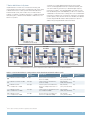
3. Swap the face panel
2. Swap switch interface
boards
Four easy steps to perform
a service hardware upgrade:
1. Upgrade Power Entry
Modules (PEMs)
2. Upgrade Switch Interface
Boards (SIBs)
3. Fix new face panel
4. Upgrade fan
• 5 SIBs per chassis, can run on 4
• Disable a SIB, swap it, re-enable
• Repeat 4 times
1. Swap power entry modules
• 2 PEM per chassis, system can run
on one
• Disable, power off the first PEM
on one
T640 or T1600
Figure 3: The in-service hardware upgrade of T640 to T1600
T4000
Figure 4: The in-service hardware upgrade of T640/T1600
to a T4000 system.
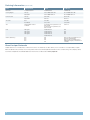
Table 4: T Series Features and Benefits
Feature
Description
Benefit
Multi-terabit capacity and
multichassis scalability
T4000 scales to 4 Tbps and T1600 scales to 1.6
Tbps in a single chassis. The TX Matrix Plus allows
incremental expansion up to a 16 Tbps system with 4
T4000s in one system. The future-proof architecture
scales comfortably to well beyond this capacity as
provider needs grow.
T Series scale and density features allow service
providers to increase capacity without adding
additional systems to the network. Multichassis
architecture offers a single network element for ease
of manageability.
High availability hardware
There is no single point of failure in T Series routers.
Component-level redundancy is available for Routing
Engines, Control Boards, and SIBs, as well as PEMs
and the internal control plane.
High availability (HA) and continuous operation is
critical in core routing, where loss of a single routing
node can remove service for a wide geographical area.
High availability software
Nonstop active routing (the foundation for unified
ISSU), as well as Junoscript commit script capabilities,
mean continuous operation under maintenance
conditions, and topological changes.
HA requirements in core networks include the
elimination of planned downtime. Key benefits include
higher operational network availability, better network
stability, easier operations, and less operational risk.
Superior packet processing via
programmable ASIC-based Packet
Forwarding Engine (PFE)
Juniper’s programmable ASICs deliver a
comprehensive, hardware-based system for packet
processing. To ensure a non-blocking forwarding
path, all channels between the ASICs are oversized
dedicated paths. Firewall filter capabilities are scalable
to hundreds of thousands of entries, and include
multiple matches and conditions.
Highly granular QoS, advanced filter-based forwarding,
flow-based monitoring, and distributed denial of
service (DDoS) prevention. All competing core routing
implementations allow for a mere fraction of the
total firewall filter terms supported on Juniper routers
without performance degradation.
Wide range of interfaces
Interfaces on the T Series range from DS3 to OC-768 for
SONET/SDH and 1GbE to 100GbE for Ethernet. Juniper
provides the largest variety of interfaces among core
routing platforms. This interface variety (both optical
and copper) is unique in the market.
Combining the functions of previously disparate
network elements offers greater network simplicity,
and retains the service building advantages of overlay
networks being replaced by the converged network.
Virtualization at scale
Virtualization capabilities include hardware logical
routing with the JCS1200, taking control plane
scalability to a new level by decoupling the control
and forwarding planes and hosting them on separate
platforms. Using logical routers, the applications,
configurations, protocols, and routing tables assigned
to a logical router belong to that one logical router.
Juniper’s state-of-the-art logical routing is the only
implementation with shared uplink support.
With these capabilities, providers can manage their
CapEx by consolidating the network hierarchy onto
a single highly available router, or by scaling service
offerings in midsize to large POPs with multichassis
routers.
Solid, modular, feature-rich
software
Each release of Junos OS runs consistently across
all Juniper Networks routing platforms and feature
sets. Junos OS was conceived and implemented as
a modular design. Advanced features include P2MP
MPLS, MPLS VPN, IPv6 provider edge, and many more
unique features in core routers.
Each Junos OS process runs in protected memory
to guard against system crashes and to ensure that
applications do not interfere with each other. Junos
OS provides the greatest breadth of features and most
stable network operating system in the industry.
Optical transport integration
PIC support includes OTN G.709 at 10 Gbps, 10GbE
tunable DWDM, OC768, 4-port OC192, 40GbE
and 100GbE. Generalized MPLS (GMPLS) is
continually enhanced along with Ethernet Operation,
Administration, and Maintenance (OAM) functionality.
Integrating optical transport technology into routers
provides flexibility in provisioning that leads to the
rapid rollout of new services, while retaining Layer 3
intelligence to ensure prompt responses to topology
changes.
5