1
Assembling Your Telescope
The Mount & Telescope Tube
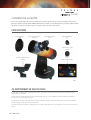
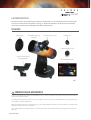
Your FirstScope’s mount and telescope tube are fully assembled. Simply remove the telescope and mount from the box
and set it on a stable surface, such as a table or picnic bench. Be sure to use a support that allows you easy access to
the eyepiece as you move the telescope around the sky.
Your FirstScope’s altazimuth mount was designed to rotate smoothly up, down, left or right with just a gentle push from
your fingers, making it easy to track celestial objects as they appear to drift across the night sky.
The tension in the up and down direction is adjustable to accommodate different weights of eyepieces. Turning the knob
counter-clockwise decreases the tension making it easier to move, while turning the knob clockwise increases tension.
Set the tension at a comfortable level so the telescope will not move downward in response to gravity.
Unlike fixed targets on the ground, astronomical targets move across the sky. This is caused by Earth’s rotation. When
you look at a celestial target in your telescope, such as the Moon or a planet, it will appear to slowly drift across the field
of view of your eyepiece. In order to keep the object centered in the field of view, you will have to nudge the mount in
altitude and azimuth.
The Eyepieces
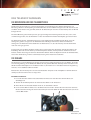
The FirstScope comes with two eyepieces, one low power (20 mm eyepiece) and one higher power (10 mm eyepiece).
Whenever you set up your telescope, always start with the 20 mm eyepiece. Once you have your target centered in the
20 mm eyepiece, you can switch to your higher power 10 mm eyepiece to get a more detailed view.
Note that because your telescope is designed for astronomical use, images of terrestrial objects will appear
upside-down. This is perfectly normal.
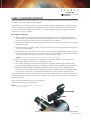
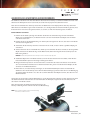
To install an eyepiece:
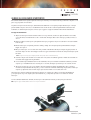
1. Loosen the two silver setscrews on the focuser and pull out the small plastic dust cap.
2. Insert the silver barrel on the bottom of the eyepiece into the focuser.
3. Tighten the two setscrews to secure the eyepiece.
4. To see the sharpest image possible, you need to focus the eyepiece. To focus, look through the eyepiece and
slowly turn the focusing
Fig. 2
English | 3