1
pressed once more to confirm the setting of all digits (the last digit on the left had
side will stop flashing).
5.
Once the Tariff is set, plug the Cost Control into the mains supply and then plug
the electrical appliance into the Cost Control.
Note: The appliance should be operated as normal - for hints on this see the “Extra
Notes” section.
13.0 Using the Cost Control
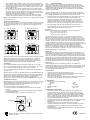
Using the Cost Control is very easy. For example: the cost to operate appliance “X” is
7.00 (DM, £ and etc.) per day and after 20 days of operating the appliance, the
TOTAL COST is 140.00 (DM, £ and etc.), therefore, we can assume the following
readings: a) Cost per day is:
Please participate in the preservation of the environment and return all used
batteries to an authorized depot.
15.0 Extra Notes:
The electrical appliance connected to the Cost Control should always be operated as
normal if forecasting of the cost is required. If an accurate reading per day, month or
year is required then it is highly recommended to keep the appliance plugged into the
Cost Control and to operate it normally for at least a few days. This is so that it can
take an average of the power used and its cost over the time period.
The longer the Total Cost of an appliance is monitored by the Cost Control, the more
accurate any forecast (day, month, year) or Total Cost reading will be. There are a
variety of reasons for this, some of them are:
•
The power supply to the mains from the Electricity Company is never constant
and at some stage will vary slightly. For example, if electricity varies by 1% for
every 1 second of usage and the Cost Control is used for only 5 minutes then the
cost forecast will not be as accurate compared to use for 3 hours with the same
variation of 1% for every 1 second in the power supply.
•
Some electrical appliances use more electricity when first turned on than others
and the amount of electricity it uses will decrease the longer it left operating
(commonly referred to as “Warming up”).
b) Cost per month is:
Example 1:
A lamp is plugged into the Cost Control and operated every evening:
Day 1, from 18.00hrs to 2000hrs
Day 2, from 19.00hrs to 2100hrs
Day 3, from 18.30hrs to 2030hrs
Assume it costs 1.00 (DM, £ and etc.), per hour to run this lamp, the Total Cost at
2000hrs on day 1 would be 2.00(DM, £ and etc.). If Total Cost per day is required
then it will show 24.00 (DM, £ and etc.) - at this point the Cost Control is assuming
the lamp will be left on all day for 24 hours, but this is not the case. At 1859hrs on
day 2, the Cost Control will show the Total Cost as the same at 24.00 (DM, £ and
etc.) but now the cost per day would have dropped to about 2.00 (DM, £ and etc.) as
it has not been used for the last 23 hours. Before the lamp is turned “ON” on day 3,
the Cost Control will have taken the total power consumption and the length of time
that it has been turned off and averaged them out for an accurate cost per day
reading. This should show 2.00 (DM, £ and etc.) and so you know how much, on
average, the lamp is costing to operate everyday.
c) Cost per year is
Example 2:
Some appliances are constantly turned on and off for varying amounts of time, such
as refrigerators (motors), freezers, TV sets and etc. The power used by each of
these electrical appliances varies greatly due to the time the motor is switched on and
off, in such cases, it is recommended to keep the appliance plugged into the Cost
Control for several days before taking the reading. If a reading is taken after the
appliance has turned on and off only once, then this will not be an accurate account
of its cost over time. It will only be an accurate reading of the cost of power that it has
used in total.
d) Total Cost is:
When the monitoring of an electrical appliance is complete; simply turn the appliance
off; remove the Cost Control from the mains and then remove the appliance from the
Cost Control. However, should further monitoring be required, then do not remove
the electrical appliance from the Cost Control and mains supply but simply take the
reading with the electrical appliance still plugged in.
Example 3:
Some appliances are used infrequently, such as power tools, food processors/mixers
and so on. In cases like these, it is not recommended to try to work out the average
cost per day, month or year. It is much easier to simply see make a note on how
much it has cost (Total Cost) each time the appliance has been operated.
Notes:
16.0 Maintenance:
• Check the product for any damages at regular intervals!
• When cleaning the LCD and casing, use a soft damp cloth only. Do not use
solvents or scouring agents.
• Do not submerge this unit into water.
• Any maintenance or repairs must only be performed by authorized service
personnel being familiar with all relevant regulations.
The above illustrations shown assume a daily value of 7.00 (DM, £ and
etc.) and 7 days per week, 30 days a month and 12 months a year (to
alternate between these displays simply press the “COST” key.
“OFL” will be displayed on the LCD should any cost forecasting reading be
over the 6-digit display range.
As the price of a kWh unit does not change (unless by the Electricity
Company), only the Total Cost display (actual electricity used per day,
month and year) requires resetting once the Cost Control has completed a
reading. To reset, press and hold down the “COST” key (for approximately
4 seconds) where all values (with the exception of Tariff - cost per kilowatt
hour) will be reset to zero (as was done in Setting up - step 2, above).
14.0 Replacing batteries
Low power batteries usually reduces the contrast of the LCD. If the LCD becomes
difficult to read then the battery must be replaced immediately. The Cost Control
uses a single LR44 Key Cell Battery, 1.5V which has an estimated average lifetime of
2 years.
To replace the battery, simply follow these steps: 1.
2.
3.
Unscrew the screws on the battery cover and remove (as illustrated below).
Remove old battery and replace with a new one of the same size and voltage
whilst observing correct polarity.
Replace battery cover and secure back into place.
Battery
Compartment
Battery Cover
17.0 Specifications:
• Absolute max. rating (short-time)
- Load
:
- Current
:
• Operating voltage
:
• Operating temperature
:
• Battery
:
3600W
16A
230VAC/50Hz
0°C to +50°C
LR44 1.5V
18.0 Liability Disclaimer:
• The manufacturer and supplier cannot accept any responsibility for any incorrect
readings and any consequences that occur should an inaccurate reading take
place.
• This product is only designed for use only as an indicator for the average cost
and average amount of electricity used for electrical appliances. Despite its
accuracy it is not officially certified and therefore readings cannot be used as
evidence in any dispute between the Electricity Company and the user.
• This product is not to be used for medical purposes or for public information.
• The specifications of this product may change without prior notice.
• This product is not a toy. Keep out of the reach of children
• Damage caused by neglect, misuse or failure to comply with this manual will
invalidate the warranty of this product.
• The manufacturer cannot and will not be held liable for any consequential
damages caused for the above.
• No part of this manual may be reproduced without written authorization of the
manufacturer.