1
DESIGN GUIDE - Data Center LAN Connectivity Design Guide
Server Consolidation
Gartner (2007) asserted that servers are growing at an annual rate of 11 percent and that storage is increasing at
22 percent, both causing tremendous strain on the data center’s power and cooling capacities. A 2007 Forrester
report2 states that 51 percent of all firms consider server centralization a key priority. Gartner also reports that
most enterprise servers operate at 20 percent capacity; new technologies like virtualization are needed to better
utilize these resources. Additionally, backup and security concerns must be addressed, and companies also demand
consolidated, centralized management solutions that help reduce the time and resources devoted to keeping data
centers online and operational.
Virtualization
Virtualization, a technology used to share resources, makes single physical resources appear as many individually
separate resources. Conversely it also makes individually separate physical resources appear as one unified
resource. Virtualization can also include making one physical resource to appear, with somewhat different
characteristics, as one logical resource. The benefits of virtualization are in creating more complex systems
with minimal effort. It takes advantage of commodity hardware to build modular systems that easily scale and
accommodate consolidation, advanced automation, security and ease of management. It is used on four main
resource categories: servers, storage, networks, and end-user desktops.
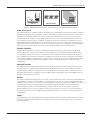
Server virtualization allows a single server using software such as VMware® or Microsoft Virtual Server to appear
as many machines. Ideal for underused application servers such as Web servers, this technology is not as suitable
for processor-intensive applications such as database servers. Server virtualization enables IT to flexibly manage
workload and also provides basic HA and disaster recovery services.
Storage virtualization helps make many storage arrays and pools and systems appear as a single resource, providing
for seamless scaling, easier migration, improved resource utilization and simplified management.
Virtualizing a network is enabled by various technologies that provide data-plane virtualization, control-plane
virtualization and management-plane virtualization. An example of data-plane virtualization is using a using 802.1q
VLAN tagging on single physical network interface to provide security to multiple network segments. Supporting
multiple routing domains and protocol instances on a single router using Virtual Routers and/or VRF are examples of
control-plane virtualization. Support for multiple logical firewall/VPN security systems using Virtual Systems (VSYS)
in a single device is a management-plane virtualization example. Virtualization delivered via MPLS and VPLS also
enable an ultra fast data center backbone network in order to meet the performance demands of the consolidated
LAN architecture. Virtualization can enable multiple switches to act as one, simplifying device configuration and
management while also increasing reliability and reducing potential choke points.
Client virtualization enables IT to provide instant and ubiquitous access to hosted desktops. Ideal for remote users or
non-employees, such hosted corporate machines are fully secure and simple to manage and upgrade.
Storage
As businesses increasingly rely on vast stores of data to make business decisions and meet compliance regulations,
scalable, high-performance storage solutions are becoming a necessity for today’s enterprise. Fibre Channel still
maintains a large portion of the SAN market, but the growing prevalence of gigabit Ethernet (GbE) and the simplicity
of deploying and managing an Ethernet-based Network Attached Storage (NAS) are making iSCSI an attractive, lowcost alternative. Additionally, Ethernet-based NAS solutions more easily take advantage of virtualization to rapidly
scale and provide HA. While 4 or 8 Gbps Fibre Channel offers a speed advantage over GbE, Network Interface Cards
(NICs) offering TCP Offload capabilities greatly enhance iSCSI performance. In addition, the emergence and adoption
of lower-cost 10 GbE allows iSCSI to outperform Fibre Channel and accommodate any high-speed storage needs.
Service Oriented Architecture (SOA)
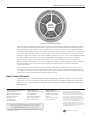
Emerging enterprise applications are increasingly using a Service-Oriented Architecture (SOA) to unify business
processes by structuring large applications as a collection of smaller independent modules called services. In this
manner, IT can leverage key processes or technology assets across applications. In an SOA-based environment,
services exchange messages to interoperate, in some instances generating millions of messages each, which can
impact LAN bandwidth needs. Web services are often used to implement SOA and provide ubiquitous access to the
applications. Web services put extra processing demands on servers while also increasing network bandwidth
Copyright © 2009, Juniper Networks, Inc.
7