1
EXTRONEWS JULY/AUG 1999
Digital Video:
Are You 4:2:2 Compliant?
by Steve Somers, V.P. Engineering
Maintaining the original quality of an
analog event is paramount in the television broadcast industry. This concern
alone drove the development and
adoption of the ubiquitous digital
recording format referred to using
various names: 4:2:2 Component
Digital, CCIR 601, D1, or perhaps SDI
(Serial Digital Interface).
Why is digital “anything” better than its
analog version? The reason digital is
“better” has to do with its ability to
replicate information consistently with
very little or no degradation from timeto-time, or copy-to-copy. This is
because information used to replicate an
analog event is saved as a stream of
numbers representing “samples” of the
analog level over time. In other words,
as the analog event is occurring, our
recording system is precisely measuring
the video level at regularly controlled
time intervals and storing only the value
measured. Capturing data from
something at regular intervals is called
“sampling”. If the recorded samples are
“played back” under the same sampling
time interval with the reverse sampling
process, the original event is restored.
The value here is obvious for the
recording of any analog event. The
decision-making process for the design
of a digital recording system involves
many parameters among which are:
How often to sample? What measurement resolution do I need? Do I have
enough storage space for all these
numbers? Can I transmit the information cost effectively? Can I do it in real
time?
Digitizing video data generates lots of
numbers to store. Receiving the RGB
image from camera sensors would
generate three full bandwidth data
channels requiring considerable storage
and processing speed. But, storing the
component version of the video image
requires less bandwidth… just as it does
in the processing chain which creates
composite NTSC. So, devising a system
that digitizes and stores the analog
component signal makes sense. This is
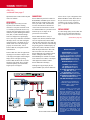
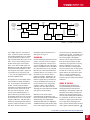
Scan Line
1
264
2
265
3
Y, CR, CB Sample
Y Sample Only
FIGURE 1. 4:2:2 ORTHOGONAL SAMPLING FOR NTSC
STEVE SOMERS
just what the CCIR 601, 4:2:2 digital
component system does. And, it’s not
compressed.
YCRCB…KEY TO DIGITAL DNA
Recall that component video is made up
of the Y channel (higher bandwidth) and
two color components, R-Y and B-Y
(lower bandwidth). Component digital
terminology for these signals is Y, Cr,
Cb. A separate A-to-D (analog to digital)
channel is dedicated to digitizing each of
the components. The sampling rate must
be the highest for the Y channel and can
be lower for the two color difference
channels. According to our father of
sampling theory, Nyquist, a signal must
be sampled at a frequency of at least two
times the highest input frequency. This
ensures that byproducts of the sums and
differences of the sampling process will
not erroneously appear within the
passband of intended signal. When this
problem does occur, we call it aliasing.
Now, although there are a number of
frequencies that satisfy Nyquist and
could be used to digitize quality video,
the exchange of video information
between standards became a great
concern both in the U.S. and Europe.
The 4:2:2 standard uses a 13.5 MHz
sample rate since it satisfies the
(continued on page 16)
5