1
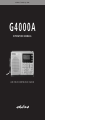
G 4 0 0 0 A O P E R AT I O N M A N UA L
MORE INFORMATION ABOUT SHORTWAVE continued
MORE INFORMATION ABOUT SHORTWAVE continued
For fully comprehensive listings of the broadcast
schedules of all countries, see the broadcast guides
recommended in the section titled SHORTWAVE
GUIDES AND MAGAZINES on page 23.
W H AT E L S E C A N A N D C A N N O T
B E H E A R D O N S H O R T W AV E ?
IS THERE ENGLISH LANGUAGE
PROGRAMMING?
Yes! Many major international broadcasters
incorporate English programming.
ARE THE SIGNALS CLEAR?
Often, but not always. Today’s technology has greatly
minimized the fading, static and interference that are
natural aspects of international broadcast listening.
CAN I HEAR A SPECIFIC
C O U N T RY ?
Yes, if that country is transmitting its signal specifically
for listening in your part of the world. Otherwise,
it may range from good to impossible.
W H AT I S T H E P R O G R A M
CONTENT LIKE?
This can vary considerably from country to country;
however, programming usually consists of world
news, local news from the country of origin, news
commentary, interview programs, culturally oriented
programs, music oriented programs, and even political
propaganda.
20
I F A C O U N T RY I S N O T
TRANSMITTING ITS SIGNAL
S P E C I F I C A L LY F O R R E C E P T I O N
IN NORTH AMERICA, IS THERE
ANY CHANCE OF RECEIVING IT?
You can hear long distance two-way marine, aviation,
and amateur radio (ham). To receive such communications, an advanced shortwave receiver with single
sideband (SSB) capability must be used. The more
advanced Grundig radios can do this. Local VHF/UHF air
traffic, police, fire, ambulance, and weather services
CANNOT be heard. For these, use a VHF/UHF scanner.
C A N D I S TA N T A M / F M B R O A D C A S T S TAT I O N S B E R E C E I V E D ?
FM is strictly for local stations. Daytime AM stations
usually have a maximum distance of 50-100 miles. At
night, AM broadcast signals can sometimes be heard
over much greater distances, hundreds of miles away.
H O W I S I T T H AT B R O A D C A S T S
FROM AROUND THE WORLD
CAN BE HEARD ON A SHORTW AV E R A D I O ?
Shortwave radio can be heard around the world
because of the earth’s ionosphere. Think of the
ionosphere as a cloud-like layer enshrouding the
earth at an altitude of 140-250 kilometers (90-160)
miles). It consists of electrons and ions, the density
of which are governed by the sun and the earth’s
geomagnetic forces. Radio waves virtually bounce
their way around the earth, bouncing off the
ionoshpere, back down to earth, often repeating
this process several times. The low angles at which
this takes place enable the radio waves to travel
great distances with each bounce. This whole
process is called radio wave deflection and ionospheric propagation.
Yes, with detailed research into broadcast time and
frequency and patience, it is possible but never
guaranteed. A professionally engineered outdoor
antenna can make a major difference. Call Grundig
technical support for advice on such antennas.
21