1
actual super elevation that will be applied to the curve. This is often referred to as unbalanced
super elevation or cant deficiency. Tilt trains have been introduced to allow faster train operation
on tracks not originally designed for “high speed” operation, as well as high speed railway
operation. The tilting of the passenger cab allows greater values of unbalanced super elevation to
be used.
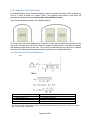
8.10.9 Limitation of Velocity on Curved Track at Zero Cross Level
The concept of maximum comfortable velocity may also be used to determine the maximum
velocity at which rolling stock is permitted to round curved track without super elevation and
maintained at zero cross level. The lead curve of a turnout located between the heel of the switch
and the toe of the frog is an example of curved track that is generally not super elevated. Other
similar locations would include yard tracks and industrial tracks where the increased velocity
capability made possible by super elevation is not required. In such circumstances the maximum
comfortable velocity for a given curve may also be the maximum velocity permitted on tangent
track adjoining the curve.
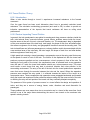
8.10.10 Height of Centre of Gravity
Operation on a curve at equilibrium velocity results in the centre of gravity of the rolling stock
coinciding with a point on a line that is perpendicular to a line across the running rails and the
origin of which is midway between the rails. Under this condition the height of the centre of gravity
is of no consequence as the resulting force Fr coincides with the perpendicular line described
above. When rolling stock stops on a super elevated curve or rounds a curve under any condition
of non-equilibrium the resulting force Fr will not coincide with the perpendicular line previously
described and the height of the centre of gravity then becomes significant in determining the
location of the resulting force Fr relative to the centre line of the track. The elasticity of the
suspension system of rolling stock under conditions of non-equilibrium will introduce a roll element
that affects the horizontal displacement of the centre of gravity and that must also be considered
when determining the location of the resulting force Fr.
8.10.11 Calculation of Curve Velocity
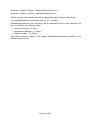
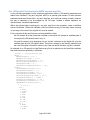
The generic formula for calculating the various curve velocities is as follows:
V=EgrG−−−−√
Where: E = Ea (track super elevation) + Ec (unbalanced super elevation)
g = acceleration due to gravity
r = radius of curve
G = track gauge
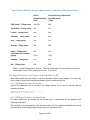
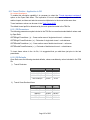
8.10.12 Typical Super Elevation Values & Speed Impact - Mixed Passenger & Freight
Routes
The values quoted below are “typical” but may vary from country to country.
Track super elevation typically will not be more than 6 inches (150mm). Naturally, depending upon
the radius of the curve, speed restrictions may apply.
Normally unbalanced super elevation is typically restricted to 3 inches (75mm), and is usually only
allowed for passenger stock.
Tilt trains may have values of up to 12 inches (305mm).
Page 110 of 206