1
R-21+22FBST ENGLISH
22/07/2003
11:42
Page 19
TIPS AND ADVICE
TIME SETTINGS
LARGE AND SMALL QUANTITIES
In general the thawing, heating and cooking times
are significantly shor ter than when using a
conventional cooker or oven. For this reason you
should adhere to the recommended times given in
this cookery book. It is better to set the times too
short, rather than too long. Test the food after it
has been cooked. It is better to have to cook
something for a little longer than to overcook it.
Microwave times are directly dependent upon the
amount of food which you would like to thaw, heat
or cook. This means that small portions cook more
quickly than larger ones.
As a rule of thumb:
TWICE THE AMOUNT = ALMOST TWICE THE TIME
HALF THE AMOUNT = HALF THE TIME
INITIAL TEMPERATURES
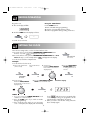
Both containers have the same capacity, but the
cooking time is longer for the deeper one. You
should therefore choose as flat a container as
possible with a large surface area. Only use deep
containers for dishes where there is a danger of
overcooking, e.g. for noodles, rice, milk etc..
DEEP AND SHALLOW CONTAINERS
Thawing, heating and cooking times are
dependent upon the initial temperature of the food.
Deep-frozen food and food stored in a
refrigerator, for example, requires longer than food
which has been stored at room temperature.
For heating and cooking, nor mal storage
temperatures are assumed (refrigerator temperature
approx. 5° C, room temperature approx. 20° C).
For thawing the temperature of the deep freeze is
assumed to be - 18° C.
ROUND AND OVAL CONTAINERS
Food cooks more evenly in round or oval
containers than in containers with corners, since
the microwave energy concentrates in the corners
and the food in these areas could become
overcooked.
COOKING TIMES
All the times given in this cooker y book are
guidelines, which can be varied according to the
initial temperature, weight and condition of the
food (water or fat content etc.).
COVERING
Covering the food retains the moisture within it and
shortens the cooking time. Use a lid, microwave
foil or a cover. Foods which are to be crispy, e.g.
roasts or chickens, should not be covered.
As a general rule, whatever would be covered in a
conventional oven should also be covered in a
microwave oven. Whatever would be uncovered
in an ordinary oven can also be left uncovered in
a microwave oven.
SALT, SPICES AND HERBS
Food cooked in your microwave retains its
individual flavour better than it does when
conventional preparation methods are used. For
this reason you should use salt very sparingly and
normally add it only after cooking. Salt absorbs
liquid and dries out the outer layer of the food.
Herbs and spices can be used as normal.
Vegetables and other foods with a high water
content can be cooked in their own juice or with
the addition of a little water. This ensures that
many vitamins and minerals are preserved.
Medium-sized items, such as hamburgers and
steaks, should be turned over once during cooking,
in order to shorten the cooking process. Large
items, such as roasts and chickens, must be turned,
since the upper side receives more microwave
energy and could dry out if not turned.
FOOD IN SKINS OR SHELLS
STANDING TIME
ADDITION OF WATER
Food such as sausages, chickens, chicken legs,
baked potatoes, tomatoes, apples, egg yolks or
such like should be pricked or pierced with a fork
or small wooden skewer. This will enable the
steam which forms to dissipate without splitting the
skin or shell.
Keeping to the standing time is one of the most
important rules with microwaves. Almost all foods,
which are thawed, heated or cooked in the
microwave, require a certain amount of time to
stand, during which temperature equalisation takes
place and the moisture in the food is evenly
distributed.
19
ENGLISH
TURNING