1
This concludes the installation part of this manual. Stick around if possible for
some explanations about how the ESP-2 does what it does, some of its superior
technical features and other general topics. Regrettably, refreshments will not be
served, even if you DO stick around.
ing power supply like those used in computers and electronic test instrumentation.
This power supply is optically isolated to keep this trash away from your audio
signal. The result is very quiet operation and another car stereo headache gone. If
your system is noisy after the ESP-2 is installed, it was noisy beforehand, too.
GENERAL EXPLANATIONS,
UNSOLICITED ADVICE AND OTHER
TOPICS
GETTING THE MOST FROM THE ESP-2
WHAT HAVE I BOUGHT?
A DISCUSSION OF THE ESP-2’S TECHNOLOGY
Yes, we’re proud of how the ESP-2 can enhance the stereo effect in your car.
Even though “changing” sound is good, making sure that adding extra “boxes” into
your signal chain doesn’t add noise is equally important.
So not only does the ESP-2 contain SPATIAL restoration amplification and
tone shaping, but also a special optically-isolated switching power supply for
superior noise rejection.
What is SPATIAL restoration? Let’s start with the basics. Stereo is composed of left and right channels. Most of the sound in the left and right channels is
the same. This is why you can hit MONO on some cassette/tuners and not hear that
much difference. You’re hearing what is called the LEFT PLUS RIGHT (L+R)
signal.
Obviously there IS a difference between stereo and mono. It’s the difference
between left and right channels. We call that LEFT MINUS RIGHT (L-R).
Sometimes the differences are obvious: If a guitar sound seems to be placed to the
left in the sound field, you can bet there is more guitar in the left channel than the
right. Not all of it but MORE.
However, L-R has another purpose, too. It contains the SPATIAL cues which
have been captured during recording or synthesized at the studio. This includes the
echoes and reverberation which give you a sense of space and position in relation to
the performers. It creates the spaciousness which sets stereo apart from mono.
The ESP-2 in action. The ESP-2 creates a copy of the L-R component of the
input signal, amplifies it, shapes its tonal contours and then injects it back into the
main signal. It’s sort of like adding “seasoning” to the “bland”, normal sound. The
amount of additional L-R signal is controlled by the Remote Restoration knob on
the dashboard. The actual “flavor” of the additional SPATIAL information is
controlled by the three tone control knobs on the top of the ESP-2.
Noise rejection power supply design. From an audio standpoint, car electrical
systems are about as quiet as a rock concert in a motorcycle factory during an
earthquake. Along with alternator whine, ignition “ticking”, turn signal clicks and
dash lamp dimmer buzz, some power amplifiers themselves add noise. (For a thorough
discussion of this, send for our Technical Paper 103).
While the ESP-2 will not contribute to this electronic cacophony, it must be
capable of REJECTING everything thrown at it. It does this with a special switch- page 12 -
As we said in the quick introduction, certain factors effect the performance of
the ESP-2. These include:
• Sufficient power. If a system is bogged down and on the verge of clipping, it
cannot successfully reproduce much L-R, much less an extra healthy dose from the
ESP-2.
• Good treble and midrange transducers. The majority of L-R SPATIAL
information lies from about 500Hz on up. A muffled system with indistinct sound
will get a little better with the ESP-2 cranked up. If your only source of treble is
speakers placed low on the doors or reflecting out of the back deck, the ESP-2 won’t
do its job as dramatically.
• A good STEREO sound source. The old proverb “Garbage in, garbage out”
applies here. Some tapes (due to crummy cassette decks with poor separation) just
don’t have as much L-R information as they should have. Multipath-ridden FM, on
the other hand, has TOO MUCH. The ESP-2 will grab the interference and
REALLY make it sound unpleasant. It will also do weird things to tape hiss. Tape
hiss is composed of random particles of oxide which are mis-oriented. The ESP-2
considers that prime L-R (difference) signal and unfortunately “enhances” it.
FOR INSTALLERS ONLY
Yes, we know that means everyone will immediately read it. But there’s
nothing secret here.
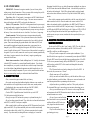
Ground Loops. Ground loops are insidious. They are caused by the non-zero
resistance of the wire used to interconnect the equipment. Typically, ground loops
are created by a piece of equipment having multiple connections into the grounding
system.
The drawing below shows what happens. Generally, the audio wiring has
higher resistance than the power wiring. Since the electrical system of the car uses
the body/frame
structure as it’s
negative return, the
non-zero (yes, it’s
small, but not small
enough!) resistance of
the car body allows
small voltage drops to
be created between
various points in the
car body.
- page 13 -