1
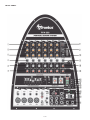
CONTROL FUNCTIONS
1)
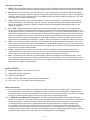
HIGH - Adjusts the relative level of the high frequency content. Rotating the knob counterclockwise decreases
the high or low frequency response. Likewise, rotating the knob clockwise increases the high or low response.
2)
MID -Adjusts the relative level of the mid frequency content. Rotating the knob counterclockwise decreases
the high or mid frequency response. Likewise, rotating the knob clockwise increases the high or mid frequency
response. When the EQ controls are set at their middle position, the channel frequency response is “flat” with
no frequencies increased or decreased.
3)
LOW - Adjusts the relative level of the low frequency content of the channel 1. Rotating the knob clockwise
increases the bass or low frequency response. Likewise, rotating the knob counterclockwise decreases the
bass or low frequency response. Likewise, rotating the knob counterclockwise decreases the bass or low
frequency response.
4)
EFF / AUX - Adjusts the amount of signal sent to the reverb processor, and to the EFF / AUX output jack.
Reverb can be used to enhance the sound quality of any performance where appropriate and desired. In the
full left position there is no level sent to the reverb processor or EFF /AUX jack. Care should be taken to set the
reverb return master control to a middle position or above, before adjusting levels from the individual channel.
When the reverb/auxiliary mix is set, overall levels of reverb can be adjusted at the master control. Reverb or
effects can enhance a musical performance or presentation. However, too much reverb can make the same
performance or presentation unintelligible or “muffled”. Keep your audience in mind when setting reverb levels.
5)
PAN - The Pan control features a notched position indicator and adjusts the perceived “position” of the mono
signal from the input within the stereo field created by the two speaker cabinets. Full left or right rotation of this
control sends the signal to the that channel only, with no signal sent to the other. The center position sends the
same amount of signal to both speakers.
6)
LEVEL - Adjusts the volume level of the individual channel. Rotating the knob clockwise increases the
respective channel’s contribution to the “Main Out” mix, while rotating it counterclockwise decreases the
volume. Adjust this control after the PPA-300’s master output level volume has been set.
7)
BAL - The balance control features a notched position indicator and adjusts the perceived “position” of the
mono signal from the input within the stereo field created by the two speakers. Full left of right rotation of this
control sends the signal to the that channel only, with no signal sent to the other. The center position sends the
same amount of signal to both speakers.
DIGITAL EFFECTS
8)
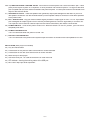
Digital delay display - 00(12ms) to 15(197ms)
9)
Digital delay display adjustment
1O) Digital echo adjustment
11) MIX TO MAIN - Digital delay effects output level adjustment
12) AUX Level - EFF / AUX Return input level adjustment
MASTER CONTROL
14, 15, 31 & 35) These LED’s monitor the output signal levels of both the main or output signals. The red LED is
illuminated when the internal limiter is engaged to prevent the signal from being clipped. (Clipping results in
overdrive distortion and should be avoided.) If the Limiter LED is flashing continuously or remains on constantly
during use, reduce the output signal levels until they flash only on strong signal peaks.
16 & 17) MASTER VOLUME LEVEL CONTROLS - The left and right master volume controls adjust the output
volume of the PPA-300. The master controls feature notched position indicators. For the majority of applications
the PPA-300 system has been balanced to operate with these controls at their notched 12 o’clock positions.
In situations where more volume is required the master controls can provide an additional 6 dB of gain
when turned to the right of the center position. Set the system up in the normal manner and adjust levels
as necessary. Raise the master volume controls beyond their 13 o’clock positions only after increasing the
individual channel level controls. PPA-300’s internal amplifiers have on-board processing designed to optimize
the system’s performance when used with the custom designed PPA-300 speakers.
–4–