1
Adobe Digital Video
CURRICULUM GUIDE
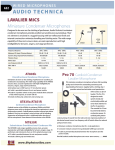
What you need are some external mics. Specialized mics
that serve narrow but useful functions. I've illustrated
them in Figure 13.1. Here are the five basic types:
•
Handheld
•
Shotgun
•
Wireless
•
Surface mount
•
Lavaliere
FIGURE 13.1: Five standard-issue mics: handheld, shotgun,
wireless handheld, boundary, and lavaliere. (Products
provided by Shure, Inc.)
Handheld Mic
If you own only one external mic, make it a handheld. They're the rugged workhorses of the audio industry. Built
with internal shock mounts to reduce handling noise, you'll use these mics for interviews, place them on
podiums to record speeches, and use them to create narrations.
Many handheld mics are omnidirectional, meaning that they pick up sound from all directions. So, they'll pick up
ambient room noise as well as close-up audio. To minimize that unwanted noise, keep the mic as close to your
subject as practical—about a foot from the speaker's mouth works well.
A top-of-the-line, rugged, durable handheld costs from $150 to $250. Shure, Inc. (http://www.shure.com), the
world's leading mic manufacturer, loaned me a handheld—as well as a lavaliere and a shotgun mic—to test
while writing this book. (A senior engineer with Shure provided the expert sidebar later in this module.) The
Shure handheld SM63LB performed flawlessly within a wide frequency range, accurately capturing low and high
voices. It retails for $225.
Most handheld mics use what's called a dynamic transducer. As Figure 13.2 illustrates, the transducer is a thin
diaphragm attached to a tiny coil. As sound waves vibrate the diaphragm, the wire moves over a magnet, which
converts that physical energy into an electrical signal. Dynamic transducer mics do not require any electrical
power to operate.
Shure, Inc. notes that “Dynamic mics are rugged and can handle high sound pressure levels, like those delivered
by kick drums, snare drums, and high volume guitar amps. They're also good for loud, aggressive vocals. Most
people start out recording with dynamic mics because of their lower cost and high durability.”
The other type of mic—the condenser transducer, also shown in Figure 13.2—needs "phantom" power to be
provided by a mixer or batteries. It uses a thin, flat plastic or metal diaphragm layered over another piece of
metal or metal-coated ceramic. This type of mic is typically very small and has an extremely weak signal that
requires preamplification before sending it to your camcorder or a mixer.
Adobe Digital Video Curriculum Guide – Module 13
13-2