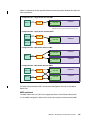
1
Includes IBM Systems Director agent and a number of pre-installed Tivoli agents, such as: – Tivoli Identity Manager (TIM), to allow easy integration into an existing Tivoli Systems Management infrastructure – Tivoli Application Dependency Discovery Manager (ADDM), which creates and automatically maintains application infrastructure maps including dependencies, change-histories, and deep configuration values vSCSI eRAS. Additional CLI statistics in svmon, vmstat, fcstat, and topas. Monitoring solutions to help manage and monitor the Virtual I/O Server and shared resources. New commands and views provide additional metrics for memory, paging, processes, Fibre Channel HBA statistics, and virtualization. For more information about the Virtual I/O Server and its implementation, see IBM PowerVM Virtualization Introduction and Configuration, SG24-7940. 3.4.5 PowerVM Live Partition Mobility PowerVM Live Partition Mobility allows you to move a running logical partition, including its operating system and running applications, from one system to another without any shutdown or without disrupting the operation of that logical partition. Inactive partition mobility allows you to move a powered-off logical partition from one system to another. Partition mobility provides systems management flexibility and improves system availability, as follows: Avoid planned outages for hardware or firmware maintenance by moving logical partitions to another server and then performing the maintenance. Live Partition Mobility can help lead to zero downtime maintenance because you can use it to work around scheduled maintenance activities. Avoid downtime for a server upgrade by moving logical partitions to another server and then performing the upgrade. This approach allows your users to continue their work without disruption. Avoid unplanned downtime. With preventive failure management, if a server indicates a potential failure, you can move its logical partitions to another server before the failure occurs. Partition mobility can help avoid unplanned downtime. Take advantage of server optimization: – Consolidation: You can consolidate workloads running on several small, under-used servers onto a single large server. – Deconsolidation: You can move workloads from server to server to optimize resource use and workload performance within your computing environment. With active partition mobility, you can manage workloads with minimal downtime. Mobile partition’s operating system requirements The operating system running in the mobile partition has to be AIX or Linux. The Virtual I/O Server partition itself cannot be migrated. All versions of AIX and Linux supported on the IBM POWER7 processor-based servers also support partition mobility. Source and destination system requirements The source partition must be one that has only virtual devices. If there are any physical devices in its allocation, they must be removed before the validation or migration is initiated. Chapter 3. Virtualization 141