1
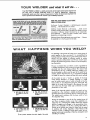
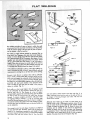
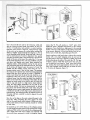
Run the first pass on beveled plates with a 5/32-inch rod
and use as high a current as you can handle to obtain a
small bead on the underside. If this is not done, insufficient
penetration will result, as shown in figure 11. Be sure to
clean each pass before laying on the next. All beads are
laid by moving the rod in a straight line with no weaving
or side-to-side movement. On the last or reinforcing pass,
a weaving motion must be used to obtain a wide weld that
wilt completely cover preceding beads. For the beginner,
the side-to-side movement (with a slight hesitation at each
end) wi!l produce a smooth top without undercut or overlap.
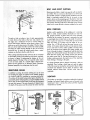
UNDERCUT
GAS
PG_CKET
TRAPPEO
SLAG
PENETRATION
Figure 11
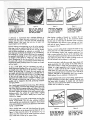
Select several practice welds of different thicknesses and
cut them into 1-1/2-inch strips. Clamp each strip in a vise
and bend it at the weld (fig. 12). If it breaks through the
we_d, study it to find the cause of failure.
figure
13
FILLET
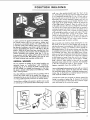
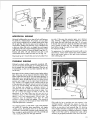
Corner welds are made on light sheet meta] by running
a single bead along the top, after tack-welding at threeinch intervals to prevent warping (fig. 13). If numerous gaps
are present, a back-up strip may be used. On heavier
metal two passes may be necessary and, if the design
permits, a smaller pass can be laid on the underside.
Beveling may be used to advantage on the thicker metals.
WELDS
BREAKING
THEWELD
Figure
4
Figure
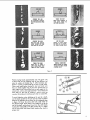
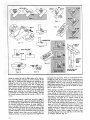
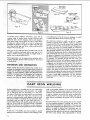
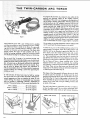
Fillet welds are used to ioin two pieces of metal with sides or
edges at right angles to each other. The size of such a
weld is based on the leg length of the largest isoscelesright
triangle that can be inscribed within the cross sectional
area, as shown by the dotted-line triangle (fig. 1). The
size of a fillet weld may also be measured with a square
and ruler, subtracting 1/32-inch from aH dimensions under
3/16-inch and 1/16-inch from all over t/4_inch (fig. 2).
For example, a 1/4-inch fillet weld should measure 5/16inch. This will offset any inaccuracy due to the slight radius
at the toe of the weld and allow for concavity of the bead.
When a filtet weTd is stressed to its maximum capacity,
faiture will usually occur through the throat section (fig. 3).
Therefore, the strength is determined by the throat dimension multiplied by the length of the we_d. Finished welds of
6
this type should always be at least four times their size in
length; that is, a 1/4-inch fiffet weld shoufd never be less
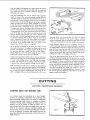
than one inch tong, The direction in which the load is applied
to a weld greatly affects its strength, which can be dearly
demonstrated by breaking the weld (fig. 4). A joint so
loaded should atways be welded on both sides with fillets
equal to the plate thickness (fig. 5). If this cannot be done,
bevel the plate to assure complete penetration and position
the work at a 45_degree angle if possible.
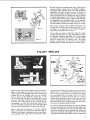
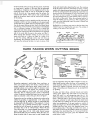
For practice, tack-weld three pieces of scrap iron together
to form a cross (fig. 6). Use a 5/32-inch rod with high current
and hold it as indicated in the front and side views. Move
the rod at a steady even pace along the seam without any
side-to-side movement and deposit one inch of weld for
each inch of rod meffed. The surface contour of a good weld
1-9